Guide · 2026 · Consulting recruiting
Consulting résumé in Harvard format: the 2026 template
If you're applying to McKinsey, BCG, Bain, Deloitte Strategy, Accenture Strategy, OC&C, L.E.K., Roland Berger, Oliver Wyman, or Strategy&, the single-page Harvard-format résumé is the de-facto standard. This guide breaks down what consulting recruiters actually filter for, how MBB differs from Tier 2, and how to write bullets at case-interview grade.
How do I write a consulting resume in the Harvard format?
Write a consulting resume in the Harvard format as a single-page PDF: name and contact on top, education first with GPA and test scores, then 3-5 experience roles with quantified business-outcome bullets, plus leadership and skills. Lead with measurable client impact and tailor bullets per firm for McKinsey, BCG, and Bain.
1. Why consulting firms filter for this format
Consulting recruiting receives 100,000+ applications a year at the top of the funnel. At McKinsey's 2024 cycle, the acceptance rate was approximately 0.8% across all offices. The first filter is structural: recruiters spend 6-8 seconds on a résumé before deciding whether to read it more carefully or move on.
The Harvard format is engineered for that 6-second read. Education at the top, institution-first hierarchy, quantified bullets, no decorative elements. A consultant-trained recruiter extracts school + GPA + brand-name internships in the first read; specific quantified accomplishments in the second; and differentiation signal (international experience, leadership at scale, unusual depth) in the third. All three reads happen inside 30 seconds.
A résumé in a different format isn't automatically rejected — it just makes the recruiter spend their first read decoding your layout instead of reading your content. In a 0.8% admit rate, you can't afford to waste a read.
2. Anatomy of a consulting résumé
The order, top to bottom:
- Header — name centered, 14pt bold. Line below: city, email, phone (with country code), LinkedIn. No photo, no DOB, no marital status. For international applicants: include work-authorization status only if strong (citizenship, permanent residency, no visa sponsorship needed).
- Education — most recent degree first. Each entry: institution + location (bold left, plain right), degree + field + GPA + honors in italics, dates right-aligned. Include test scores in the same line if strong: GMAT 740 (97th percentile), GRE 329. Coursework only if it differentiates (advanced statistics, microeconomics for a non-business undergrad).
- Experience — 3 to 5 roles, reverse- chronological. Each role: organization + location, role + dates, 2-4 bullets following the McKinsey-style structured pattern (see Section 4). For recent grads, internships count as experience and should be 60-70% of this section.
- Leadership & Activities — clubs, consulting case competitions, student government, published research, founded organizations. This is where consulting candidates DIFFERENTIATE — the pre-MBA pool has near-identical experience but radically different leadership signals.
- Skills & Interests — technical skills (SQL, Python, Tableau, financial modeling), languages with fluency level (CEFR-style: C2 native, C1 advanced, B2 working), 2-3 genuine interests. Skip generic skills like “Microsoft Office”.
- Honors & Awards (optional) — Detur, Phi Beta Kappa, Rhodes, Marshall, Fulbright, merit-based scholarships with selectivity stated (e.g., “1 of 12 from 8,000 applicants”).
Deliberately absent: an “Objective” section (Goldman doesn't care that you're “seeking opportunities in management consulting”); a “Summary of Qualifications” paragraph (your bullets ARE your summary); references (“available upon request” is implied); and certifications below the bachelor's level (HubSpot Inbound Marketing isn't a consulting credential).
3. MBB vs Tier 2 — what each emphasises
The format is identical. The signal they screen for within it differs:
MBB (McKinsey · BCG · Bain)
- Tier-1 undergrad + GPA 3.7+
- Brand-name internship (often: McK MBA Fellow, BCG Intern, Goldman, MS)
- Quantitative course depth (econ, stats, CS)
- Leadership at SCALE (officer of major org, founded venture)
- International experience preferred (study abroad, work outside home country)
Tier 2 (Deloitte S · Accenture S · S&·· · OC&C · LEK)
- Strong undergrad + GPA 3.5+ acceptable
- Industry depth often valued over consulting brand name
- Specialized skills weighted (Salesforce, SAP, healthcare for sector practices)
- Leadership stories matter but less brand-sensitive
- Practical client-facing experience (consulting internships, client-side projects)
Implication for your résumé: same format across firms, but reorder bullets within each role to foreground the signal that firm screens for. The editor on this site lets you keep multiple versions under one subscription so you can tailor without cloning files.
4. The McKinsey-style structured bullet
The X-Y-Z formula (“accomplished X, as measured by Y, by doing Z”) is the floor. Consulting recruiters expect more: a bullet structured as business outcome → mechanism → scale.
Worked on a CRM system implementation for a Fortune 500 client
Led the CRM implementation that increased lead-to-close conversion by 41% across the West Coast sales team of 60 reps, by re-architecting the lead-scoring model and training the team on the new workflow
The improved version states the business outcome first (conversion +41%), then the scale (60 reps, West Coast), then the mechanism (re-architecture + training). A recruiter scanning your résumé needs zero seconds to register impact.
Built financial models for venture investments
Built the DCF model that anchored the $14M Series B investment decision in a B2B SaaS portfolio company, projecting 3-year ARR growth across 4 product scenarios reviewed by the partnership
Capital deployed ($14M), specificity of role (anchored the decision), scope (4 scenarios reviewed by partners). Without the dollar amount, this bullet is invisible.
Strong leader and team player passionate about solving complex problems
Co-founded a 230-member undergraduate consulting club; sourced 8 pro-bono engagements with Boston-area nonprofits and grew membership from 15 to 230 in 24 months
Replace ALL 'passionate self-starter' style filler with a single specific story. Members grown (15→230), engagements sourced (8), timeframe (24 months).
The constraint is: every bullet has at least one number. If you can't quantify it, the bullet isn't earning its line. Cut it.
5. Real example (download included)
The sample below is what a strong consulting candidate might submit. Identical to what comes out of the editor on this site after you fill your own data.
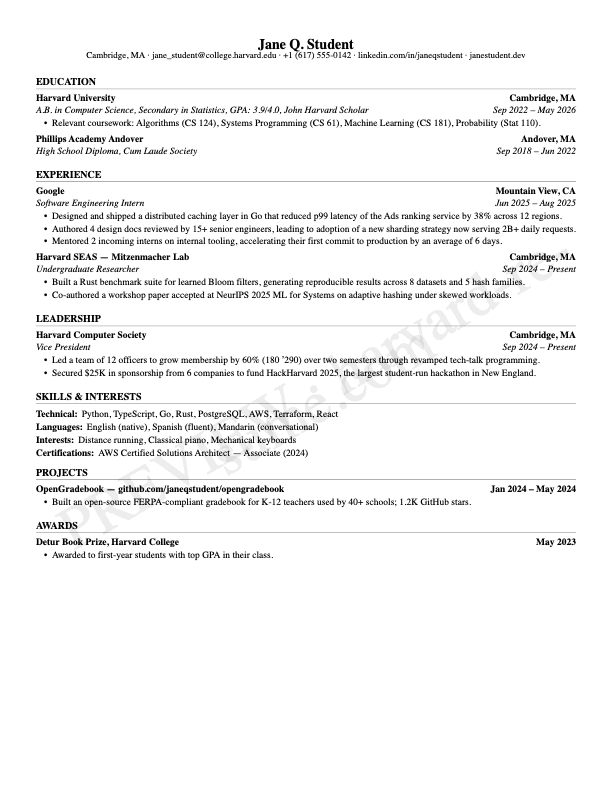
“In the first read, I'm looking for credentials. In the second, for quantified impact. In the third, for what makes you different from the other 11 people whose undergrad GPA and McKinsey internship I just read.”
6. Mistakes that get auto-rejected
- Two pages. Without exception below MBA level. With MBA + 10 years senior experience, maybe 1.5 pages. Otherwise, one.
- No GPA listed. Recruiters assume you're hiding a sub-3.5. If yours is below 3.5, omit GPA and lead with stronger signals (test scores, brand internships, awards).
- Buzzword bullets. “Synergised cross-functional initiatives”, “leveraged stakeholder relationships”, “drove strategic outcomes”. Every consulting reviewer has trained themselves to skip these phrases. Replace with quantified specifics.
- Inflated internship titles. “Summer Strategy Consultant” for a 10-week internship at a mid-size firm reads as desperate. State the actual title (e.g., “Summer Analyst”) and let the bullets demonstrate the work.
- Listing every tool. “Proficient in Excel, Word, PowerPoint, Outlook, Teams” tells the reviewer you don't have real skills to list. Replace with 3-5 specific tools that differentiate (SQL, Python, Tableau, Looker, Hubspot, financial modeling).
- Unstated scope on leadership. “Treasurer of student finance club” means nothing. “Treasurer of 340-member student finance club; managed $52K budget across 18 events including the annual New York banking conference” tells the reviewer you can run things.
- Generic interests. “Reading, traveling, music” signal you didn't put thought into how this résumé would read. Replace with three specific things you actually do (training for a marathon, playing the piano, restoring vintage motorcycles). These seed interview rapport.
7. Cover letter expectations by firm
Most consulting applications require a cover letter; a few don't. Quick reference:
- McKinsey — required. Standard 3-paragraph structure: why consulting, why McKinsey, why you. One page.
- BCG — required. Similar structure; emphasise problem-solving stories more than McKinsey's “why us”.
- Bain — required. Bain explicitly values personality; let the cover letter be a bit more human.
- Deloitte Strategy & Operations — required for most offices.
- Accenture Strategy — optional but recommended for non-Tier-1 undergraduates.
- OC&C, L.E.K., Roland Berger, Oliver Wyman — required for most regions.
- Strategy& — required.
Our editor will ship a matching cover-letter tool in a future release (the monthly and annual plans mention it under “coming soon”). For now, write cover letters in a separate document with the same header style as your résumé to keep visual consistency.
8. OCR vs experienced-hire timeline
On-campus recruiting (OCR)
Aug-Oct (full-time)
Feb-Apr (internship)
- Résumé due 4-6 weeks before deadline
- Career center pre-screens — formatting must be tight
- Coffee chats + alumni networking in parallel
Experienced hire (post-MBA / lateral)
Rolling all year
- No deadline — but Q4-Q1 is highest hiring
- Network in first; cold app converts <1%
- Résumé must show clear “consulting transferable” signal
Start your consulting résumé. Pay later.
Free editor, free watermarked preview. The clean PDF is $3.99 once or $39/year for unlimited downloads across multiple versions (one per firm).
Open the editor9. Frequently asked
- How do I write a consulting resume in the Harvard format?
- Write a consulting resume in the Harvard format as a single-page PDF: name and contact on top, education first with GPA and test scores, then 3-5 experience roles with quantified business-outcome bullets, plus leadership and skills. Lead with measurable client impact and tailor bullets per firm for McKinsey, BCG, and Bain.
- Do MBB firms (McKinsey, BCG, Bain) require a specific résumé format?
- They don't mandate a template, but their career portals all expect a single-page PDF with selectable text and no exotic formatting. The Harvard format is what their own alumni from HBS, Stanford, Wharton, Kellogg, MIT, and INSEAD submit and what reviewers are trained to scan. Submitting in that format means your reader spends zero seconds on layout adjustment.
- What's the difference between an MBA application résumé and a consulting job résumé?
- The format is identical. What changes: MBA résumés lead with academic signal (education + scholarships); consulting résumés lead with quantified work outcomes. For an MBA admission you want to look like a future leader; for a consulting hire you want to look like someone who has already produced measurable client impact.
- Should I include consulting case competitions on my résumé?
- Yes, especially if you won or placed top 3. They go under Leadership & Activities with the competition name, your team's placement, and 1 quantified bullet (e.g., 'led 4-person team to 1st place out of 280 teams at Wharton MBA Case Competition; recommended go-to-market strategy adopted by client'). Don't list every competition you participated in.
- How do I handle a sub-3.5 GPA when applying to MBB?
- Don't list it. Lead with stronger signals: standardized test scores (GMAT 740+ is more compensating than GPA 3.7), brand-name internships, awards, or quantified achievements that demonstrate analytical rigor. If asked in interview, have a 2-sentence honest narrative ready (extracurricular leadership commitment, unusual difficulty, etc.) — never volunteer it.
- Should I name-drop client names on my résumé?
- Only if (a) it's already public (the engagement was announced) or (b) you have explicit permission. Otherwise generalize: 'Fortune 500 industrial manufacturer' or 'top-3 US health insurer'. Naming a client without permission is a confidentiality violation that gets you rejected on its own.
- Will this résumé pass the ATS that consulting firms use?
- Yes. The PDF has selectable text, no embedded images, no multi-column layout, no exotic fonts. Tested against Workday, Greenhouse, Lever, Avature, and iCIMS — the systems used by McKinsey, BCG, Bain, Deloitte, and Accenture for screening.
- Can I use the same résumé for multiple firms in the same recruiting cycle?
- Use the same format. Reorder bullets within each role to foreground the signal each firm screens for: MBB wants leadership-at-scale + brand internships; Tier 2 wants industry depth + quantified impact. Our subscription tier lets you save 10 versions and download all of them clean — useful when applying to 6-12 firms in parallel.
Related guides
- Applying to MBA programs? — per-school anatomy (HBS, Stanford GSB, Wharton, INSEAD, Kellogg).
- ¿Aplicas desde Chile? — guía específica al mercado consultor chileno (en español).
- Pricing — $3.99 one-time, $9.99/month, $39/year.
- Harvard OCS Resumes & Cover Letters Guide (PDF) ↗ — public source.