Accounting · 2026
Harvard Resume for Accountants
From staff accountant to controller — how public-accounting and corporate-finance recruiters read a close-cycle résumé in 8 seconds.
How do I write a Accountants resume in the Harvard format?
Accounting hiring is credential- and rigor-driven. Recruiters at the Big 4 (Deloitte, PwC, EY, KPMG), mid-tier firms (BDO, Grant Thornton), and corporate finance teams scan three things first: your CPA status (or candidacy), your degree and 150-credit eligibility, and the dollar scale of what you've reconciled, closed, or audited. The Harvard one-page format puts your credential and quantified ledger impact in the top third — exactly where a hiring manager looks before deciding to read on.
What recruiters look for
- CPA status spelled out: licensed, candidate, or eligible (150 credits) — and the state
- ERP / accounting systems named: NetSuite, SAP, Oracle, QuickBooks, Workday, Sage Intacct
- Quantified scale: $ in revenue/assets reconciled, # of entities consolidated, close-time reduced (days)
- Technical depth: GAAP, IFRS, ASC 606/842, SOX controls, multi-entity consolidation
- Specialty signaled: audit, tax (1120/1065/1040), FP&A, AP/AR, or technical accounting
- Excel/data fluency beyond basics: pivot tables, VLOOKUP/XLOOKUP, Power Query, Alteryx, or SQL
Required sections, in this order
Education & credential header
- Lead Education with degree, school, GPA (if 3.5+), and 150-credit-hour status if CPA-eligible
- Put CPA status on the contact line OR top of Skills — never buried: 'CPA (TX, licensed 2024)' or 'CPA candidate — 3/4 sections passed'
- List the specific exam progress for candidates (FAR, AUD, REG passed) — it signals momentum
- No photo, no DOB, no marital status — these flag a non-US-standard résumé to recruiters
Experience bullets — lead with the ledger
- Open each bullet with the accounting function and its dollar/entity scale, not 'responsible for'
- Name the cycle: month-end / quarter-end / year-end close, and the days you cut it to
- Quantify reconciliations by account count and dollar value (e.g., '$40M in intercompany balances')
- Cite the framework or control you applied: ASC 606, SOX key control, audit sample, tax form filed
Skills & certifications section
- Group: Systems (NetSuite, SAP) · Frameworks (US GAAP, IFRS, ASC 842) · Tools (Excel, Power BI, Alteryx)
- List certifications in progress: CPA, CMA, CIA, EA — with status and expected date
- Add audit/tax software specifics (CCH Axcess, Caseware, BNA, Vertex) — assumed knowledge for the role
- Skip generic 'detail-oriented' and 'team player' — every accountant claims them; show them in bullets
Sample in Harvard format
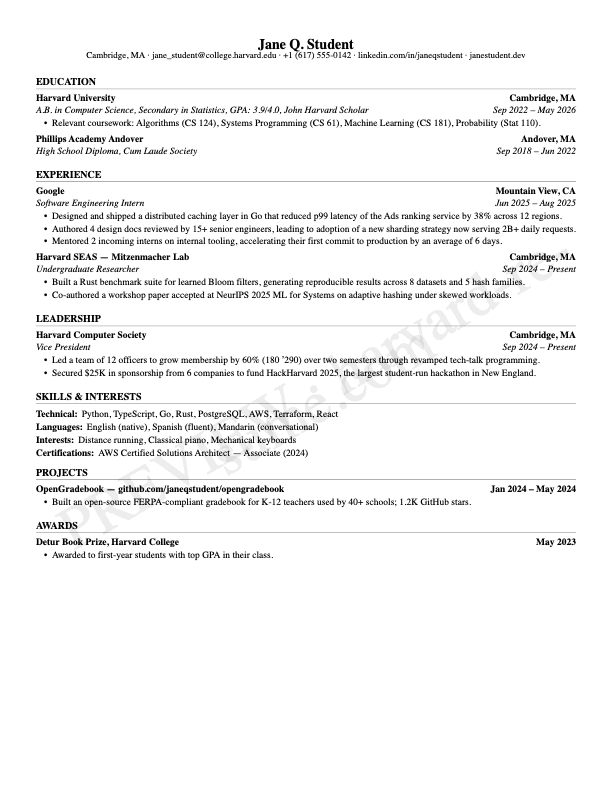
Strong vs weak bullets
Responsible for month-end close and account reconciliations
Owned the month-end close for a 6-entity manufacturing group ($120M annual revenue), reconciling 40+ balance-sheet accounts and posting accruals; cut close time from 9 to 5 business days by standardizing the journal-entry checklist in NetSuite
Names the cycle (month-end), the scale (6 entities, $120M), the account volume (40+), and the measured improvement (9→5 days) plus the system (NetSuite). A controller infers you can run a real close in 4 seconds.
Helped with the annual audit and provided requested documents
Served as primary liaison for the EY year-end audit; prepared 25+ PBC schedules and walked auditors through revenue recognition under ASC 606, resolving all 3 proposed adjustments before the close meeting with zero post-issuance entries
Shows audit ownership, the framework (ASC 606), the deliverable count (25+ PBC schedules), and a clean outcome (3 adjustments resolved, zero post-issuance). Signals you reduce, not create, audit friction.
Worked on accounts payable and processed invoices
Managed a $4.2M monthly AP run across 600+ vendors; implemented a 3-way match control in SAP that caught $180K in duplicate and overbilled invoices in the first year and reduced late-payment penalties by 90%
Quantifies the run ($4.2M, 600+ vendors), names the control (3-way match in SAP), and proves recovered dollars ($180K) plus a process metric (90% fewer penalties). Turns a routine task into measurable savings.
Prepared tax returns for clients
Prepared and reviewed 80+ federal and multi-state returns (1120, 1065, 1040) during busy season; identified $310K in R&D and §179 deductions across a manufacturing client portfolio, raising the realization rate on those engagements to 94%
Names the forms (1120/1065/1040), the volume (80+), the dollar value found ($310K in specific deductions), and a firm metric (94% realization). A tax partner sees both technical range and profitability awareness.
Mistakes specific to this role
- Hiding CPA status. 'CPA candidate, 2 sections passed' belongs on the contact line — recruiters filter on it first, so don't make them hunt.
- Listing duties instead of dollars. 'Reconciled accounts' is invisible; '$40M in intercompany accounts across 6 entities' is a screen-pass. Always attach scale.
- Naming every Office app as a skill. Excel and Outlook are assumed. Reserve the Skills line for ERPs (NetSuite, SAP), frameworks (ASC 606/842), and analytics tools (Power Query, Alteryx, SQL).
- Going to two pages too early. Staff and senior accountants — even most managers — fit on one page. A two-pager signals you can't prioritize, which is the opposite of the accounting brand.
- Vague framework references. 'Followed GAAP' tells a reviewer nothing; 'applied ASC 842 to a 14-property lease portfolio' tells them you can handle technical accounting.
Your résumé starts here. Pay later.
Start composingFrequently asked
- Where exactly do I put my CPA status if I'm still sitting for the exam?
- On the contact line under your name, or as the first item in your Skills/Certifications section — never buried in Education. Write it precisely: 'CPA candidate (TX) — FAR, AUD, REG passed; final section scheduled Q3 2026.' Recruiters screen on exam progress, so showing momentum beats a vague 'pursuing CPA.'
- Should I list every ERP and accounting system I've touched?
- List the ones you can actually be tested on — typically 2-4 systems where you've posted entries, run reports, or built reconciliations (e.g., NetSuite, SAP, QuickBooks). Depth beats breadth: a reviewer trusts 'closed the books monthly in NetSuite' far more than ten logos you opened twice.
- I'm in audit/tax at a firm — how do I keep confidential client work specific but anonymous?
- Generalize the client and keep the economics concrete: 'a $200M private equity-backed SaaS company' or 'a Fortune 1000 retail client.' Then quantify your work (PBC schedules prepared, deductions identified, adjustments resolved). The convention is well understood; reviewers want the numbers, not the names.
- How do I show impact when my job is accuracy, not growth?
- Quantify what accuracy protects or recovers: dollars reconciled, close days cut, duplicate or overbilled invoices caught, audit adjustments avoided, penalties reduced, controls implemented. 'Reduced close from 9 to 5 days' and 'caught $180K in duplicate invoices' are growth metrics in disguise — they prove you make the function faster, cleaner, and cheaper.