Insurance & Risk · 2026
Harvard Resume for Actuaries
From actuarial analyst to FSA — how P&C, life, and health recruiters read an exam-progress résumé in 8 seconds.
How do I write a Actuaries resume in the Harvard format?
Actuarial hiring is exam-gated and modeling-driven before anything else. Recruiters at insurers (Prudential, MetLife, Travelers), reinsurers (Munich Re, Swiss Re), and consultancies (Milliman, WTW, Mercer, Oliver Wyman) scan three things first: how many SOA or CAS exams you've passed (and your VEE credits), which side of the business you work — life, P&C, health, or pension — and the technical depth behind your pricing, reserving, or capital work. The Harvard one-page format puts your exam count and a quantified modeling result in the top third, exactly where a hiring manager decides whether to read on.
What recruiters look for
- Exam progress spelled out: exams passed by name (P, FM, IFM/SRM, STAM/FAM, MAS-I/MAS-II, Exam 5/6) plus ASA/ACAS/FSA/FCAS status and all VEE credits
- Track named: life, P&C, health, or pension/retirement — recruiters filter on it before reading bullets
- Modeling tools: SAS, R, Python, SQL, plus actuarial software (Prophet, GGY AXIS, Moody's RiskIntegrity, Tyche, ResQ, Arius)
- Technical depth: GLMs, loss reserving (chain-ladder, Bornhuetter-Ferguson), pricing, ALM, stochastic modeling, MCEV/EV
- Regime fluency: IFRS 17, LDTI (ASU 2018-12), Solvency II, RBC, ORSA, statutory vs GAAP reserving
- Quantified impact: reserve adequacy, loss-ratio improvement, premium volume priced, capital relief, automation time saved
Required sections, in this order
Exam & credential header
- Put exam count and credential at the very top: 'ASA · 6/7 FSA exams passed' or 'CAS — Exams 5 & 6 passed, FCAS track' on the contact line or first Skills item
- List exams by their actual code (P, FM, SRM, STAM, MAS-I) with sitting dates — recruiters and ATS screen on momentum, not a vague 'pursuing FSA'
- Confirm all VEE credits (Economics, Accounting & Finance, Mathematical Statistics) and your degree, GPA if 3.5+
- No photo, no DOB, no marital status — these flag a non-US-standard résumé to an actuarial recruiter
Experience bullets — lead with the model and the dollars
- Open with the actuarial function and its scale, not 'responsible for': premium volume priced, reserves booked, lives or policies covered
- Name the method and tool: 'built a Tweedie GLM in R for auto pricing' beats 'did pricing analysis'
- Quantify the outcome a reviewer cares about: loss-ratio points, reserve movement, capital relief, combined-ratio impact, runtime cut
- Cite the regime when relevant: IFRS 17 CSM, LDTI cohort modeling, Solvency II SCR, statutory reserve under VM-20
Skills & technical section
- Group cleanly: Languages (R, Python, SAS, SQL, VBA) · Actuarial software (Prophet, AXIS, ResQ, Arius) · Methods (GLM, GBM, chain-ladder, stochastic)
- List the regimes you've actually worked under (IFRS 17, LDTI, Solvency II, RBC) — assumed knowledge for the role
- Add data/ML depth if real: gradient boosting, Spark, Power BI, Tableau, cloud (AWS/Azure) — differentiates a modern actuary
- Skip 'strong analytical skills' and 'detail-oriented' — every actuary claims them; prove them in the bullets instead
Sample in Harvard format
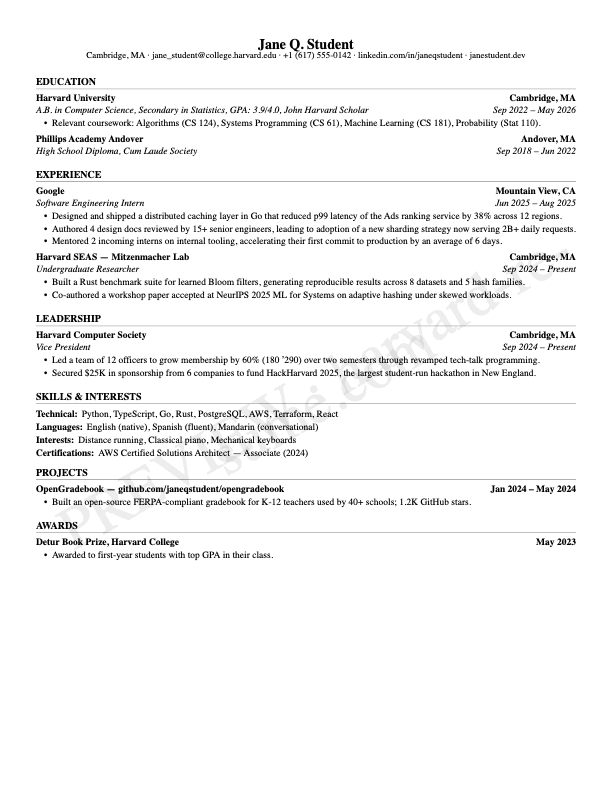
Strong vs weak bullets
Worked on pricing for the personal auto line
Re-priced a $180M personal auto book by building a Tweedie GLM in R across 12 rating variables; the new plan cut the loss ratio by 4.2 points and was filed and approved in 14 states with zero objections
Names the book size ($180M), the method and tool (Tweedie GLM in R), the variable count (12), the outcome (4.2 loss-ratio points), and the rollout (14 states, zero objections). A pricing manager infers real GLM ownership in seconds.
Helped set reserves for the workers' comp line
Owned quarterly loss reserving for a $420M workers' comp portfolio using chain-ladder and Bornhuetter-Ferguson in ResQ; identified $8M of redundant IBNR that released to earnings after a triangle re-segmentation by injury type
Shows the scale ($420M), the methods (chain-ladder, B-F), the tool (ResQ), and a hard dollar outcome ($8M IBNR released) tied to a real technique (re-segmentation by injury type). Signals reserving judgment, not just running a model.
Did valuation work for the life insurance block
Led IFRS 17 transition modeling for a $2.6B traditional life block in Prophet, building the CSM roll-forward and risk-adjustment under the GMM; cut the model runtime 60% by re-engineering the projection grid, hitting every quarterly close on time
Names the regime (IFRS 17 GMM), the scale ($2.6B), the tool (Prophet), the deliverable (CSM roll-forward, risk adjustment), and a process win (60% faster runtime, on-time close). Proves both technical and delivery depth.
Built reports and automated some processes
Automated the monthly experience-study pipeline in Python (pandas + SQL), replacing a 3-day manual Excel process with a 20-minute run that feeds mortality and lapse assumptions to the valuation team across 1.4M policies
Quantifies the automation (3 days → 20 minutes), names the stack (Python, pandas, SQL), the actuarial deliverable (experience study feeding mortality/lapse assumptions), and the scale (1.4M policies). Turns 'automation' into measurable analyst leverage.
Mistakes specific to this role
- Burying exam progress. '4 SOA exams passed, ASA-track' belongs on the contact line — recruiters and ATS filter on exam count first, so don't make them hunt for it.
- Listing duties instead of dollars and methods. 'Did reserving' is invisible; '$420M WC portfolio, chain-ladder and B-F, $8M IBNR released' is a screen-pass. Always attach scale, method, and outcome.
- Naming Excel as a headline skill. Excel and VBA are assumed. Reserve the Skills line for R/Python/SAS/SQL, actuarial software (Prophet, AXIS, ResQ), and methods (GLM, stochastic, chain-ladder).
- Mixing tracks vaguely. A reviewer hiring for P&C pricing needs to see GLMs and loss ratios, not generic 'insurance experience.' Signal your track — life, P&C, health, or pension — in the first third.
- Going to two pages as a student or analyst. Exam-track and even most credentialed actuaries fit on one page. A two-pager signals you can't prioritize — the opposite of the actuarial brand.
Your résumé starts here. Pay later.
Start composingFrequently asked
- Where exactly do I put my exam progress if I'm still sitting for them?
- On the contact line under your name, or as the first item in your Skills/Certifications section — never buried in Education. Be precise: 'SOA — Exams P, FM, FAM, ALTAM passed; ASA-track, sitting ILALFMU next sitting' or 'CAS — Exams 5 & 6 passed, ACAS expected 2026.' List VEE credits separately. Exam count is the first screen, so showing named, dated progress beats a vague 'pursuing FSA.'
- Do I list life/P&C/health exams differently, and does the track matter on the résumé?
- Yes — name your track early because hiring is track-specific. SOA candidates note the FSA specialty fellowship track (e.g., ILA, QFI, retirement, group & health); CAS candidates list Exams 5/6/7/8 toward ACAS/FCAS for P&C. A P&C pricing recruiter wants GLMs and loss ratios; a life valuation team wants IFRS 17 or VM-20. Mirror the track in both your exam list and your bullets.
- I'm an actuarial analyst with no fellowship yet — how do I show impact?
- Quantify what your models moved or protected: loss-ratio points improved, reserve redundancy released, premium volume priced, capital relief from a reinsurance structure, or runtime and manual hours cut by automation. 'Cut auto loss ratio 4.2 points on a $180M book' and 'released $8M of IBNR' are senior-level signals even from an analyst — they prove your work changed the numbers.
- Should I list programming and machine learning, or stick to traditional actuarial skills?
- List both if they're real. Modern actuarial teams hire for R, Python, and SQL alongside Prophet or AXIS, and predictive-modeling roles increasingly want GLMs, gradient boosting, and cloud. But depth beats logos: 'built a Tweedie GLM in R that re-priced a $180M book' is worth more than ten tools you opened once. Keep traditional methods (reserving, valuation, ALM) visible too — they're still the core of the role.