Aerospace & Defense 2026
Aerospace Engineer Resume (Harvard Format)
Show flight-proven hardware, not job duties — quantify mass, margin, and mission readiness.
How do I write a Aerospace Engineer Resume (Harvard Format) resume in the Harvard format?
Aerospace hiring managers at primes, NewSpace startups, and Tier-1 suppliers scan for flight heritage, regulatory rigor, and the ability to close mass, thermal, and structural margins under schedule pressure. A Harvard-format resume forces you to compress propulsion analyses, CDR-readiness, and test campaigns onto one page where every bullet ties a design decision to a measured outcome. This guide shows how to turn 'supported the airframe team' into evidence that you flew hardware, met TRL gates, and held the program to spec.
What recruiters look for
- Lifecycle ownership across NPR 7120 / DO-178C / ARP4754A gates — concept, PDR, CDR, qual, and flight, with TRL advancement called out (e.g., TRL 4 to TRL 6)
- Analysis toolchain depth: ANSYS / NASTRAN / Abaqus FEA, STAR-CCM+ or Fluent CFD, MATLAB/Simulink, GMAT or STK for trajectory, and CAD (CATIA V5/CREO/NX) with GD&T to ASME Y14.5
- Quality and compliance fluency: AS9100, MIL-STD-810/461, DO-160 environmental qual, and ITAR/EAR export-control awareness
- Quantified margins and budgets owned — mass, power, thermal, link, and structural Factor of Safety / Margin of Safety reported to specific numbers
- Hardware-in-the-loop and test campaign experience: vibration, thermal-vac, HALT/HASS, wind tunnel, hot-fire, or flight test with anomaly resolution closed
- Clearance status (Secret/TS-SCI) where relevant, plus FE/PE licensure or NPSS, MBSE (Cameo/SysML), and DFMEA/PFMEA discipline
Required sections, in this order
Lead With Flight Heritage and Program Phase
- Anchor each role to the program and its lifecycle phase — 'Propulsion lead, PDR through CDR on a 22 kN bipropellant thruster' tells a recruiter your TRL exposure in one line.
- Name the platform class (LEO smallsat, UAV, turbofan hot section, launch vehicle upper stage) so reviewers can map your domain to their req without guessing.
- State whether hardware actually flew, qualified, or stayed paper — 'flight-proven on 3 on-orbit missions' is the single strongest signal you can give.
- Keep it one page: a 5-year engineer earns roughly 4 bullets per role; lead with the design you owned, not the team you sat in.
Quantify Margins, Budgets, and Test Results
- Report the numbers aerospace runs on — Margin of Safety, mass in kg, thermal in °C, delta-V in m/s, link budget in dB — never 'improved structural performance'.
- Tie analysis to test: 'FEA predicted 1.4 MoS; vibe test confirmed within 6% of model' proves your models track reality, which is what qual gates reward.
- Show schedule and cost impact, not just physics — 'cut 180 g and 9% from BOM' speaks to systems and program leads simultaneously.
- Use the Harvard XYZ formula: accomplished [X] measured by [Y] by doing [Z], so every bullet carries a verifiable result instead of a responsibility.
Make Tools, Standards, and Clearances Scannable
- Group a Skills line by category: Analysis (NASTRAN, STAR-CCM+, Simulink), CAD/PLM (CATIA V5, Teamcenter), Standards (AS9100, DO-160, MIL-STD-810), Domains (GN&C, thermal, propulsion).
- List standards you actually worked to, not buzzwords — a reviewer will ask which DO-178C DAL level you certified to, so claim only what you can defend.
- State clearance and citizenship plainly ('Active Secret, US Citizen') near the top for defense reqs — recruiters filter on it before reading bullets.
- Put FE/PE, Six Sigma, or MBSE/SysML certs in Education or a tight Certifications line, not buried inside experience prose.
Sample in Harvard format
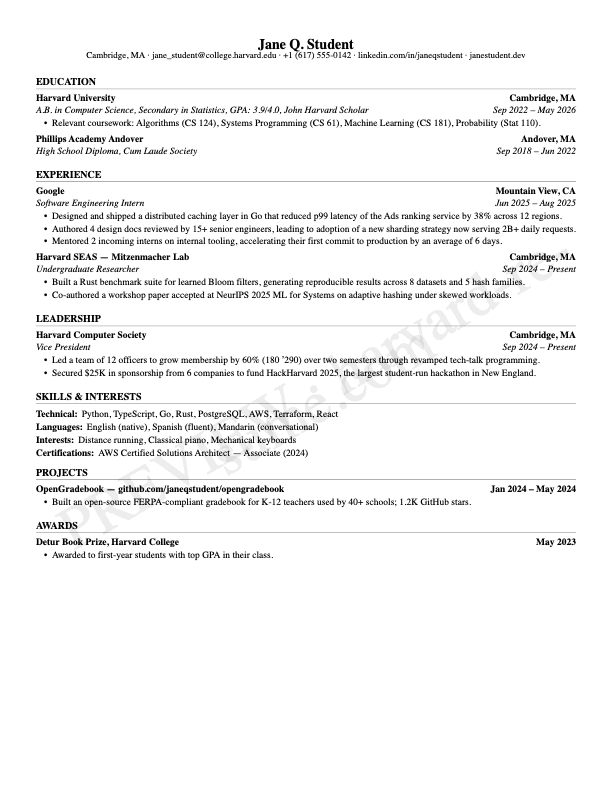
Strong vs weak bullets
Worked on the structural analysis for a satellite component to make sure it was strong enough.
Closed positive Margin of Safety (+0.18) on a 1.9 kg CubeSat deployer bracket using NASTRAN FEA under 14g random-vibe loads, then validated the model within 7% on the shaker table, clearing the structure for the qual gate two weeks early.
Names the part, mass, load case, tool, the exact margin, and test correlation — and ties it to a schedule outcome at a qual gate.
Helped improve the performance of a jet engine combustor.
Cut combustor liner peak metal temperature by 62°C on a 35 kN turbofan by redesigning effusion-cooling hole patterns in STAR-CCM+ across 40 CFD cases, extending predicted hot-section life by 1,800 cycles at no added cooling-air mass.
Quantifies the thermal delta, thrust class, simulation scale, and the durability payoff with an explicit no-mass-penalty constraint.
Was responsible for trajectory analysis on a launch vehicle.
Recovered 140 m/s of delta-V margin on an upper-stage mission by re-optimizing the ascent trajectory in GMAT and POST2 across 12 dispersed Monte Carlo runs, enabling a 28 kg payload increase without a propellant change.
Uses the currency of trajectory work (delta-V, m/s, payload kg) and names the real toolchain plus the Monte Carlo dispersion rigor.
Led testing for a new avionics box and fixed issues that came up.
Drove DO-160 environmental qualification of a flight avionics unit through thermal-vac, vibration, and EMI, resolving a resonance anomaly at 220 Hz by adding a stiffening rib that dropped peak deflection 41% and achieved first-pass qual sign-off.
Cites the qual standard, the specific test suite, a measured anomaly with its fix, and the first-pass result that programs care about.
Mistakes specific to this role
- Listing CAD and analysis tools as a wall of acronyms with no context — a reviewer can't tell if you ran 3 NASTRAN decks or 300; attach tools to outcomes instead.
- Claiming standards you never certified to (DO-178C, AS9100) — aerospace interviews probe DAL levels and audit findings, and a bluff collapses fast.
- Reporting vague 'improved' or 'optimized' results with no margin, mass, temperature, or delta-V — the field thinks in numbers, and unquantified bullets read as junior.
- Hiding flight heritage in prose — if hardware flew or qualified, say so explicitly; 'flight-proven' belongs in the first line of the role, not buried mid-bullet.
- Overflowing past one page or omitting clearance/citizenship on defense-relevant resumes, forcing recruiters to filter you out before they read your work.
Your résumé starts here. Pay later.
Start composingFrequently asked
- Should I list my security clearance on an aerospace resume?
- Yes, if it's active and the roles you target are defense or ITAR-controlled. State it plainly near the top ('Active Secret clearance, US Citizen'). Recruiters filter on clearance and citizenship before reading bullets, so burying it costs you interviews. Never disclose program-specific or classified details — just the level and status.
- How do I show flight heritage if my hardware never actually flew?
- Be honest about the highest gate you reached. 'Qualified to DO-160' or 'passed CDR and completed protoflight vibe' are strong even without on-orbit time. State the TRL you advanced the design to (e.g., TRL 4 to TRL 6). Reviewers respect rigor and accurate maturity claims far more than an inflated 'flight-proven' you can't defend.
- Which tools and standards matter most on the resume?
- Lead with what your target domain uses: FEA (NASTRAN/Abaqus), CFD (STAR-CCM+/Fluent), MATLAB/Simulink, CAD/PLM (CATIA, Teamcenter), and trajectory tools (GMAT, STK, POST2) for GN&C roles. For standards, claim only those you worked to — AS9100, DO-178C, MIL-STD-810/461, DO-160 — because interviewers probe specifics like DAL level or qual findings.
- Do I need an FE or PE license to get aerospace roles?
- For most analysis, design, and R&D roles in primes and NewSpace, no — domain skill and flight experience dominate. An FE is a useful early signal and a PE matters in structures, civil-adjacent, or consulting paths where stamped work occurs. List it if you have it, but don't treat it as a gate for typical engineering positions.