Architecture & Design · 2026
Harvard Resume for Architects
For the architect whose drawings ship buildings — make your résumé read like a tight construction set, not a portfolio cover letter.
How do I write a Architects resume in the Harvard format?
Architecture firms, developer in-house design teams, and government agencies are hiring principals and design directors who scan for one thing in the first six seconds: are you licensed, and have you carried real square footage and budget from concept through CA. The Harvard one-page format forces you to lead with your degree (NAAB-accredited M.Arch or B.Arch), your registration status, and quantified project bullets — instead of burying that under a mood board. It is the format that reads like a clean construction set: every line load-bearing, nothing decorative.
What recruiters look for
- Licensure and exam status: NCARB record number, AXP hours logged, ARE 5.0 divisions passed, and which state boards you hold (e.g. RA in CA, NY, TX)
- Quantified project scale: gross square footage (e.g. 280,000 SF), construction budget ($45M), occupancy type (healthcare, K-12, multifamily, lab), and your phase ownership (SD/DD/CD/CA)
- BIM and documentation fluency: Revit proficiency level, Navisworks clash detection, AutoCAD, and whether you've managed a model across a multi-discipline team
- Sustainability credentials and outcomes: LEED AP BD+C, WELL AP, Passive House (PHIUS/CPHC), and measurable results like Energy Use Intensity (EUI) reductions or LEED certification level achieved
- Project delivery and code mastery: IBC/code analysis, zoning entitlements, design-build vs. CMAR experience, and on-time/on-budget CA track record
- Software beyond BIM: Rhino + Grasshopper, Enscape/Lumion/V-Ray rendering, Bluebeam Revu for markups, and Deltek/Newforma for project management
Required sections, in this order
Lead with Education + Licensure (the Harvard order)
- Put your NAAB-accredited degree first — "M.Arch, NAAB-accredited" or "B.Arch (5-yr)" — with the institution and graduation year; firms verify this for licensure paths so it is non-negotiable.
- Add a one-line Licensure block directly under education: NCARB certificate, Registered Architect (states), ARE 5.0 status, and AXP completion — recruiters scan here before reading a single project.
- Cut the design philosophy paragraph and any objective statement; the Harvard format has no summary fluff — let the credential line and bullets carry it.
- If you are pre-licensure, label yourself "Architectural Designer" honestly and show ARE divisions passed + AXP hours — never imply registration you do not hold (state boards regulate the title 'Architect').
Write project bullets like a project record, not a portfolio caption
- Lead each bullet with your phase role and quantify the project: square footage, construction value, occupancy type, and delivery method — a principal infers your seniority from scale instantly.
- Show outcomes a client pays for: schedule held, budget variance, RFIs reduced, change orders avoided, EUI or LEED level achieved — not adjectives about your aesthetic.
- Name the software and standard you worked to (Revit LOD 350, IBC 2021 code analysis, Bluebeam CA logs) so reviewers can mentally test your fluency.
- Reserve a single 'Selected Projects' subsection if needed: 3-4 marquee projects with name, type, SF, budget, and your role — and link your portfolio URL once in the header (do not paste images).
Keep it one page, no photo, no portfolio inside
- No headshot, no DOB, no full-bleed renderings — the Harvard standard is text-only; your visual work lives behind the single portfolio link in your header.
- Place Skills/Software and Licensure as scannable single lines, not a star-rating chart; rate yourself by what you can be tested on in an interview.
- Trim anything older than ~12-15 years or unrelated (retail jobs, undergrad studio prizes) unless it is a landmark project; one page means ruthless editing.
- Match keywords to the posting (Revit, LEED AP, CA, multifamily, AXP) because firms run résumés through ATS like Deltek and Greenhouse before a human sees them.
Sample in Harvard format
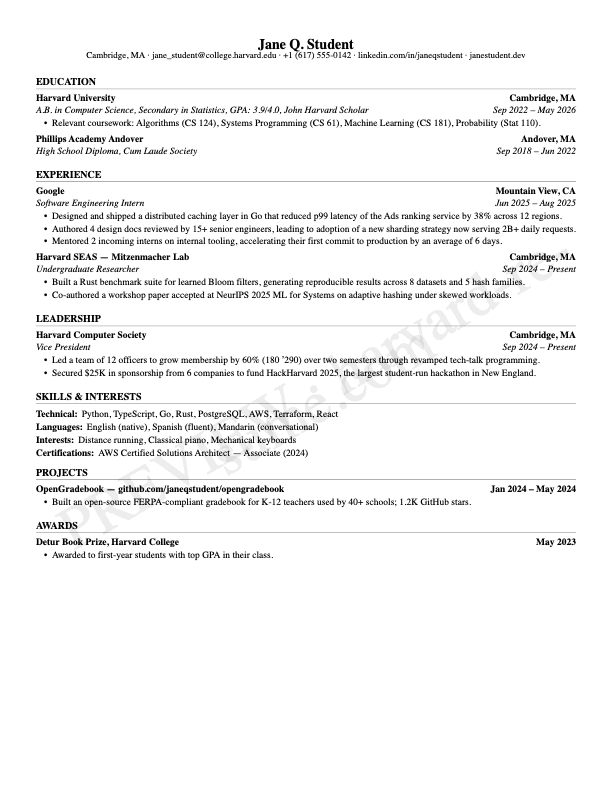
Strong vs weak bullets
Worked on a large mixed-use project using Revit and helped with construction drawings.
Produced the full CD set in Revit (LOD 350) for a 280,000 SF mixed-use development ($62M construction), coordinating 4 consultant models in Navisworks to resolve 340+ clashes before bid, cutting RFIs by 31% during CA.
Names the SF, budget, software, LOD, the coordination tool, and a measurable CA outcome (RFI reduction). A principal reads production-grade documentation skill in four seconds.
Helped make the building more sustainable and energy efficient.
Led the energy strategy that took a 150-unit multifamily project to LEED Gold (BD+C), reducing modeled Energy Use Intensity from 38 to 24 kBtu/SF-yr through envelope and HVAC redesign, verified with the mechanical engineer's energy model.
Quantifies the sustainability claim with a real metric (EUI in kBtu/SF-yr), the certification level, and how it was verified — turning a vague 'green' bullet into evidence of technical leadership.
Managed a team and made sure the project stayed on schedule.
Ran the project architect role on a $45M K-12 school through SD–CA, managing a 5-person production team and delivering CDs on a 14-month schedule with zero schedule slippage and a 1.8% change-order rate against a 5% contingency.
Shows phase ownership (SD–CA), team size, budget, occupancy type, and two hard delivery metrics (schedule slippage, change-order rate) — the numbers a hiring principal uses to judge a project architect.
Did entitlements and worked with the city on approvals.
Secured zoning entitlements and design review approval for a 12-story, 320-unit residential tower, navigating a variance and 3 public hearings to win approval in 7 months — 2 months ahead of the developer's pro forma.
Translates entitlement work into developer language: unit count, height, the approval hurdles cleared, and a timeline beating the pro forma — proof you protect the client's schedule and capital.
Mistakes specific to this role
- Submitting a graphic-heavy 'portfolio résumé' with renderings, custom fonts, and color blocks. Firms ATS-parse résumés; images and two-column layouts get garbled, and the Harvard one-page text format reads cleanly to both robot and principal.
- Hiding your licensure status. 'Architect' is a legally protected title — bury your NCARB/ARE/AXP status and a recruiter assumes you have nothing to report; state it on line one under education.
- Describing projects with aesthetic adjectives ('elegant', 'innovative', 'iconic') instead of SF, budget, occupancy type, and phase role. Principals hire on delivered scale, not vibe.
- Listing every software icon you've ever opened. Depth over breadth — Revit, Rhino+Grasshopper, Bluebeam, and one renderer you can be tested on beat a 20-logo wall you can't defend.
- Padding to two pages with studio projects, competition entries, and coursework. One page forces you to show only the projects that actually got permitted and built.
Your résumé starts here. Pay later.
Start composingFrequently asked
- Should I include my portfolio in the résumé or send it separately?
- Keep the résumé to one page of text and put a single portfolio URL in your header. Firms expect a separate PDF or web portfolio for visuals; the résumé's job is to prove licensure, scale, and delivery so a principal decides to open the portfolio at all.
- I'm not licensed yet — can I still call myself an Architect on my résumé?
- No. In every U.S. state and most countries, 'Architect' is a protected title that requires registration. Use 'Architectural Designer' or 'Job Captain' and show your progress honestly: ARE 5.0 divisions passed and AXP hours logged. That progress is itself a strong signal to a firm investing in your path.
- How do I show project work when I was one of many people on a large team?
- Be precise about your phase and scope: 'authored the CD set for the curtain wall and core', not 'worked on the tower'. Quantify your slice (SF you documented, consultant models you coordinated, RFIs you closed). Honest, specific ownership reads stronger than implied credit for the whole building.
- Should LEED AP and other credentials go after my name or in a separate section?
- Put earned post-nominals (RA, NCARB, LEED AP BD+C) after your name in the header for instant scanning, and repeat the full credential with any exam status in a one-line Licensure block under education. Recruiters filter for these, so make them impossible to miss in both spots.