Accounting & Assurance · 2026
Auditor Resume Guide (Harvard Format)
Build a Harvard-format auditor resume that proves you find risk, quantify exposure, and close findings — not just tick boxes.
How do I write a Auditor Resume Guide (Harvard Format) resume in the Harvard format?
Auditing is judged on the rigor of your evidence and the dollar impact of what you catch — yet most auditor resumes list standards and tools without a single quantified finding. A Harvard-format resume forces you onto one page and rewards bullets that name the framework (SOX, COSO, ISO 27001), the scope (revenue cycle, $40M in transactions), and the outcome (control deficiency remediated, audit cycle cut). This guide shows how to translate fieldwork into recruiter-legible accomplishments whether you sit in external (Big 4), internal, or IT audit.
What recruiters look for
- Credentials and progress toward them: CPA, CIA, CISA, CFE, ACCA, or CA — and whether you reference active exam status or licensure state
- Framework fluency named explicitly: SOX 404, COSO 2013, PCAOB AS 2201, COBIT, ISO 27001, GAAS/ISA, and US GAAP/IFRS
- Quantified scope and materiality: sample sizes, transaction volumes, dollars of revenue/assets tested, and number of controls walked through
- Findings and remediation outcomes: control deficiencies identified, severity (significant deficiency vs. material weakness), and time-to-close
- Tooling depth: IDEA, ACL/Galvanize, TeamMate+, AuditBoard, Workiva, Alteryx, Tableau, and ERP exposure (SAP, Oracle, NetSuite, Workday)
- Efficiency and PBC discipline: cycle-time reduction, audit hours saved through data analytics or automation, and clean working-paper review notes
Required sections, in this order
Lead with findings and materiality, not duties
- Open each bullet with the audit outcome (a deficiency caught, a control rationalized, a cycle shortened), then attach the framework and the dollar or volume scope it covered.
- Quantify exposure: dollars of misstatement identified, transaction populations tested, sample sizes, and the materiality threshold you worked to.
- Distinguish your assurance lane — external/financial-statement, internal/operational, or IT/cybersecurity — so reviewers map you to the right opening immediately.
- Name severity in finding language recruiters trust: 'significant deficiency,' 'material weakness,' 'high-risk observation,' tied to a remediation owner and deadline.
Show technical depth across standards and tools
- Cite the exact standard you applied — SOX 404, PCAOB AS 2201, COSO 2013, ISA 315, COBIT 2019 — instead of the vague phrase 'audit standards.'
- Pair every analytics claim with the tool and the win: IDEA/ACL scripts that ran 100% of a population, Alteryx workflows that cut tie-out time, TeamMate+ or AuditBoard for workpaper management.
- Surface ERP and data exposure (SAP, Oracle, NetSuite, Workday) because system fluency signals you can pull and trust the source data, not just review printouts.
- List credentials and exam progress in a dedicated line — 'CPA (licensed, NY)', 'CISA candidate, passed Domain 1-3' — so it survives a 6-second scan.
Keep the one-page Harvard discipline
- Reverse-chronological, one page for under ~10 years of experience; no objective statement, no photo, no references line.
- Use consistent past-tense action verbs (Assessed, Tested, Reconciled, Remediated, Quantified) and strip filler like 'responsible for' and 'assisted with.'
- Group engagements by client industry or risk domain when you've worked many short engagements, so a reader sees breadth without a wall of logos.
- Reserve the Skills/Certifications band for hard, verifiable items — frameworks, tools, certs, ERPs — not soft traits like 'detail-oriented.'
Sample in Harvard format
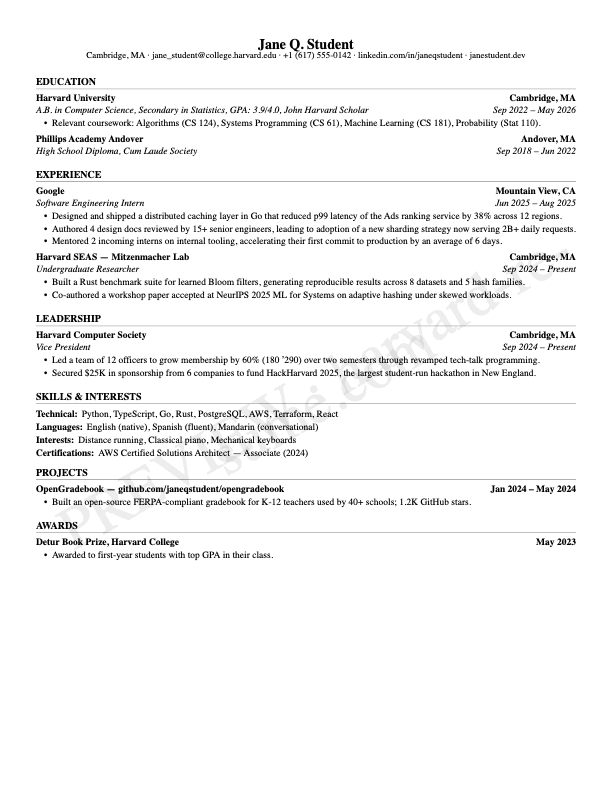
Strong vs weak bullets
Responsible for testing internal controls during the audit.
Tested 142 key SOX 404 controls across the revenue and procure-to-pay cycles for a $1.2B manufacturer, identifying 3 control gaps (1 significant deficiency) and partnering with process owners to remediate all 3 before year-end opinion.
Names the framework (SOX 404), scope ($1.2B, two cycles, 142 controls), the finding severity, and the remediation outcome — not just an activity.
Used data analytics to make the audit more efficient.
Built an IDEA script to test 100% of the 380K-line AP population for duplicate and split payments, replacing a 60-sample manual check and surfacing $214K of duplicate disbursements that the prior-year audit had missed.
Specifies the tool (IDEA), the full-population scale (380K lines), the technique it replaced, and the dollar value recovered.
Helped reduce the time it took to complete audits.
Standardized PBC request lists and migrated 9 recurring engagements to AuditBoard, cutting average fieldwork cycle time from 6.5 to 4 weeks and reducing review-note rework by 35% across the internal audit team.
Quantifies the cycle-time and rework reduction, names the platform (AuditBoard), and shows scope (9 engagements) rather than a vague 'helped.'
Performed IT audit work for the company's systems.
Led the ITGC assessment of SAP access and change-management controls under COBIT 2019, evaluating 28 controls and flagging segregation-of-duties conflicts affecting 47 user roles, which drove a role-redesign that closed 100% of high-risk conflicts within the quarter.
Anchors to the right standard (COBIT/ITGC), the system (SAP), the control count, and a measurable conflict-resolution outcome.
Mistakes specific to this role
- Listing standards and tools (SOX, COSO, ACL) with no finding, dollar amount, or scope attached — the resume reads like a syllabus, not a track record.
- Hiding credentials: burying 'CPA' or 'CISA candidate' in a paragraph instead of a scannable certifications line, or omitting licensure state and exam status.
- Confusing audit lanes — describing external financial-statement work and internal operational audits in the same vague language so a reviewer can't tell what you actually do.
- Over-claiming severity by calling every observation a 'material weakness'; misusing the finding taxonomy signals you don't understand it.
- Spilling onto a second page with engagement minutiae and soft skills, breaking the one-page Harvard discipline reviewers expect from assurance candidates.
Your résumé starts here. Pay later.
Start composingFrequently asked
- Should I list every audit engagement or client I worked on?
- No. Confidentiality often forbids naming clients, and a logo list adds no signal. Group engagements by industry and risk domain (e.g., 'Financial services — SOX 404 and IT general controls'), and lead with the quantified outcomes — findings, dollars tested, controls assessed — rather than a roster of names.
- How do I show I'm progressing toward the CPA, CIA, or CISA if I'm not licensed yet?
- State exam status explicitly on the certifications line: 'CPA candidate — 3 of 4 sections passed (FAR, AUD, REG)' or 'CISA candidate, sitting Q3 2026.' Recruiters discount vague 'pursuing certification' phrasing; concrete progress and a date read as credible and reduce perceived risk.
- Big 4 versus industry internal audit — should my resume differ?
- Yes, in emphasis. Big 4 and external roles reward GAAS/PCAOB methodology, materiality judgment, and breadth across clients; internal audit rewards risk-based audit planning, operational and fraud findings, and remediation follow-through. Reframe the same engagements toward the audience: external highlights opinion-supporting evidence, internal highlights business risk reduced and process improvement.
- How technical should I get about analytics and ERP systems?
- Technical enough to be credible, not so deep it crowds out findings. Name the specific tools (IDEA, ACL/Galvanize, Alteryx, Tableau) and ERPs (SAP, Oracle, NetSuite, Workday) you genuinely used, and tie at least one bullet to a full-population test or automation that produced a measurable result. Generic 'proficient in data analytics' carries no weight.