Medical Devices · 2026
Harvard Resume for Biomedical Engineers
From R&D to medical-device manufacturing — what device-company recruiters and hiring managers scan before the interview.
How do I write a Biomedical Engineers resume in the Harvard format?
Hiring managers at medical-device companies — Medtronic, Stryker, Boston Scientific, Abbott, and the startup wave behind them — screen biomedical engineers against a regulated reality first: can you work inside design controls, support a DHF, and run verification and validation without compromising compliance. In the first 10 seconds they look for your degree, the device class you've shipped, the standards you've worked under (ISO 13485, IEC 60601, ISO 14971), and the tools you've built in. The Harvard one-page format pushes education and technical signal to the top, then backs it with quantified, audit-ready accomplishments.
What recruiters look for
- ABET-accredited BS/MS in Biomedical, Mechanical, Electrical, or Chemical Engineering — and a named specialty (medical devices, tissue engineering, imaging, biomechanics, instrumentation)
- Regulatory fluency: FDA 21 CFR 820 / QSR, ISO 13485, ISO 14971 risk management, design controls, and submission type (510(k), PMA, De Novo, IEC 62304 for SaMD)
- Standards you've designed to: IEC 60601-1 (electrical safety), ISO 10993 (biocompatibility), IEC 62366 (usability), ISO 11135/11607 (sterilization & packaging)
- V&V and statistics: design verification/validation protocols, DOE, Gage R&R, Cpk/process capability, run in Minitab, JMP, or MATLAB
- Design and lab tooling: SOLIDWORKS / Creo / NX, LabVIEW, MATLAB/Simulink, ANSYS or COMSOL FEA, GD&T, and bench-test rigs
- Manufacturing & quality systems: CAPA, NCR/MRB, FMEA (dFMEA/pFMEA), process validation (IQ/OQ/PQ), and DHF/DMR/eQMS (MasterControl, Greenlight Guru, Windchill)
Required sections, in this order
Header & technical summary — surface the device class and standards
- Add a Technical Skills or summary line naming device class (Class II/III), modality (implantable, IVD, imaging, wearable), and the standards you've worked under (ISO 13485, IEC 60601-1, ISO 14971)
- Group skills by category: Design (SOLIDWORKS, GD&T, FEA) · Test & Data (LabVIEW, MATLAB, Minitab, DOE) · Regulatory/Quality (design controls, 510(k), CAPA, IQ/OQ/PQ)
- List certifications that gate roles: EIT/FE, PE, ASQ CQE/CSSBB, CBET, or RAC if you've crossed into regulatory
- No photo, no DOB, no marital status — a U.S. engineering résumé never includes these
Education-first, the Harvard way
- Lead with your degree(s): BS/MS in Biomedical Engineering (note ABET accreditation), institution, year; list GPA only if 3.5+
- Surface a senior design / capstone or thesis with the device built, the standard it targeted, and a measurable result — decisive for new grads
- Add high-signal coursework or labs only if early-career: biomaterials, medical instrumentation, biomechanics, signal processing, regulatory affairs
Experience bullets — anchor to the device lifecycle and compliance
- Open each role with the device, its class, and your phase ownership (concept, DV, V&V, transfer-to-manufacturing, sustaining)
- Tie work to the quality system: DHF authored, design reviews led, CAPAs closed, protocols (IQ/OQ/PQ) executed, FMEAs owned
- Quantify like an engineer: Cpk gains, yield/scrap reduction, cycle-time, cost-per-unit, test-coverage, audit findings closed, time-to-submission
- Cut generic duties ('designed parts', 'ran tests') — name the deliverable, the standard, and the number
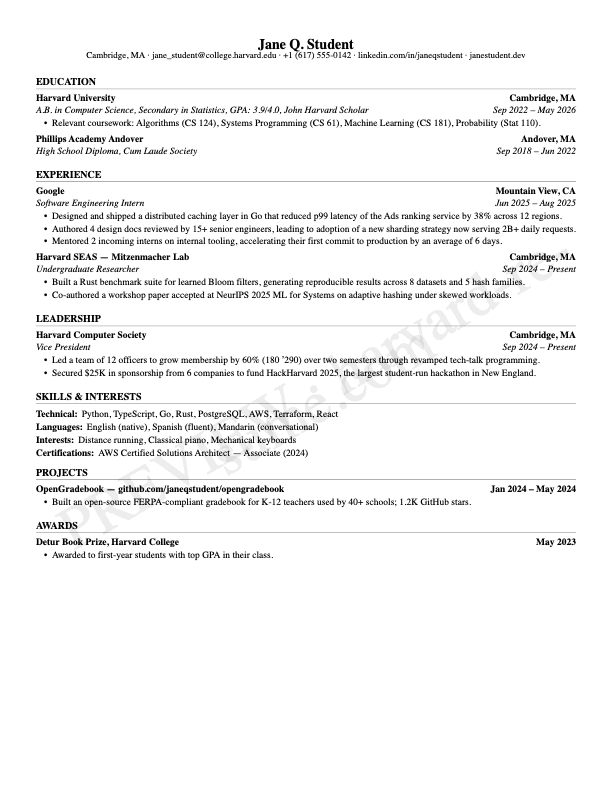
Sample in Harvard format
Strong vs weak bullets
Worked on design verification testing for a medical device
Authored and executed the design-verification protocol for a Class II infusion pump per IEC 60601-1 and ISO 14971; built a LabVIEW bench-test rig that automated 14 of 19 V&V test cases, cutting per-build test time from 6 hours to 90 minutes and clearing the DHF for 510(k) submission on schedule
Names the device class, the standards (IEC 60601-1, ISO 14971), the tool (LabVIEW), the V&V scope, a real time metric, and the regulatory deliverable (DHF for 510(k)). A hiring manager pictures you inside design controls immediately.
Helped improve a manufacturing process and reduce defects
Led a pFMEA and DOE on the laser-weld step of an implantable lead; identified two critical-to-quality parameters and re-centered the process, lifting Cpk from 0.92 to 1.71 and cutting weld-related NCRs by 64% across 220K units/year
pFMEA, DOE, and Cpk are the exact vocabulary device-quality teams screen for. A capability index moving past 1.67 and a defect reduction on a named process step read as audit-ready, not hand-wavy.
Did risk management and documentation for a project
Owned the ISO 14971 risk file for a wearable cardiac monitor — built the hazard analysis and dFMEA covering 87 hazards, drove 11 design mitigations into V&V, and closed all open risk items with zero post-market complaints in the first 12 months of launch
Quantifies a notoriously fuzzy task: 87 hazards, 11 mitigations traced into V&V, and a post-market outcome (zero complaints). It proves you can carry a risk file through to launch, not just fill a template.
Supported the transfer of a product to manufacturing
Drove design transfer of a single-use surgical instrument from R&D to a contract manufacturer; executed IQ/OQ/PQ on three injection-molding tools, validated the process to a 95%/99% reliability acceptance, and ramped first-article yield from 78% to 96% within two pilot lots
Design transfer, IQ/OQ/PQ, and a reliability acceptance criterion are the language of process validation. The yield jump across pilot lots shows you closed the loop from drawing to scalable, validated production.
Mistakes specific to this role
- Listing 'medical devices' generically without the device class, modality, or standards. Recruiters filter on Class II/III experience and named standards (IEC 60601, ISO 14971) — vagueness gets you auto-screened.
- Writing duty-list bullets ('designed components', 'performed testing'). Every BME does that. Lead with the deliverable, the standard, and a Cpk/yield/cycle-time number instead.
- Omitting the quality-system context. Work that isn't tied to design controls, DHF, CAPA, or V&V reads as academic — device companies hire for regulated execution.
- Burying your senior-design or thesis as a course line. For early-career BMEs it's your strongest proof of a full design cycle — give it the device, the standard, and a result.
- Padding to two pages with coursework and every software tool. One tight page with quantified, compliance-anchored bullets reads as the more disciplined engineer.
Your résumé starts here. Pay later.
Start composingFrequently asked
- I'm a new-grad biomedical engineer with only a capstone project. What do I put?
- Lead with your ABET degree, then treat the senior-design/capstone as real experience: name the device you built, the standard you designed to (e.g. ISO 14971 risk analysis), the tools (SOLIDWORKS, LabVIEW, MATLAB), and one measurable result — prototype tested to X, FEA reduced stress by Y%. Add internships, co-ops, and any lab roles with quantified outcomes.
- Should I list FDA standards and regulations on my résumé?
- Yes, but only the ones you've actually worked under, and tied to a deliverable. 'Designed to IEC 60601-1', 'authored ISO 14971 risk file', 'supported 510(k) verification' is far stronger than a dumped list of standard numbers. Device-quality teams screen for genuine hands-on regulatory fluency.
- Do I need a PE license as a biomedical engineer?
- Usually not — most device roles don't require it, since BME work falls under the manufacturer's quality system rather than a stamped public-works design. The EIT/FE is a nice early signal, and a PE matters mainly for consulting, forensic, or rehab/clinical-engineering roles. ASQ certifications (CQE, CSSBB) often carry more weight on the manufacturing side.
- How do I show R&D and manufacturing experience without it looking scattered?
- Frame it as the device lifecycle, not separate jobs. Use one engineering-skills line that spans design through transfer, then let each role show its phase — concept and DV in one, V&V and design transfer in another, sustaining/CAPA in a third. It reads as an engineer who can carry a product end-to-end, which is exactly what device teams pay for.