Brand · 2026
Harvard Resume for Brand Managers
Brand managers are mini-GMs of a P&L. Your Harvard one-pager has to prove you grew share, volume, and margin — not that you 'managed the brand.'
How do I write a Brand Managers resume in the Harvard format?
Brand Manager roles at CPG/FMCG companies like P&G, Unilever, Nestlé, and Mondelēz are filled by marketing directors and brand VPs who treat you as a mini-GM of a P&L. In the first six seconds they scan for market-share movement, volume and net-revenue growth, gross-margin impact, and a named product launch (NPD) you led from concept to shelf. The Harvard one-page format forces you to drop agency-speak and lead every bullet with a measured business result drawn from Nielsen, Circana (IRI), or Kantar data.
What recruiters look for
- P&L ownership: net revenue, volume, gross margin, and A&P (advertising & promotion) budget you managed end-to-end
- Market-share and equity movement they can verify: share points gained, penetration, brand awareness/consideration, and household penetration from Nielsen, Circana (IRI), or Kantar
- A named NPD launch you led through the stage-gate process — concept, claims testing, distribution (ACV), and year-one velocity
- Channel and trade-marketing depth: trade spend efficiency, ROI on promotions, and execution with retailers (Walmart, Target, Kroger) or e-commerce/Amazon
- Tooling and analytics fluency: Nielsen/Circana, Kantar, Numerator, GfK, GA4, and media platforms (Meta, Google, TikTok) plus a consumer-insights method
- An MBA or a CPG-marketing rotational program, plus credentials like the AMA PCM, Pragmatic, or Meta Blueprint
Required sections, in this order
Lead Experience with brand scope and a metric
- Title each role by the business you ran, not the function: 'Brand Manager — $85M Snacks Portfolio (P&L owner, $9M A&P budget)' tells a reviewer your level instantly.
- Open every bullet with the number that matters to a GM: '+2.3 share points,' '+11% net revenue,' '180bps gross-margin' — never 'Responsible for.'
- Anchor share and consumption claims to the source (Nielsen, Circana/IRI, Kantar) so the figure is defensible in a panel interview.
- Keep one bullet per role on an NPD launch end-to-end (concept → shelf) and one on a P&L or pricing decision you owned.
Make Skills a CPG operator's toolkit, not a vibe
- Group the platforms you actually run: Insights (Nielsen, Circana/IRI, Kantar, Numerator, GfK), Analytics (GA4, Tableau), Media (Meta, Google, TikTok, Amazon Ads).
- Name the brand frameworks you apply — brand equity/funnel, positioning/brand key, JTBD, price-pack architecture, and stage-gate NPD — not generic 'strategy.'
- List certifications inline: AMA Professional Certified Marketer, Pragmatic, Google Analytics (GA4), or Meta Blueprint — fast trust signals for screeners and ATS.
- Cut soft-skill filler ('creative,' 'team player'); your bullets should prove those, and the one-page Harvard format has no room for it.
Keep Education and format Harvard-clean
- Education first: degree, institution, graduation year, GPA only if 3.5+ or recent; foreground an MBA or a brand-management rotational program if you have one.
- No photo, no date of birth, no full address — a city/metro line keeps the ATS and the reviewer focused on the P&L results.
- One page, reverse-chronological, consistent tense, single clean serif font — this is the Harvard discipline that signals you can edit ruthlessly.
- If you led a notable launch or won an internal/industry award (Effie, brand of the year), give it one tight line with the metric, not a paragraph.
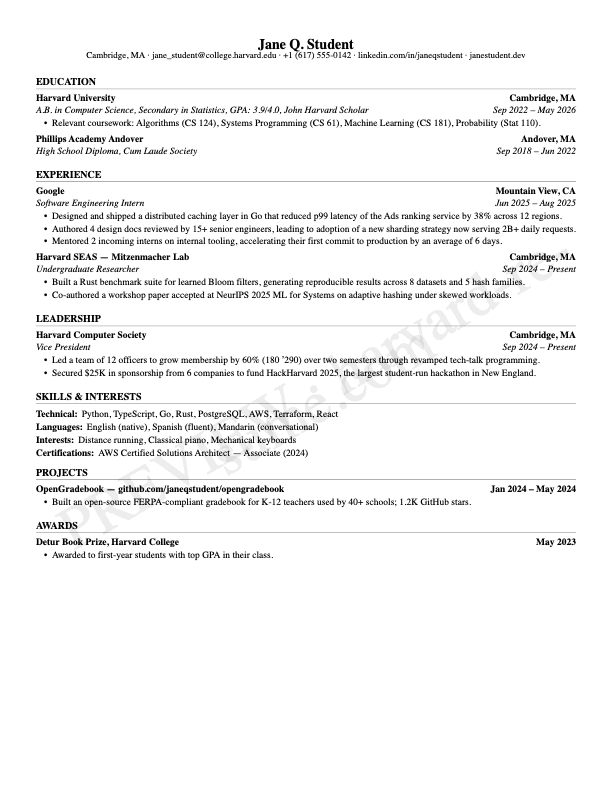
Sample in Harvard format
Strong vs weak bullets
Managed the brand and grew market share in a competitive category.
Grew a $85M snacks brand +2.3 share points (Nielsen) to category #2 by repositioning around a 'better-for-you' claim and reallocating $3M of A&P to digital, lifting net revenue 11% YoY.
Names the P&L size, the share gain with its data source (Nielsen), the strategic lever (repositioning + reallocation), and the revenue outcome — a brand director sees a P&L-literate GM in four seconds.
Led the launch of a new product line for the brand.
Led a 4-SKU line extension from concept to shelf in 11 months through a 5-gate stage-gate process, hitting 62% ACV distribution at Walmart, Target, and Kroger and $14M year-one net revenue at 41% gross margin.
Quantifies the launch scope, the process discipline (stage-gate), distribution (ACV) with named retailers, and year-one revenue and margin — it proves you can run an NPD end-to-end, not just brief an agency.
Improved the efficiency of our trade promotion spending.
Restructured a $12M trade-promotion budget by killing 6 unprofitable promos (Circana ROI < 0.8) and shifting to everyday-low-price packs, lifting promotion ROI from 1.1x to 1.9x and recovering 150bps of gross margin.
Specifies the trade budget, the data threshold used to cut spend (Circana ROI), the pricing lever, and both ROI and margin outcomes — it shows financial rigor finance can defend, not vanity 'efficiency.'
Ran consumer research and used insights to guide brand strategy.
Commissioned a Kantar usage-and-attitudes study (n=2,400) that reframed the target from heavy users to lapsed Gen-Z buyers, driving a repackaging and TikTok campaign that lifted household penetration from 18% to 24% in four quarters.
Names the research method and sample size, the strategic insight, the executional response, and a penetration metric over a defined window — the Harvard XYZ formula applied to brand-building, not a vague 'data-driven' claim.
Mistakes specific to this role
- Leading bullets with responsibilities ('Responsible for the marketing plan') instead of the share, volume, or margin number you actually moved.
- Quoting share or growth with no data source — '+3 share' is unverifiable; '+3 share points (Nielsen)' is defensible in a panel and reads as CPG-fluent.
- Vanity metrics with no P&L link — impressions, reach, and 'engagement' mean nothing to a GM without share, net revenue, penetration, or margin attached.
- Burying the NPD launch or the P&L. The dollar size of the business you ran and the launch you led belong in the first bullet of each role, not the last.
- Spilling onto a second page with brand-deck adjectives. The Harvard one-pager is a forcing function: if a bullet has no metric, cut it.
Your résumé starts here. Pay later.
Start composingFrequently asked
- I work in a small company without Nielsen or Circana data — how do I quantify share?
- Use the closest defensible proxy: internal net-revenue and volume growth, household penetration or repeat rate from your own DTC/loyalty data, distribution gains (new doors or ACV), or branded-search lift. State the source ('internal sell-through,' 'Shopify cohort data') so the figure stays credible without a syndicated-data subscription.
- How do I show a brand or marketing role that wasn't purely P&L ownership?
- Tie your work to the downstream brand number you influenced: awareness or consideration lift from a campaign (Kantar/brand tracker), penetration or velocity from a launch, or trade ROI from a promotion you ran. Even an assistant brand manager can show a share point, a distribution gain, or an equity-metric movement on a specific SKU.
- Do I need an MBA to be competitive for Brand Manager roles?
- At blue-chip CPGs (P&G, Unilever, PepsiCo) an MBA or a brand-management rotational program is common but not mandatory if you have a P&L track record. On the resume, foreground the MBA or rotation in Education, then let quantified share, launch, and margin bullets carry the case — results outweigh the credential.
- Should I list certifications like AMA PCM or Meta Blueprint on a one-page resume?
- Yes, but inline and compact — a single 'Certifications' line under Skills with AMA Professional Certified Marketer, Pragmatic, Google Analytics (GA4), and Meta Blueprint. They're fast trust signals for screeners and ATS keyword matches, and they cost you one line, not a dedicated section.