Business Analysis · 2026
Harvard Resume for Business Analysts
BA hiring runs on requirements clarity and dollars saved. The Harvard format puts process rigor and impact on one scannable page.
How do I write a Business Analysts resume in the Harvard format?
Business Analyst hiring is judged on two things at once: how rigorously you elicit and document requirements, and how much money or time your analysis actually moved. Hiring managers in banking, insurance, SaaS, consulting, and enterprise IT scan the top third for domain, tooling (SQL, JIRA, BPMN), and a quantified outcome — then read your last two roles for evidence you can bridge business and engineering. The Harvard one-page format forces you to lead with those signals instead of burying them under generic 'liaised with stakeholders' filler.
What recruiters look for
- Domain depth named explicitly (payments, claims, supply chain, healthcare RCM, lending)
- Requirements artifacts you actually produced: BRD, FRD, user stories, use cases, process maps (BPMN/UML)
- Tooling stated, not implied: SQL, JIRA/Confluence, Tableau/Power BI, Visio, ServiceNow, Salesforce
- Quantified impact: $ saved, cycle-time cut, defect/rework reduction, manual hours automated
- Methodology fluency: Agile/Scrum, Waterfall, SAFe — and which ceremonies you owned (backlog grooming, UAT)
- Certifications that matter: CBAP/CCBA (IIBA), PMI-PBA, Scrum (CSM/PSM), or Six Sigma Green Belt
Required sections, in this order
Header & summary framing
- Add a one-line tag under your name: e.g. 'Business Analyst · Payments & Lending · 7 yrs'
- List 2-3 core tools inline in the contact area only if space allows — otherwise reserve for Skills
- No photo, no DOB, no marital status — keep it ATS-clean and education-first
Experience bullets — lead with the artifact and the metric
- Open each bullet with what you produced (BRD, process map, dashboard) and the outcome it drove
- Name the methodology and your role in it (owned backlog grooming, ran UAT for 40 test cases)
- Quantify the business case: $ saved, hours automated, defect rate cut, adoption %
- Cut 'liaised with stakeholders' — replace with the decision you enabled and its number
Skills & certifications section
- Group skills: Analysis (SQL, BPMN, UML) · BI (Tableau, Power BI) · Tools (JIRA, Confluence, ServiceNow)
- Put CBAP/CCBA/PMI-PBA/CSM on their own line — they are a fast credibility signal
- Skip 'Microsoft Office' and generic 'communication skills'; they read as filler
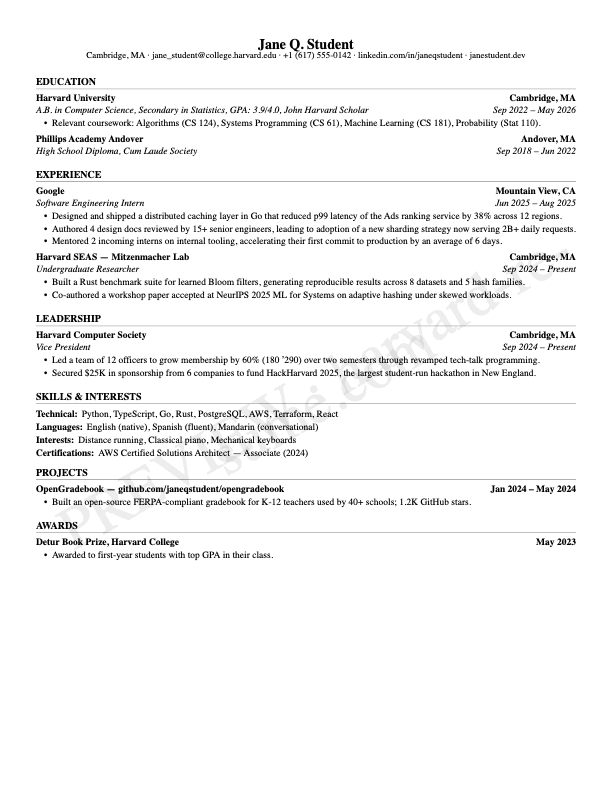
Sample in Harvard format
Strong vs weak bullets
Gathered requirements and worked with stakeholders on a new system
Authored the BRD and 64 user stories for a claims-intake redesign across 3 business units; ran 11 elicitation workshops and 2 UAT cycles, cutting average claim cycle-time from 9.2 to 5.4 days and rework defects by 38%
Names the artifacts (BRD, 64 stories), the process (11 workshops, 2 UAT cycles), the scale (3 units), and two hard metrics. A hiring manager infers a BA who owns the full lifecycle in 4 seconds.
Built reports and dashboards to help the business
Built 6 Power BI dashboards on a SQL-backed model consolidating 4 source systems; surfaced a billing-leakage pattern that recovered $1.3M in under-billed revenue and replaced 22 hours/week of manual Excel reconciliation
Specific tool (Power BI), data scope (4 sources), and two outcomes — recovered revenue ($1.3M) and automated hours (22/week). It proves analysis that moved money, not just charts.
Helped improve a business process
Mapped the order-to-cash process in BPMN, identified 3 redundant approval gates via root-cause analysis, and drove a re-design that reduced invoice approval time from 6 days to 31 hours and saved an estimated $210K/year in carrying cost
Names the technique (BPMN, root-cause), the specific waste (3 redundant gates), and quantifies both cycle-time and dollars — the exact business case a BA is hired to build.
Managed the product backlog in JIRA for the team
Owned a 180-item JIRA backlog across 2 Scrum teams; refined acceptance criteria that lifted first-pass UAT acceptance from 71% to 94% over 4 sprints, cutting an average of 1.5 rework cycles per release
Backlog ownership is easy to claim; here it is measured — backlog size, the acceptance-rate jump, and rework cycles eliminated. It signals a BA whose requirements actually hold up downstream.
Mistakes specific to this role
- Writing 'liaised between business and IT' with no outcome. Every BA does this — show the decision you unblocked and its number.
- Listing tools as a wall ('SQL, Excel, JIRA, Confluence, Visio, Tableau, Power BI, SharePoint...'). Group them and keep depth you can be tested on.
- Hiding the metric. A requirements bullet without cycle-time, $, or defect-rate impact is invisible next to a quantified one.
- Calling yourself 'detail-oriented' and a 'strong communicator'. These are assumed for a BA; prove them with a UAT or workshop result instead.
- Forgetting domain. 'Worked on a system' tells a reviewer nothing; 'claims-intake in P&C insurance' tells them you can ramp fast.
Your résumé starts here. Pay later.
Start composingFrequently asked
- Should I list CBAP or PMI-PBA if I'm still early-career?
- Yes — even ECBA (the entry IIBA cert) or a Scrum CSM/PSM signals you know the discipline's vocabulary. Put it on its own Certifications line. CBAP/CCBA carry the most weight once you have the hours to qualify.
- How do I show impact when my work was 'just documentation'?
- Documentation is never the deliverable — the business change is. Tie every artifact to its downstream metric: a BRD that cut cycle-time, user stories that lifted UAT pass-rate, a process map that removed approval steps. Quantify the thing the document caused.
- Do I list SQL and BI tools as skills or prove them in bullets?
- Both. Keep a grouped Skills line for ATS keyword matching, but also embed the tool in at least one bullet ('built 6 Power BI dashboards on a SQL model'). A skill that appears only in a list reads as aspirational.
- Is one page realistic with 8+ years and multiple domains?
- Yes. Keep the last 2-3 roles detailed, compress older roles to one line each, and cut any project that doesn't carry a metric or a domain you want to be hired for. The discipline of compression is itself a BA signal.