Business Development · 2026
Harvard Resume for Business Development Managers
BD hiring is a numbers interview on paper — quota attainment, pipeline value, and deals closed have to travel together on one page.
How do I write a Business Development Managers resume in the Harvard format?
Business development hiring is decided by one question a sales VP asks in the first 10 seconds: did you carry a number, and did you hit it? Recruiters at SaaS scale-ups, agencies, and enterprise sales orgs scan for quota attainment, pipeline generated, and ACV before they read a single qualitative line. The Harvard format suits BD perfectly because it forces every line to be an outcome — and an outcome in BD is always a metric.
What recruiters look for
- Quota attainment as a percentage, every year (e.g. '118% of $2.4M annual quota')
- Pipeline value generated and deal sizes — ACV, TCV, average deal size, sales cycle length
- CRM and sales-stack fluency named explicitly: Salesforce, HubSpot, Outreach, Salesloft, ZoomInfo, Gong, Apollo
- Methodology certifications recruiters trust: MEDDIC/MEDDPICC, Challenger, SPIN, Sandler, Winning by Design
- Net-new logos vs. expansion split, and whether you built territory from zero or inherited a book
- Channel/partnership work quantified: partner-sourced revenue, number of resellers or alliances signed
Required sections, in this order
Header & positioning line
- Add a one-line positioning tag under your name: e.g. 'BD Manager · B2B SaaS · $4M+ closed · 5 yrs'
- Include LinkedIn URL on the contact line — recruiters will check it against your résumé numbers
- No photo, no DOB; lead with the segment you sell into (SMB, mid-market, enterprise)
Experience bullets — the quota spine
- Open every role with your number: quota size, attainment %, and ranking on the team
- One bullet for net-new acquisition, one for pipeline/sourcing, one for a marquee logo or strategic deal
- Name the sales motion: inbound vs. outbound, PLG-assisted, channel, or enterprise field sales
- Show progression — bigger quota, larger segment, or longer cycle as you advance roles
Skills & tools section
- CRM + sales stack as named tools (Salesforce, HubSpot, Outreach, Gong, ZoomInfo), not 'CRM software'
- Methodologies you actually run (MEDDPICC, Challenger, SPIN) — not 'consultative selling'
- Languages and territories if you sell across regions (LatAm, EMEA, NAM)
- Skip generic 'excellent communicator' / 'relationship builder' — show it in a quota bullet instead
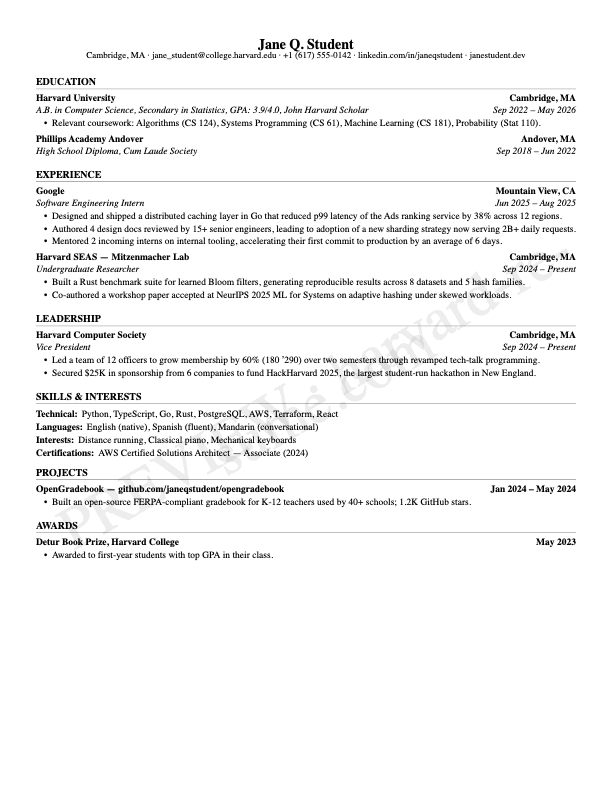
Sample in Harvard format
Strong vs weak bullets
Responsible for generating new business and hitting sales targets
Closed $3.1M in net-new ARR at 124% of a $2.5M annual quota selling mid-market SaaS; ranked #2 of 14 AEs and self-sourced 60% of pipeline via outbound on Outreach + ZoomInfo
Names the number ($3.1M ARR), attainment (124%), the segment (mid-market SaaS), team rank (#2 of 14), self-sourced % (60%), and the actual tools. A VP infers a hunter who hits quota in 5 seconds.
Built relationships with partners to grow the channel
Launched the reseller channel from zero, signing 11 partners in 9 months and driving $1.4M in partner-sourced TCV (22% of regional revenue) using a co-sell motion in HubSpot
Channel work is usually vague. Here it's quantified: zero-to-11 partners, timeframe (9 months), partner-sourced revenue ($1.4M TCV), and share of total (22%).
Managed the sales pipeline and improved conversion
Rebuilt the qualification process on MEDDPICC, lifting SQL-to-close win rate from 19% to 31% and cutting average sales cycle from 94 to 61 days across a 140-opportunity book
A process bullet with teeth: names the methodology (MEDDPICC), two before/after metrics (win rate, cycle length), and the scale of the book (140 opps).
Worked on expanding existing accounts and upselling
Grew a $900K book of 38 mid-market accounts to $1.6M through structured QBRs and multi-threading into 3+ stakeholders per account; achieved 142% net revenue retention over 4 quarters
Expansion BD is judged on NRR. This names the starting book ($900K, 38 accounts), the tactic (QBRs, multi-threading), and the gold-standard metric: 142% NRR.
Mistakes specific to this role
- Listing duties instead of numbers. 'Responsible for new business' is invisible — every bullet needs a quota %, a dollar figure, or a conversion rate.
- Hiding quota attainment. If you hit or beat quota, lead with it; if you missed, show the dollar amount closed and a process win instead.
- Vague 'relationship building' language. A VP wants pipeline sourced and deals closed, not adjectives — show the relationship in a revenue outcome.
- Naming no tools. A BD résumé without Salesforce/HubSpot/Outreach/Gong reads as junior; recruiters filter on stack fluency.
- Claiming team revenue as your own. Be precise about your individual quota vs. team number — VPs verify this in the interview and a mismatch ends the process.
Your résumé starts here. Pay later.
Start composingFrequently asked
- What if I missed quota last year — should I still put a number?
- Yes. Omitting the number reads worse than a miss. Lead with dollars closed and attainment ('92% of a $3M quota in a down market'), then a bullet showing a process or pipeline win. Context-setting an honest miss beats a suspicious silence.
- Should I list specific deal sizes and client names?
- List sizes always (ACV, TCV, average deal). Name clients only if they're recognisable logos and not under NDA — 'closed a Fortune 500 logo' or 'signed a $400K enterprise deal' works when you can't name them.
- Where do sales methodology certifications go?
- Skills section as a one-liner (MEDDPICC, Challenger, Sandler). Only break out an Awards/Certifications section if you have 3+ or a President's Club / top-rep distinction worth its own line.
- How do I show a transition from SDR/BDR into a closing BD role?
- Make your closing/quota-carrying bullets the strongest since they're scanned first. Your SDR experience earns its line through sourcing metrics — 'sourced $2.8M in pipeline, 38 SQLs/quarter' — which proves the top-of-funnel engine behind your later closing numbers.