Culinary & Hospitality 2026
Chef Resume Guide (Harvard Format)
A Harvard-format resume that proves you can run a line, hit food cost, and lead a brigade under pressure.
How do I write a Chef Resume Guide (Harvard Format) resume in the Harvard format?
A strong chef resume is judged on the numbers behind the plate: food cost percentage, covers per service, labor as a share of sales, and the menus you launched. The Harvard one-page format forces you to lead each line with a quantified accomplishment instead of a vague duty list, which is exactly how executive chefs and F&B directors scan candidates. Whether you are moving from sous to head chef or jumping cuisines, this guide shows how to translate kitchen wins into XYZ bullets that survive a 15-second read.
What recruiters look for
- Food cost and labor control: ability to hold food cost at 28-32% and labor under 30% of sales, with COGS and inventory variance you can name
- Volume and pace: covers per service, average check, and station throughput during peak (e.g., 280 covers, 90-second ticket times on the saute station)
- Certifications: ServSafe Manager (and ServSafe Allergens), HACCP, local food handler card, and any culinary degree (CIA, Le Cordon Bleu, Johnson & Wales)
- Menu development and P&L impact: dishes you costed, priced, and launched, with margin and mix shift, plus seasonal/menu-engineering work
- Brigade leadership: line cooks, sous chefs, and dishwashers managed, plus turnover, training time, and scheduling against forecasted covers
- Health and safety record: inspection scores (e.g., 98/100), zero critical violations, and audited HACCP logs
Required sections, in this order
Format & one-page discipline
- Keep it to one page with a clean reverse-chronological layout: name, contact, then Experience, Education, Certifications, and Skills — no photo, no objective, no graphics that break ATS parsing
- Lead every bullet with a strong past-tense verb (Re-engineered, Cut, Plated, Trained) and end with a number; recruiters scan the right-hand side of the page for digits
- Name the venue type and scale up front — fine dining, high-volume banquet, 220-seat brasserie, ghost kitchen — so reviewers calibrate covers and check average instantly
Quantify the kitchen with XYZ bullets
- Use the Harvard XYZ formula: accomplished [X] measured by [Y] by doing [Z]. Tie every win to food cost %, labor %, covers, waste, or revenue
- Translate fuzzy duties into hard metrics: 'reduced food cost by 4 points to 29% by re-costing the menu and renegotiating three produce vendors' beats 'managed inventory'
- Include throughput and consistency metrics: ticket times, plate-up consistency, comp/return rate, and inspection scores — the numbers a chef-owner actually cares about
Skills, certs & education that pass the screen
- List active certifications with the most recent first: ServSafe Manager, HACCP, food handler card, allergen training — include expiry-relevant currency so they read as valid
- Group hard skills by cuisine and technique (charcuterie, sous-vide, garde manger, line/grill, pastry) and systems (Toast, Square for Restaurants, MarketMan, inventory/COGS tools)
- Put culinary education and stages where they add credibility — name the program, Michelin-starred or notable kitchens you staged in, and any externships
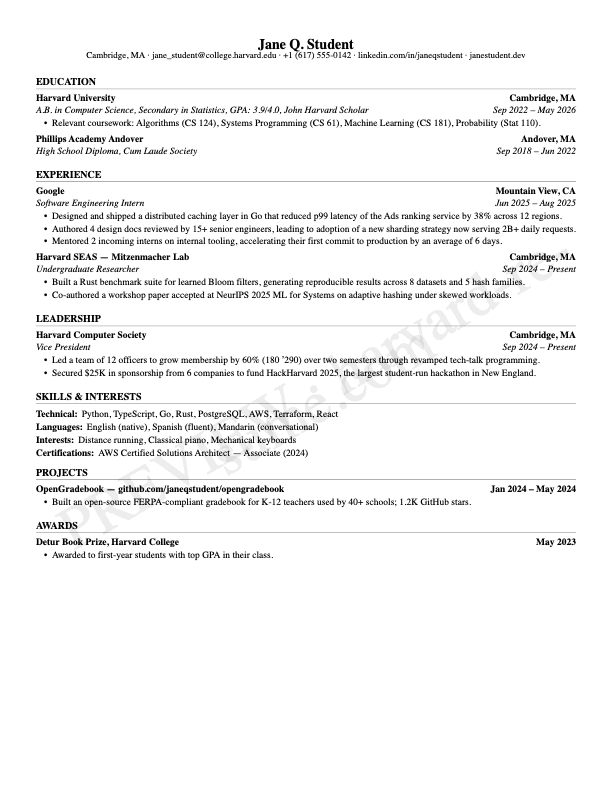
Sample in Harvard format
Strong vs weak bullets
Responsible for the kitchen and keeping food costs down.
Cut food cost from 34% to 29% of sales over two quarters by re-costing 60+ menu items, instituting weekly inventory counts, and renegotiating contracts with three produce vendors.
Leads with the metric (5-point reduction), names the scale (60+ items) and the exact actions (re-costing, inventory cadence, vendor terms) — the X-Y-Z a F&B director can verify.
Cooked food during busy dinner shifts.
Ran the saute and grill stations for a 240-cover Friday service, holding sub-90-second ticket times and a comp rate under 1.5% across a 6-cook line.
Quantifies volume (240 covers), pace (90-second tickets), quality (comp rate), and team size — proving you perform at peak, not just that you 'cooked'.
Helped create new menu items for the restaurant.
Engineered a seasonal 14-dish menu that lifted average check from $42 to $51 and shifted product mix toward 68% gross-margin plates, generating $180K in incremental quarterly revenue.
Connects menu work to check average, margin mix, and dollar revenue — showing P&L literacy, not just creativity.
Trained new cooks and managed the team.
Built a 3-week station-certification program for 18 line cooks that cut new-hire ramp time by 40% and reduced annual kitchen turnover from 85% to 52%.
Turns 'training' into measurable onboarding speed and retention — leadership outcomes a hiring chef can compare across candidates.
Mistakes specific to this role
- Listing duties ('prepared food, cleaned station, followed recipes') instead of quantified outcomes like food cost %, covers, or inspection scores
- Omitting volume context — '200 covers' means nothing without service type (fine dining vs. banquet) and check average to calibrate it
- Burying or forgetting certifications: a missing ServSafe Manager or HACCP line gets resumes screened out for any management role
- Running two pages or cramming every job since dish-pit; keep it to one page and cut roles older than 10-12 years to relevant highlights
- Using flowery food adjectives ('artisanal, passionate, world-class') instead of numbers — chefs trust margins and inspection scores, not buzzwords
Your résumé starts here. Pay later.
Start composingFrequently asked
- How do I quantify cooking experience if I never tracked numbers?
- Estimate conservatively from what you know: covers per service from reservation/POS data, food cost from the percentage your chef targeted, team size from the schedule, and inspection scores from your last health visit. Even ranges ('180-240 covers nightly,' 'held food cost near 30%') are far stronger than duty lists, and they signal you think in P&L terms.
- Should I include stages and externships on a chef resume?
- Yes — stages in notable or Michelin-starred kitchens are powerful credibility signals, especially early-career. List the kitchen, chef (if recognizable), dates, and one technique-focused line. Keep older or one-off stages to a single grouped line so they don't crowd your one page.
- Do I need a culinary degree to land a head chef role?
- No. Many head and executive chefs rose through the brigade without a degree. What recruiters weigh is your food cost and labor control, the kitchens and cuisines you've run, and your ServSafe/HACCP certifications. If you have a CIA, Le Cordon Bleu, or J&W credential, list it; if not, let your quantified line and menu results carry the resume.
- How far back should my chef resume go?
- Roughly 10-12 years or 4-5 roles, whichever keeps it to one page. Lead with your most senior, highest-volume positions. Collapse early line-cook and prep jobs into a brief 'Earlier roles' line unless one was at a marquee restaurant worth naming.