Process & Manufacturing · 2026
Chemical Engineer Resume (Harvard Format)
Build a one-page Harvard-format resume that proves you ship process improvements, hit yield and safety targets, and de-risk scale-up.
How do I write a Chemical Engineer Resume (Harvard Format) resume in the Harvard format?
A chemical engineering resume is judged on whether you can move a process metric, not on the unit operations you can name. Recruiters at EPCs, refineries, specialty chemical, and pharma sites want proof you improved yield, throughput, energy intensity, or OEE while keeping PSM and environmental limits intact. The Harvard one-page format forces you to lead every bullet with the quantified outcome — percent yield gained, hours of downtime cut, dollars of OPEX saved — and back it with the tool, model, or process change that got you there.
What recruiters look for
- Quantified process wins: yield %, conversion, throughput (kg/hr or BPD), first-pass yield, OEE, and energy intensity (GJ/tonne) with before/after numbers
- Process safety fluency: PSM, PHA/HAZOP leadership, MOC, LOPA, relief-system sizing (API 520/521), and a clean recordable-incident record
- Simulation and design tools: Aspen Plus/HYSYS, AVEVA PRO/II, gPROMS, plus P&ID literacy and DCS/PLC exposure (DeltaV, Honeywell Experion)
- Six Sigma / Lean credentials (Green or Black Belt), DOE, SPC, and Minitab or JMP used on a named project with a measured result
- FE/PE licensure (or EIT), GMP/cGMP and FDA experience for pharma, or OSHA 1910.119 PSM and EPA RMP exposure for bulk chemicals
- Scale-up and tech-transfer track record: bench → pilot → commercial, with capital cost (CAPEX), commissioning, and startup ownership
Required sections, in this order
Header & Structure (one page, Harvard order)
- Name, then one line: email, phone, LinkedIn, city/state, and PE/EIT status if licensed — no full address, no photo, no objective statement.
- Order sections Education → Experience → Projects/Technical → Skills for new grads; flip to Experience-first once you have 2+ years on a process or plant.
- Reserve a tight Technical Skills line for simulation (Aspen Plus), data (Python/Minitab), and standards (API, ASME, PSM) — group them, don't list every chemical you've touched.
- Keep it to one page until 10+ years; use a single clean serif or sans font, consistent date alignment, and zero graphics or skill bars.
Experience Bullets (XYZ formula for process roles)
- Lead with the metric and unit operation: yield, conversion, throughput, OEE, energy intensity, OPEX, or downtime — never 'responsible for the reactor.'
- Name the lever: a DOE, an APC loop, a heat-integration retrofit, a catalyst change, a HAZOP action, or a control-narrative rewrite — show the engineering, not just the result.
- Tie work to dollars and safety in the same bullet when you can: '$420K/yr OPEX' or 'eliminated a Tier-1 PSM finding' lands harder than a bare percentage.
- Use past tense, strong verbs (re-engineered, debottlenecked, commissioned, validated), and keep each bullet to 1–2 lines so the page stays scannable.
Skills, Certs & Projects
- List credentials recruiters filter on: FE/PE or EIT, Six Sigma belt, GMP, OSHA PSM, and software (Aspen, AutoCAD/SmartPlant, DCS) — with the version or vendor where it matters.
- For capstones, co-ops, or internships, write them as mini-XYZ projects with a real number even if it's pilot-scale (e.g., '12% conversion gain on a 5-L bench reactor').
- Show domain breadth strategically — distillation, heat transfer, kinetics, separations — but only where you have a quantified result to attach.
- Cut soft skills and clichés ('team player', 'detail-oriented'); a HAZOP you led or a validated PPQ batch proves both without saying them.
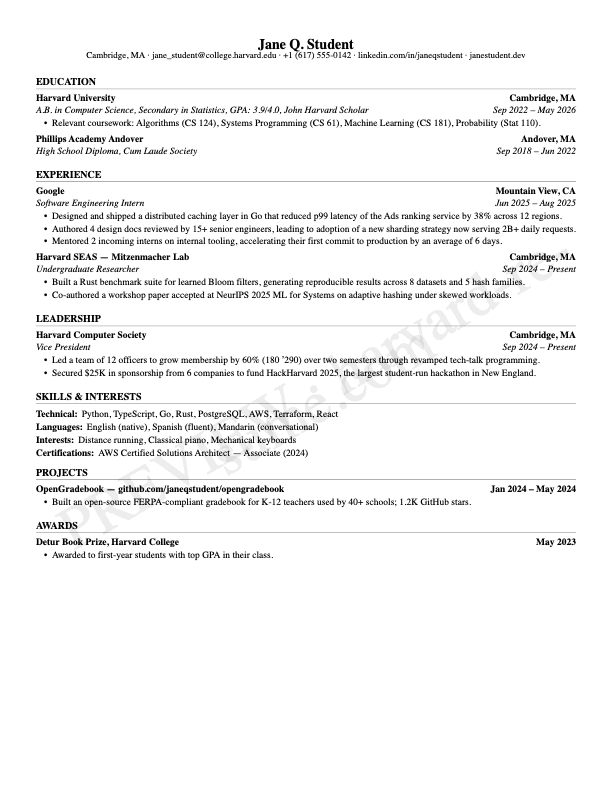
Sample in Harvard format
Strong vs weak bullets
Worked on improving the distillation column to make it run better.
Increased distillation column throughput 18% (from 42 to 49.5 tonnes/hr) by re-trimming the reflux ratio via an Aspen Plus sensitivity study and tuning the temperature APC loop in DeltaV, with no purity loss below 99.4%.
Names the unit op, the metric and scale, the simulation tool, the control system, and the constraint held — a process engineer's whole story in one line.
Helped with safety and ran some hazard reviews on the unit.
Led a 6-session HAZOP and LOPA on a 200 BPD hydrotreater that closed 31 action items and removed two SIL-2 gaps, cutting the unit's PHA backlog to zero ahead of the OSHA PSM revalidation deadline.
Shows PSM leadership with concrete scope (sessions, action items, SIL gaps) and ties it to a real regulatory milestone instead of vague 'safety.'
Reduced costs in the production process and saved the company money.
Cut $380K/yr in steam and natural-gas OPEX by redesigning a feed-effluent heat-integration network (10°C approach) identified through a pinch analysis, lowering the plant's energy intensity from 4.8 to 4.1 GJ/tonne.
Converts a generic 'saved money' into a dollar figure, the specific lever (pinch/heat integration), and an industry KPI (GJ/tonne).
Scaled up a new product from the lab to the plant.
Led tech transfer of a specialty polymer from 5-L bench to a 2,000-gal commercial reactor, delivering 3 consecutive PPQ batches at 96% first-pass yield and on-time commercial launch within a $1.2M CAPEX budget.
Demonstrates the bench→pilot→commercial arc with first-pass yield, validation batches, and CAPEX ownership that scale-up roles screen for.
Mistakes specific to this role
- Listing unit operations and software as a skills dump with no project or number attached — recruiters can't tell a reactor you read about from one you ran.
- Burying or omitting process safety: no PSM, HAZOP, MOC, or relief-sizing signal reads as a liability to any operating-company hiring manager.
- Writing duty statements ('responsible for daily operations') instead of XYZ outcomes with yield, throughput, OEE, or OPEX numbers.
- Spilling onto a second page with coursework or every lab technique; a one-page Harvard format with quantified wins beats an exhaustive two-pager.
- Claiming 'improved efficiency' or 'optimized the process' with no baseline — without a before/after, the number is unverifiable and gets discounted.
Your résumé starts here. Pay later.
Start composingFrequently asked
- Do I need a PE license on my chemical engineering resume?
- Not for most industry roles — an FE/EIT signals you're on track and is worth listing. A PE is a real differentiator for consulting, EPC design sign-off, and public-sector or environmental work, so put it right in your header line if you hold one.
- How do I show safety experience without a major incident to point to?
- Lead with proactive safety work: HAZOPs or LOPAs you participated in or led, MOCs you authored, relief-valve or LOPA calcs, near-miss closures, and your unit's recordable rate. Hiring managers read process-safety fluency as risk reduction even without a headline event.
- I'm a new grad with only internships and a capstone — what goes in Experience?
- Treat co-ops, internships, and your capstone as real experience and write them as XYZ bullets with whatever number you have, even pilot-scale: conversion gained, hours of downtime avoided, a DOE that narrowed a variable. A quantified bench result beats a list of coursework every time.
- Should I list every simulation and design tool I've touched?
- List the ones you've actually used on a project — Aspen Plus/HYSYS, PRO/II, gPROMS, AutoCAD/SmartPlant, a DCS like DeltaV — and tie at least one to a bullet. A tool named in a result is credible; a 20-item software list with no context reads as filler.