Engineering · 2026
Harvard Resume for Civil Engineers
From EIT to PE — what engineering firms, DOTs, and design-build contractors actually scan for first.
How do I write a Civil Engineers resume in the Harvard format?
Civil engineering hiring is credential-gated and project-driven. Hiring managers at AECOM, Jacobs, Kiewit, state DOTs, and regional design firms scan three things first: your licensure status (PE, EIT/EIT-in-progress), your degree from an ABET-accredited program, and the dollar scale and discipline of projects you've delivered. The Harvard one-page format puts exactly those in the top third — education and license up front, quantified project bullets right under them.
What recruiters look for
- Licensure status spelled out: PE (state + number), EIT/FE-passed, or 'PE-eligible 2027'
- ABET-accredited BS/MS in Civil or a sub-discipline (structural, geotechnical, transportation, water resources)
- Project scale in dollars and scope: $40M interchange, 12-story mixed-use, 8-mile corridor
- Design software named: AutoCAD Civil 3D, Revit, MicroStation/OpenRoads, STAAD.Pro, SAP2000, HEC-RAS, HydroCAD
- Codes and standards you've actually applied: ASCE 7, ACI 318, AASHTO LRFD, IBC, AISC 360, local DOT specs
- Delivery method and role: design-bid-build vs design-build, EOR, engineer-of-record support, CA/construction phase
Required sections, in this order
Education & licensure block
- Put PE / EIT status on the contact line or directly under your name — it is the first filter for most reqs
- Education first: degree, ABET-accredited institution, year; add MS if structural/geotech (these tracks reward it)
- List FE/PE exam status precisely: 'FE passed Oct 2024, PE eligible 2027' beats a vague 'pursuing licensure'
- Relevant coursework only for new grads with no project experience yet (e.g., Reinforced Concrete Design, Soil Mechanics)
Skills section — make it a tools-and-codes block
- Software grouped by use: Design (Civil 3D, Revit), Analysis (STAAD.Pro, SAP2000, RISA), Hydraulics (HEC-RAS, StormCAD)
- Codes and standards you can be tested on: ASCE 7, ACI 318, AASHTO LRFD, IBC, AISC 360 — list the ones you've used
- Specialized methods: load-rating, seismic detailing, MSE walls, stormwater/SWPPP, traffic modeling (Synchro/VISSIM)
- Cut generic 'Microsoft Office' and 'strong communication' — those are assumed and burn a line
Experience bullets — lead with the project
- Open each bullet with the project type and dollar scale, then your specific deliverable
- Name the role: design lead, EOR support, resident engineer, CA reviewer — ownership level matters
- Quantify outcomes: cost saved via value engineering, schedule compressed, design quantities, RFIs resolved
- For PMs/seniors, add team size, sub-consultant coordination, and budget owned
Sample in Harvard format
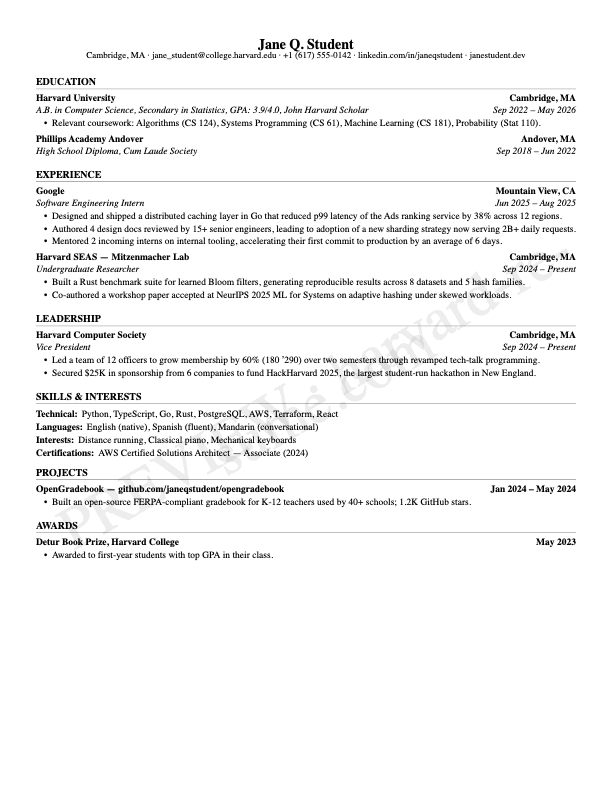
Strong vs weak bullets
Worked on the design of a highway interchange project
Led structural design of a $42M diamond-interchange replacement (AASHTO LRFD, AutoCAD Civil 3D + STAAD.Pro), including a 3-span 320-ft prestressed-girder bridge; value-engineered the pier layout to cut $1.8M in substructure cost while holding the 22-month schedule
Names the project scale ($42M), the codes (AASHTO LRFD), the software, the specific structure (3-span 320-ft bridge), and a dollar-and-schedule outcome. A reviewer infers PE-track design ownership in 4 seconds.
Helped with stormwater design and got permits
Designed stormwater management for a 38-acre commercial development (HydroCAD + HEC-RAS), sizing 4 detention basins to the local MS4 standard; authored the SWPPP and secured NPDES and Section 404 permits with zero agency review cycles beyond the first submittal
Site scale (38 acres), tools (HydroCAD, HEC-RAS), specific deliverables (4 basins, SWPPP), and a clean-permit metric (zero extra review cycles) that signals quality and agency fluency.
Did construction inspection and reviewed submittals
Served as resident engineer on a $28M sanitary-sewer rehabilitation (4.2 mi of CIPP lining); reviewed 140+ shop drawings and resolved 86 RFIs averaging 2-day turnaround; kept the project 6% under budget and 3 weeks ahead of the GMP milestone
Role (resident engineer), scope ($28M, 4.2 mi), throughput (140+ submittals, 86 RFIs, 2-day turnaround), and dual budget/schedule outcomes — exactly the construction-phase signals a firm wants.
Performed structural calculations for buildings
Performed structural analysis and EOR-support calcs for a 12-story post-tensioned concrete residential tower (ACI 318, ASCE 7 seismic, SAP2000); sized columns and shear walls for Seismic Design Category D, reducing rebar tonnage 9% versus the preliminary scheme through optimized core placement
Building type and height (12-story PT concrete), the governing codes (ACI 318, ASCE 7, SDC D), the analysis tool, and a quantified material savings tie design judgment to a number.
Mistakes specific to this role
- Burying or omitting licensure status. PE, EIT, or 'FE passed, PE-eligible 2027' belongs at the top — it's the first hard filter.
- Listing software you opened once. Name 5-8 tools (Civil 3D, Revit, STAAD, HEC-RAS) you could be tested on, not 20.
- Vague project bullets with no scale. '$42M interchange' tells a reviewer everything; 'a road project' tells them nothing.
- Skipping codes and standards. A structural or transportation engineer who never names ASCE 7 or AASHTO LRFD reads as junior.
- Forgetting your delivery role. 'Worked on' hides whether you were EOR, design support, or CA — name the ownership level.
Your résumé starts here. Pay later.
Start composingFrequently asked
- I'm an EIT, not yet a PE. How do I present that?
- State it precisely and forward-looking: 'EIT (FE passed Oct 2024), PE-eligible 2027' on the contact line or under Education. It signals you're on the licensure track, which most reqs require, without overclaiming.
- Should I list every project I've touched?
- No. Pick 4-6 projects that show range and ownership, led by dollar scale and your specific role. A long undifferentiated project list reads as junior; a curated set with metrics reads as a designer who owned outcomes.
- Do certifications like LEED AP, PMP, or OSHA 30 belong on a civil résumé?
- Yes if relevant to the role: LEED AP for buildings/sustainability, PMP for project-management tracks, OSHA 30 for construction/field roles. List them in a compact Certifications line under Education — don't dedicate a full section unless you have 4+.
- How do I handle confidential or government project clients?
- Generalize the client ('a state DOT', 'a Fortune 500 manufacturer') and keep the engineering specifics — scale, codes, your deliverable, the outcome. Reviewers care about the work, not the client name.