Cloud · Infrastructure · 2026
Harvard Resume for Cloud Engineers
Platform, SRE, and infrastructure teams scan for reliability math, IaC discipline, and cloud-spend impact — not a Kubernetes buzzword wall.
How do I write a Cloud Engineers resume in the Harvard format?
Cloud and platform hiring is judged on outcomes the business can feel: uptime, latency, blast radius, and dollars off the AWS bill. Reviewers at AWS, GCP, and platform-heavy startups spend their first 8 seconds confirming you ship infrastructure-as-code, you understand reliability math (SLOs, error budgets), and you can name a real cloud spend you cut. This recipe customises the Harvard format for cloud engineers across SRE, DevOps, and platform tracks — from associate to staff.
What recruiters look for
- Active cloud certs named by tier — AWS Solutions Architect Pro / DevOps Pro, GCP Professional Cloud Architect, CKA / CKAD
- Infrastructure-as-code ownership: Terraform or Pulumi modules, not click-ops in the console
- Reliability fluency: SLOs, error budgets, p99 latency, MTTR, on-call rotation owned
- Cloud-spend impact in dollars or percent (FinOps: rightsizing, Savings Plans, Spot, idle teardown)
- Kubernetes depth at the version/operator level, plus the CI/CD and GitOps tooling (Argo CD, Flux) you ran
- Security and compliance signals: IAM least-privilege, SOC 2 / PCI evidence, secrets management
Required sections, in this order
Skills section (place above Experience for platform roles)
- Group by category: Clouds · IaC · Containers/Orchestration · Observability · CI-CD
- Name the cloud depth honestly — 'AWS (EKS, Lambda, RDS, VPC peering)' beats 'cloud computing'
- List 6-10 tools per group you can be whiteboarded on, not a 30-logo wall
- Surface active certs with their tier and year (e.g. 'AWS Solutions Architect — Professional, 2025')
Experience bullets — lead with reliability and cost
- Open each role's top bullet with an SLO, uptime, latency, or cost-savings metric
- Name the IaC tool and the blast radius (regions, accounts, services, nodes)
- Show on-call maturity: MTTR reduced, incidents handled, runbooks/automation authored
- Quantify scale concretely: req/s, nodes, clusters, monthly cloud spend managed
Header and certifications
- Add GitHub link as the second contact-line entry, after email
- Certifications can be their own one-line section near Education if you hold 3+ active
- No photo, no DOB — list region/timezone only if relevant to a remote on-call rotation
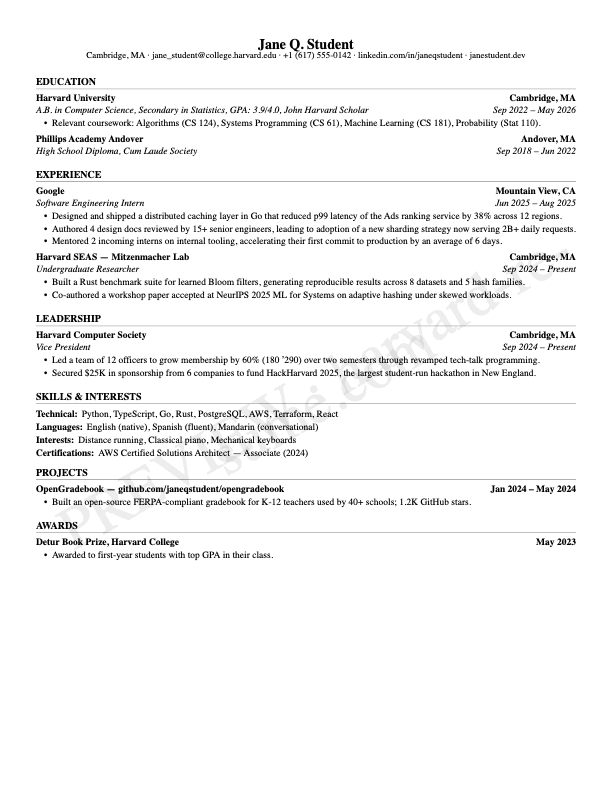
Sample in Harvard format
Strong vs weak bullets
Worked on migrating our infrastructure to the cloud
Led a lift-and-reshape migration of 140 services from on-prem VMs to AWS EKS using Terraform modules; cut infrastructure cost 41% ($840K/yr) via Spot node groups and Savings Plans while holding 99.95% availability through cutover
Names the destination (EKS), the tool (Terraform), the scale (140 services), and pairs dollar savings with an availability guarantee — a reviewer infers full-cycle migration ownership in seconds.
Improved system reliability and reduced downtime
Defined SLOs and an error-budget policy for the payments platform (99.95% target); built golden-signal dashboards and Prometheus alerting that cut MTTR from 42 to 9 minutes across 60+ on-call incidents over two quarters
Reliability is hard to prove — this shows the discipline (SLO + error budget), the tooling (Prometheus, golden signals), and the measurable outcome (MTTR 42 → 9 min over 60 incidents).
Built CI/CD pipelines for the engineering team
Replaced a Jenkins monolith with GitOps on Argo CD across 28 microservices; cut median deploy lead time from 3.5 hours to 11 minutes and raised deploy frequency from 12 to 90+ per week with automated progressive rollouts
Names what it replaced (Jenkins → Argo CD GitOps), the scope (28 services), and two DORA-grade metrics (lead time and deploy frequency) — exactly what platform leads benchmark on.
Helped with cloud cost optimization
Ran a FinOps audit across 3 AWS accounts; rightsized 220 EC2 instances, killed idle EBS/NAT spend, and migrated batch jobs to Spot — trimming the monthly bill 33% ($28K/mo) with zero customer-facing latency regression
Specific levers (rightsizing, idle teardown, Spot), specific scope (3 accounts, 220 instances), and a guarded outcome (33% / $28K with no latency hit) signal FinOps maturity, not guesswork.
Mistakes specific to this role
- Listing 30 logos under Skills (every AWS service, every tool). Recruiters trust depth — name the 8-10 you can be whiteboarded on.
- Claiming 'Kubernetes expert' with no version, operator, or cluster scale. Say 'ran 12-node EKS clusters, wrote 3 custom operators' instead.
- No reliability metrics. A cloud résumé with zero SLO, uptime, latency, or MTTR numbers reads as click-ops, not engineering.
- Forgetting cost. FinOps is now a core expectation — at least one bullet should quantify spend you cut in dollars or percent.
- Listing expired or unscoped certs. Mark the tier and year; an 'AWS Certified' with no level and no date looks padded.
Your résumé starts here. Pay later.
Start composingFrequently asked
- Which cloud certifications actually move the needle on a résumé?
- Professional-tier and Kubernetes certs carry the most weight: AWS Solutions Architect Professional or DevOps Engineer Professional, GCP Professional Cloud Architect, Azure Solutions Architect Expert, and CKA/CKAD. Associate-tier certs help early-career candidates but are table stakes by mid-level. List the tier and year; an undated 'AWS Certified' line is weak.
- I'm a generalist DevOps engineer — should I target SRE, platform, or DevOps roles?
- Pivot the same Harvard skeleton, don't rewrite it. For SRE, lead bullets with SLOs, error budgets, and MTTR. For platform engineering, lead with developer-experience and self-service IaC adoption. For DevOps, lead with CI/CD and DORA metrics (deploy frequency, lead time, change-fail rate). The Experience section stays; only which metric opens each bullet changes.
- How do I show cloud experience without naming a confidential employer's spend?
- Use percentages and relative scale instead of absolute dollars when the figure is sensitive: 'cut compute cost 33%' or 'managed mid-seven-figure annual cloud spend.' Reviewers care that you can attach a number to your work — exact figures aren't required, and ranges are credible.
- Do homelab or personal infrastructure projects belong on a cloud résumé?
- Only if the depth is unusual and recent. A self-hosted multi-region Kubernetes cluster with GitOps, IaC, and observability you built in the last 12 months is signal for early-career candidates. A single Raspberry Pi running Docker is a credibility hit — leave it off once you have real production experience.