Construction & Built Environment 2026
Construction Manager Resume (Harvard Format)
A Harvard-format resume for construction managers who deliver projects on schedule, under budget, and with zero recordables.
How do I write a Construction Manager Resume (Harvard Format) resume in the Harvard format?
Construction managers are hired on a single question: can you bring the project in on time, on budget, and incident-free? A Harvard-format resume answers it with hard numbers — contract value managed, schedule variance, RFI turnaround, and EMR — not adjectives like "detail-oriented." This guide shows you how to turn jobsite responsibility into one page of quantified, recruiter-ready proof.
What recruiters look for
- Total contract value delivered (e.g. $45M ground-up, $12M tenant improvement) and delivery method — design-bid-build, design-build, CM at-risk, or GMP
- Schedule and cost performance: SPI/CPI, days ahead/behind baseline, change order value as a percentage of contract, and CPM scheduling in Primavera P6 or Microsoft Project
- Safety record: EMR below 1.0, TRIR/DART rate, OSHA 30, and zero lost-time incidents across recorded man-hours
- Software fluency: Procore, Autodesk Build/BIM 360, Bluebeam Revu, PlanGrid, Sage 300 CRE or Viewpoint Vista for cost
- Credentials: PMP, CCM (Certified Construction Manager), LEED AP, AGC CMIT, plus trade-specific OSHA, and a state contractor or GC license where applicable
- Self-perform vs. subcontractor management — number of trades coordinated, RFI/submittal volume, and pay application (AIA G702/G703) processing
Required sections, in this order
Lead with delivery metrics, not duties
- Open the experience section with the project: type (healthcare, multifamily, data center), square footage, contract value, and delivery method — "$38M, 220,000 SF Class-A office, GMP" frames every bullet that follows.
- Quantify the triple constraint in every bullet: schedule (days vs. baseline), cost (budget delivered, change order %), and quality/safety (punch list items, EMR, recordables).
- Use the Harvard XYZ formula — accomplished [X] measured by [Y] by doing [Z] — so a recruiter sees outcome, metric, and method in one line.
- Lead each bullet with a strong past-tense verb: Delivered, Resequenced, Negotiated, Closed out, De-risked — not "Responsible for" or "Helped with."
Make the technical core unmistakable
- List a Skills line with named systems, not categories: "Procore, Primavera P6, Bluebeam Revu, Sage 300 CRE, AIA G702/G703, CPM scheduling, OSHA 30."
- Put certifications and licenses near the top — CCM, PMP, LEED AP, OSHA 30, and any state GC/contractor license number — because GCs and owners screen for them before reading bullets.
- Show command of the project lifecycle: preconstruction estimating, buyout, RFI/submittal management, pay apps, change order negotiation, commissioning, and closeout.
- Name the trades and scopes you coordinated (MEP, structural steel, curtain wall, sitework) so a hiring superintendent can gauge complexity instantly.
Hold the one-page Harvard discipline
- One page for under ~15 years of experience; reverse-chronological; no photo, no objective statement, no graphics or skill bars — owners and GCs want a clean, scannable document.
- Cap each role at 3-5 bullets and lead with the highest-dollar, highest-risk project; drop pre-2010 roles to a single line or omit them.
- Keep consistent date formatting (MM/YYYY), 0.5" margins, and a single professional font (11-12pt) — ATS systems used by ENR-400 firms parse clean layouts, not tables.
- Mirror the job posting's exact language — "CM at-risk," "self-perform concrete," "OAC meetings" — so keyword-matching ATS and human reviewers both register the fit.
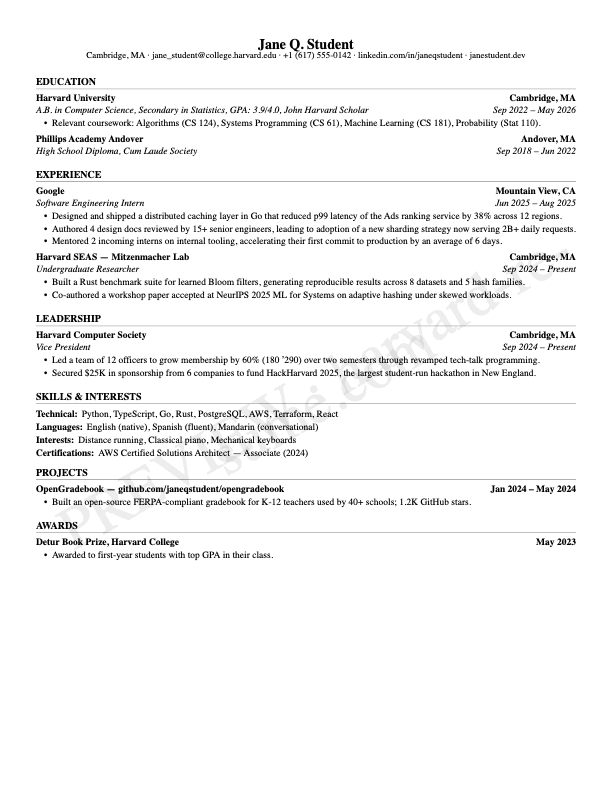
Sample in Harvard format
Strong vs weak bullets
Managed construction projects and kept them on schedule and budget.
Delivered a $38M, 220,000 SF Class-A office (CM at-risk, GMP) 3 weeks ahead of baseline and 4.2% under budget by resequencing the MEP rough-in and running a 6-week pull-plan with 14 subcontractors.
Names contract value, delivery method, scale, and two quantified outcomes tied to a specific scheduling method.
Responsible for jobsite safety and worker compliance.
Drove EMR from 1.12 to 0.78 over 410,000 man-hours by implementing daily pre-task plans and weekly toolbox talks, achieving zero lost-time incidents across an 18-month high-rise build.
Uses the EMR metric and man-hours that owners screen for, with a clear method and an incident-free outcome.
Handled RFIs, submittals, and change orders for the project.
Cut RFI turnaround from 9 days to 3.5 days on a 1,400-RFI hospital project by standardizing Procore workflows, holding change orders to 2.1% of the $62M contract against a 5% industry benchmark.
Quantifies RFI volume, turnaround improvement, the tool, and change-order discipline against a benchmark.
Worked with the estimating team during preconstruction.
Led buyout on a $24M multifamily project, securing $1.9M in scope savings (7.8% under estimate) by competitively bidding 11 trade packages and value-engineering the structural system in Bluebeam.
Shows a preconstruction outcome with dollar savings, percentage, scope count, and the named tool.
Mistakes specific to this role
- Listing duties instead of outcomes — "oversaw subcontractors" tells a GC nothing; "coordinated 14 trades to deliver 3 weeks early" does.
- Omitting safety metrics — leaving out EMR, TRIR, or lost-time incidents reads as a red flag to any owner or GC, since safety is a prequalification gate.
- Vague money references like "large projects" or "multimillion-dollar" instead of exact contract values, change-order percentages, and budget variance.
- Burying scheduling software and methodology — not naming Primavera P6, CPM, or pull planning makes you look like a coordinator, not a manager.
- Running to two pages with pre-2010 roles and an objective statement, breaking the one-page Harvard discipline owners expect.
Your résumé starts here. Pay later.
Start composingFrequently asked
- Should I include my EMR and safety stats on a construction manager resume?
- Yes. EMR (ideally below 1.0), TRIR/DART, recorded man-hours, and a zero-lost-time record are among the first signals owners and GCs screen for — safety is a prequalification requirement on most bids, so omitting it works against you.
- Which certifications matter most for a construction manager resume?
- CCM (Certified Construction Manager) and PMP carry the most weight for the CM role, followed by LEED AP for sustainability-focused work and OSHA 30 as a baseline. Include any state GC/contractor license number — owners verify it.
- How do I show project scale without naming confidential clients?
- Quantify by project type, square footage, contract value, and delivery method — "$45M, 180,000 SF acute-care hospital, design-build" — instead of the client name. This conveys complexity and risk while respecting NDAs.
- Can a construction manager resume really fit on one page?
- Yes, and it should for under ~15 years of experience. Lead with your two or three highest-dollar projects, cap each at 3-5 quantified bullets, condense early roles to one line, and drop the objective statement — that keeps it to a clean, ATS-friendly page.