Marketing & Content · 2026
Content Writer Resume (Harvard Format)
A Harvard-format resume for content writers that proves your words move traffic, rankings, and revenue — not just that you can write.
How do I write a Content Writer Resume (Harvard Format) resume in the Harvard format?
Hiring managers skim a content writer's resume for proof that your articles ranked, converted, and shipped on schedule — not adjectives like "passionate storyteller." The Harvard format forces one tight page of quantified outcomes: organic sessions, keyword positions, conversion rate, and word-count throughput. This guide shows how to turn bylines and briefs into metrics an editor or content lead can trust.
What recruiters look for
- Organic traffic and SEO impact: sessions driven, keywords ranked on page 1, and growth in non-branded clicks (Google Search Console, Ahrefs, Semrush)
- Conversion and engagement metrics: email signups, demo requests, time-on-page, and assisted conversions tied to specific pieces
- Publishing velocity and editorial reliability: pieces/month shipped, on-time rate, and pieces managed through a CMS (WordPress, Webflow, Contentful, HubSpot)
- SEO and research tooling fluency: Surfer/Clearscope/Frase content scoring, keyword clustering, SERP-intent analysis, and on-page optimization
- Range across formats and the funnel: long-form pillar pages, product/landing copy, email sequences, and thought-leadership ghostwriting
- Style-guide discipline and AI-assisted workflows: AP/Chicago/house style adherence, editing AI drafts (ChatGPT/Claude), and brand-voice consistency
Required sections, in this order
Header & Professional Summary
- Lead the header with your byline name plus a portfolio URL (or Clippings.me/Contently link) — editors click it before they read line two.
- Write a two-line summary anchored to a niche and a number: e.g. "B2B SaaS content writer who grew organic blog traffic 140% in 11 months." Skip "wordsmith" and "passionate."
- Name your strongest verticals (fintech, healthcare, DTC) and primary funnel stage (TOFU SEO, BOFU product) so a recruiter can pattern-match in five seconds.
- List your top tools inline — Ahrefs, Surfer SEO, WordPress, HubSpot — but keep it to the ones you'd be tested on in an interview.
Experience Bullets (XYZ Formula)
- Use "Accomplished X (metric) as measured by Y by doing Z": traffic, rankings, or conversions first; the writing tactic second.
- Quantify the unglamorous wins too — publishing cadence (8 articles/month), on-time delivery (98%), and editing turnaround — these signal reliability to a content lead.
- Attribute results honestly: "contributed to" a team pillar vs. "owned" a series you researched, wrote, and optimized end-to-end. Recruiters probe inflated claims.
- Show the full content lifecycle in your verbs: researched, briefed, drafted, optimized, edited, and updated/refreshed evergreen pieces for ranking maintenance.
Skills, Portfolio & Education
- Group skills into SEO (keyword research, on-page, internal linking), Content (long-form, email, landing pages), and Tools (CMS, analytics, content scoring) — not one undifferentiated blob.
- Anchor your portfolio to results: link 3–5 pieces and note the outcome ("ranked #2 for 'X', 4.2K monthly sessions") rather than just the title.
- List relevant credentials concretely: HubSpot Content Marketing, Semrush Content Marketing Toolkit, or Google Analytics certification — with the issuing body and year.
- Keep education brief; a journalism/English/marketing degree is a plus but a ranked portfolio outweighs it — give the portfolio the prime real estate.
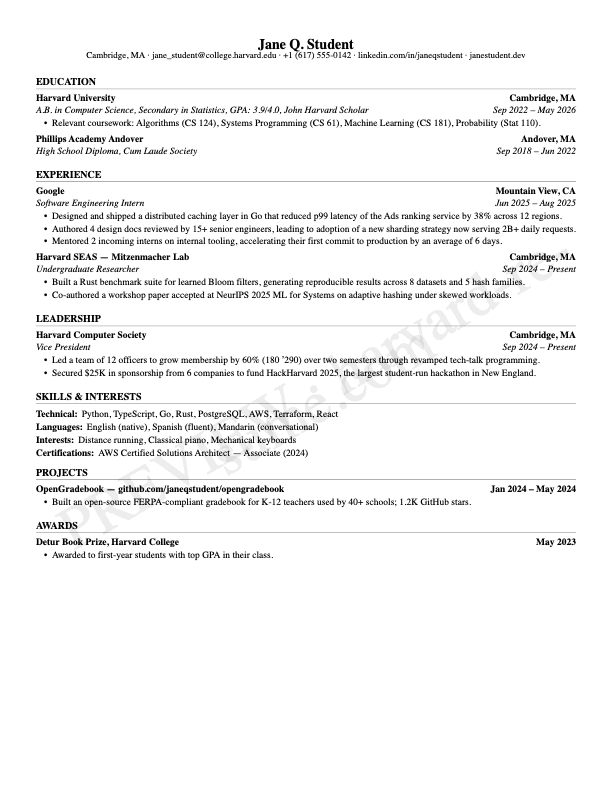
Sample in Harvard format
Strong vs weak bullets
Wrote blog posts to help grow website traffic.
Grew organic blog traffic from 18K to 43K monthly sessions (+139%) over 11 months by researching and publishing 60+ SEO pillar and cluster articles, optimizing each to a Surfer content score above 80.
Names the traffic delta, timeframe, volume of output, and the optimization tool with a concrete target score.
Created content that ranked well on Google.
Earned 14 page-1 Google rankings (4 in the top 3) for high-intent keywords by rebuilding underperforming posts with SERP-intent analysis and internal linking, lifting non-branded clicks 62% in Search Console.
Quantifies rankings by tier, ties them to a specific SEO tactic, and uses a real Search Console metric instead of a vague "ranked well."
Helped with the email newsletter and got more signups.
Lifted newsletter signup conversion from 1.9% to 3.4% on the blog by writing 25 mid-funnel guides with inline CTAs and A/B-testing lead-magnet copy, adding ~1,100 subscribers per quarter.
Shows a before/after conversion rate, the testing discipline, and the absolute subscriber gain — the metrics a content lead is judged on.
Managed publishing on the company blog and met deadlines.
Shipped 8 long-form articles per month at a 98% on-time rate across a 4-writer freelance pool, owning the WordPress editorial calendar and cutting average draft-to-publish time from 9 to 5 days.
Turns reliability into numbers — cadence, on-time rate, team size, and a cycle-time reduction — which proves operational trust, not just craft.
Mistakes specific to this role
- Listing adjectives ("creative, passionate storyteller") instead of outcomes — every line should carry a traffic, ranking, conversion, or velocity number.
- Hiding the portfolio link or burying it in the footer; editors evaluate writers by clips, so the URL belongs in the header next to your name.
- Claiming SEO impact with no tool or metric — "improved SEO" means nothing without keyword positions, Search Console clicks, or a content score.
- Overflowing to two pages with every guest post and freelance gig; curate to the pieces with measurable results and keep the Harvard one-page discipline.
- Inflating ownership of team content — recruiters ask which sentences were yours, so distinguish "contributed to" from pieces you researched and wrote end-to-end.
Your résumé starts here. Pay later.
Start composingFrequently asked
- Should a content writer's resume include a portfolio link or a separate portfolio?
- Both. Put one clean portfolio URL in the header (your site, Contently, or Clippings.me) and reference specific pieces with their results inside experience bullets. The resume earns the click; the portfolio closes the interview, so make the link impossible to miss.
- What metrics matter most on a content writer resume?
- Organic sessions and traffic growth, page-1 keyword rankings, and conversion or engagement lift (signups, demo requests, time-on-page) carry the most weight. Pair them with reliability metrics — pieces shipped per month and on-time rate — to prove you're both effective and dependable.
- How do I show SEO skills if I've mostly written, not run campaigns?
- Tie your writing to search outcomes: name the keywords you targeted, the content-scoring tool you hit (Surfer/Clearscope), and the Search Console clicks or rankings that followed. You don't need to own the strategy to prove your drafts ranked — show the before/after.
- Should I mention using AI tools like ChatGPT or Claude on my resume?
- Yes, framed as editorial control, not output volume. Position it as "edited and fact-checked AI-assisted drafts to brand voice" or a velocity gain you supervised. Employers want writers who can wield AI without sacrificing accuracy or voice — show judgment, not just speed.