Customer Success · 2026
Harvard Resume for Customer Success Managers
CS hiring runs on retention math. The Harvard format puts NRR, churn saved, and book size in the first 8 seconds.
How do I write a Customer Success Managers resume in the Harvard format?
Customer Success hiring at SaaS companies — Gainsight, HubSpot, Datadog, Snowflake, and high-growth Series B startups — is retention-math first. A VP of CS or RevOps recruiter scans the top third for three things: the size of book you carried (ARR + logo count), the net revenue retention you drove, and the platform you ran (Gainsight, Catalyst, Totango). The Harvard one-page format forces you to lead with those numbers instead of burying them under 'passionate about customers' filler.
What recruiters look for
- Book of business sized in ARR and logo count (e.g., '42 accounts, $6.8M ARR')
- Net revenue retention (NRR) and gross retention (GRR) you personally drove
- Churn reduction and expansion/upsell ARR with dollar figures
- CS platform fluency: Gainsight, Catalyst, Totango, ChurnZero, Vitally + Salesforce
- Segment owned (SMB / mid-market / enterprise / strategic) and renewal ownership
- Health-score, QBR, and onboarding-TTV systems you built or ran
Required sections, in this order
Header & book-of-business framing
- Optional one-line tagline under your name: e.g., 'Enterprise CSM · B2B SaaS · $8M book · 6 yrs'
- Lead each role's first line with segment + book size: 'CSM, Mid-Market — 38 accounts / $5.4M ARR'
- No photo, no DOB, no 'customer-obsessed' tagline — show it in the numbers
Experience bullets — retention-forward
- Open each role with the renewal/NRR outcome, then the playbook that produced it
- Pair a revenue metric (NRR, expansion ARR, churn $) with an operational one (TTV, adoption %, health-score coverage)
- Name the platform and the motion: 'ran QBRs in Gainsight', 'built churn-risk playbooks in Catalyst'
Skills & certifications section
- Platforms: Gainsight, Catalyst, Totango, ChurnZero, Vitally, Salesforce, Zendesk
- Certs that signal craft: Gainsight CSM/Admin (Level 1–2), SuccessHACKER CCSM, Pulse certifications
- Cut generic 'communication' and 'relationship-building' — every CSM claims those; show methods (EBRs, success plans, mutual action plans) instead
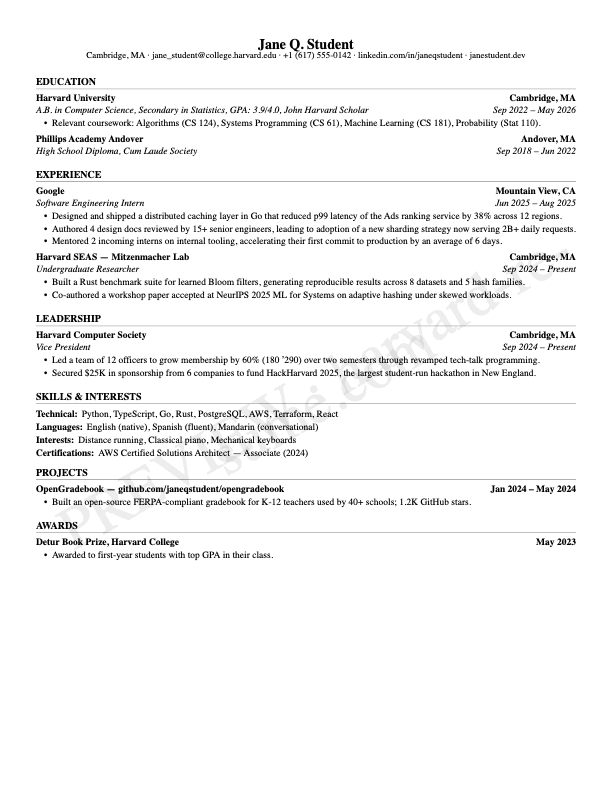
Sample in Harvard format
Strong vs weak bullets
Managed a portfolio of customers and reduced churn
Owned a 42-account mid-market book ($6.8M ARR); drove gross retention from 86% to 94% and net revenue retention to 118% over 4 quarters by rebuilding the onboarding-to-value playbook and instrumenting health scores in Gainsight across 100% of accounts
Names the book (42 accounts, $6.8M), the two retention metrics that matter (GRR 86→94, NRR 118%), the time frame, the mechanism (onboarding playbook + health scores), and the platform. A VP of CS reads full ownership in 4 seconds.
Worked on upsells and grew account revenue
Generated $1.4M in expansion ARR across 19 accounts in FY25 by running a usage-based account-scoring model that flagged seat-expansion and cross-sell triggers; partnered with AEs on 11 multi-year renewals at an average 22% uplift
Expansion is the highest-signal CS metric. Dollar figure ($1.4M), account count (19), the method (usage-based scoring), and the renewal uplift (22%) prove you move revenue, not just sentiment.
Improved customer onboarding to get users active faster
Cut median time-to-first-value from 47 to 21 days across 120+ new logos by redesigning a 5-milestone onboarding journey in Catalyst; lifted 90-day product adoption from 54% to 79% and reduced first-90-day churn by 38%
TTV is the leading indicator every CS org watches. Two adoption metrics (47→21 days, 54→79%) plus the downstream churn impact (-38%) and the platform make this concrete and defensible in interview.
Ran quarterly business reviews with key accounts
Ran 60+ executive QBRs per year across 14 strategic accounts ($4.2M ARR); standardized a value-realization EBR deck that tied product usage to customer ROI, contributing to a 96% logo-retention rate and 3 customer-reference wins for sales
QBR count + segment + ARR + the artifact you built (value-realization deck) + the retention outcome (96%) + a cross-functional win (3 references). It shows operating cadence, not just meeting attendance.
Mistakes specific to this role
- Leading with 'passionate, customer-obsessed relationship-builder' instead of book size and NRR. Recruiters trust numbers over adjectives.
- Listing churn 'reduced' or revenue 'increased' with no baseline. '94% GRR up from 86%' beats 'reduced churn significantly' every time.
- Confusing support metrics with CS metrics. CSAT and ticket-resolution time are support signals; NRR, GRR, expansion ARR, and TTV are what CS leaders hire on.
- Omitting the platform you ran. A VP of CS wants to know if you can be productive in Gainsight or Catalyst on day one — name it.
- Not stating your segment. A $200K SMB book and a $20M strategic book are different jobs; ambiguity reads as inflation.
Your résumé starts here. Pay later.
Start composingFrequently asked
- Should I list NRR even if my whole team's number was company-reported, not just mine?
- List the number you personally influenced and label it: 'drove book-level NRR to 118%'. If you only have the company-wide figure, scope it ('contributed to company NRR of 121% as one of 8 enterprise CSMs') so it reads as honest, not borrowed.
- Where do CS certifications like Gainsight CSM or CCSM go?
- A one-line Skills/Certifications entry near the bottom. Gainsight Admin (Level 2), SuccessHACKER CCSM, and Pulse certs are worth naming because they signal platform craft. Don't dedicate a full section unless you hold three or more.
- I came from support or account management — how do I frame the transition?
- Make your most recent CS-aligned bullets the strongest, since they're scanned first. Reframe prior roles around retention and expansion outcomes ('grew 12 accounts' rather than 'resolved tickets') so the through-line to revenue ownership is obvious.
- Can I name specific customers on my résumé?
- Name logos only if they're public references or marquee names that strengthen you and aren't under NDA. Otherwise generalize ('a Fortune 500 logistics customer', 'a $2M strategic enterprise account') and keep the economics specific.