Security · 2026
Harvard Resume for Cybersecurity Engineers
SOCs, cloud-security teams, and product-security orgs scan for incidents owned, MTTR cut, and CVEs killed — not a wall of acronyms.
How do I write a Cybersecurity Engineers resume in the Harvard format?
Security hiring is adversarial by instinct — managers at MSSPs, FAANG product-security teams, banks, and cloud-native startups read a résumé the way they read an alert: scanning for signal and discounting noise. In the first 8 seconds they look for certs that map to the level (OSCP vs Security+), the stack you've actually defended (SIEM, EDR, cloud), and incidents you owned end-to-end. The Harvard one-page format forces you to lead with detections built, MTTR cut, and risk reduced — not a 40-line tool dump that screams junior.
What recruiters look for
- Certs mapped to level: Security+ / CySA+ (entry), OSCP / GCIH / GCIA (mid), OSCE / GXPN / CISSP (senior)
- Named defensive stack: Splunk / Sentinel / Elastic SIEM, CrowdStrike / SentinelOne EDR, Wiz / Prisma Cloud CSPM
- Incident metrics: MTTD/MTTR reduced, alerts triaged, true-positive rate, P1s contained without breach
- Offensive proof: CVEs published, bug-bounty payouts/rank (HackerOne, Bugcrowd), CTF placements
- Cloud + IaC security: AWS/GCP/Azure hardening, Terraform/CloudFormation policy-as-code, CIS benchmark coverage
- Frameworks applied, not just listed: MITRE ATT&CK mapping, NIST CSF, SOC 2 / ISO 27001 / PCI-DSS evidence owned
Required sections, in this order
Header & specialization signal
- Add a one-line tagline under your name to declare the track: 'Detection & Response Engineer · Cloud-Native · 5 yrs' — security roles fragment hard (blue/red/AppSec/GRC/cloud) and recruiters filter on it
- Put GitHub under the contact line if you have public detections, Sigma rules, or tooling; a personal blog with real write-ups (not reposts) is strong offensive/research signal
- No photo, no DOB — and never list a current employer's internal tool names or undisclosed CVEs you're still under NDA on
Certifications section (place it high)
- For security, certs belong near the top — put them right after Education, italicized, with the year earned (recruiters check currency on CISSP/OSCP)
- List the level-appropriate ones only: a senior with OSCP + CISSP should drop Security+; piling 8 entry certs reads as junior padding
- Note in-progress certs honestly ('OSCP — exam scheduled Q3 2026'); recruiters reward the pursuit but discount fabricated ones they can verify
Experience bullets — defend with numbers
- Lead each bullet with what you built or contained, not the tool: 'Engineered 40 Sigma detections' beats 'Used Splunk'
- Quantify the security outcome: alerts reduced, MTTR cut, attack paths closed, audit findings remediated, false-positive rate dropped
- Map work to MITRE ATT&CK or a compliance control when relevant — it signals you think in frameworks a hiring manager respects
- Separate offensive (pentests, red-team ops, CVEs) from defensive (detections, IR, hardening) so reviewers can place your track instantly
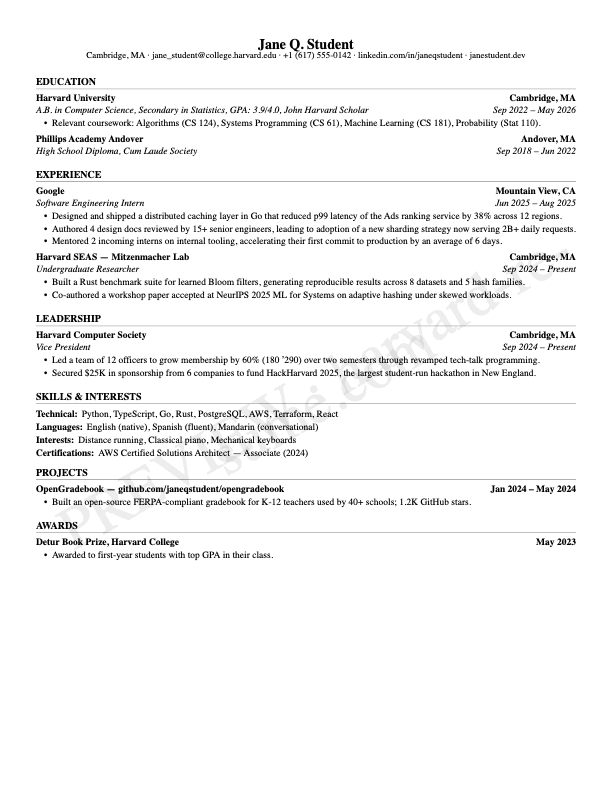
Sample in Harvard format
Strong vs weak bullets
Monitored security alerts and responded to incidents in the SOC
Engineered 38 detection rules in Splunk ES mapped to MITRE ATT&CK (T1059, T1003, T1486), cutting mean-time-to-detect from 42min to 9min and reducing false positives 61% across a 4,000-endpoint estate; contained 3 P1 ransomware attempts pre-encryption
Names the SIEM (Splunk ES), the framework (ATT&CK with real technique IDs), the metrics (MTTD 42→9min, FP -61%), the scale (4K endpoints), and the outcome (3 P1s contained pre-encryption). A SOC lead infers production detection-engineering in 4 seconds.
Performed penetration tests and found vulnerabilities for clients
Led 14 web-app and cloud penetration tests (OWASP Top 10, AWS IAM privilege-escalation) for fintech clients; discovered and responsibly disclosed CVE-2025-XXXXX (auth bypass, CVSS 9.1) affecting 200+ deployments; wrote remediation playbooks adopted across 3 client SOCs
Engagement count + scope (web + cloud, named methodology), a published CVE with CVSS and blast radius, and downstream impact (playbooks adopted). A red-team lead reads depth, not a generic 'found vulnerabilities'.
Helped move the company to the cloud securely and set up monitoring
Hardened a 12-account AWS Organization to CIS Benchmark Level 2 using Terraform policy-as-code and Wiz CSPM; closed 340 high-severity misconfigurations, enforced SCPs blocking public S3 + unencrypted EBS, and cut critical cloud findings 78% quarter-over-quarter
Cloud scope (12-account AWS Org), the standard (CIS L2), the tooling (Terraform IaC + Wiz), and quantified risk reduction (340 findings closed, -78% QoQ). A cloud-security manager infers real policy-as-code ownership.
Worked on compliance and helped pass the security audit
Owned SOC 2 Type II evidence collection across 64 controls; built automated control-monitoring in Vanta integrated with CloudTrail and GitHub, reducing manual evidence effort ~120 hours/quarter and achieving zero exceptions on first audit
Control count (64), the tooling (Vanta + CloudTrail + GitHub), quantified time saved (~120 hrs/quarter), and the result (zero exceptions, first try). GRC and engineering managers both read this as someone who automates compliance rather than firefighting it.
Mistakes specific to this role
- Dumping every tool you've ever opened into a 30-line skills wall. Security managers trust depth — list 8-12 tools you could be tested on live, grouped by function (SIEM, EDR, cloud, IaC).
- Listing acronym certs with no level logic — a CISSP next to five entry-level badges reads as padding. Show the highest, drop the obsolete.
- Vague 'monitored alerts' / 'responded to incidents' with zero metrics. Without MTTR, alert counts, or P1s contained, a security bullet is invisible.
- Claiming CVEs, bug-bounty rank, or CTF placements you can't back up — security hiring verifies HackerOne profiles, CVE attribution, and CTFtime rankings in minutes.
- Listing compliance frameworks (SOC 2, ISO 27001, PCI-DSS) without saying which controls you owned or what you automated — 'familiar with SOC 2' tells a reviewer nothing.
Your résumé starts here. Pay later.
Start composingFrequently asked
- Should I list CTF placements and bug-bounty earnings on a security résumé?
- Yes, if they're notable and verifiable. A top-100 HackerOne rank, a CTFtime team placement, or DEF CON CTF finals belong under Awards or Skills with the platform named. Below that, fold a one-liner into a project bullet rather than dedicating a section — recruiters will check CTFtime and HackerOne directly.
- How do I write bullets when my best work is classified, under NDA, or covers active CVEs?
- Generalize the context, keep the impact concrete: 'Detected and contained a targeted intrusion against a financial-services environment, reducing dwell time to <24h.' For embargoed CVEs, list 'CVE pending coordinated disclosure (CVSS 8.x, auth-bypass class)' without the vendor. Security hiring managers know and respect the convention.
- Which certifications actually move the needle, and where do they go on the page?
- Map to your target: OSCP/OSCE for offensive and pentest roles, GCIH/GCIA/GCFA for blue-team and DFIR, CISSP/CCSP for senior and architecture, and cloud-specific (AWS Security Specialty, GCP PCSE) for cloud-security roles. Put them in a Certifications block right after Education, with the year — recency matters because several require CPE renewal.
- Is one page realistic for a security engineer with offensive and defensive experience?
- Yes, and it's expected up to senior level. Pick your track, lead with the strongest 2-3 roles, and cut the tool wall to what's relevant. Only principal/architect candidates or those with a long publication and CVE record justify a second page — and even then the Harvard one-pager is the front page hiring managers scan first.