Data · 2026
Harvard Resume for Data Analysts
From entry-level to senior analyst — what data, product, and analytics-engineering teams actually scan for in 8 seconds.
How do I write a Data Analysts resume in the Harvard format?
Data analyst hiring is run by analytics managers, data leads, and product teams at companies like Spotify, Airbnb, Stripe, banks, and e-commerce scale-ups. In the first scan they look for three things: SQL depth, the BI tool you live in (Tableau, Looker, Power BI), and whether your dashboards changed a decision. The Harvard one-page format forces you to lead with quantified business impact instead of a list of tools — which is exactly how a hiring manager separates a report-builder from an analyst who moves the number.
What recruiters look for
- SQL fluency stated concretely (window functions, CTEs, query optimization) — not just "proficient in SQL"
- Primary BI tool named with depth (Tableau, Looker/LookML, Power BI, Metabase) plus dashboards adopted by real teams
- A/B test and experiment literacy: reading significance, segmenting, surfacing confounders (analysts read tests, not necessarily build models)
- Business outcomes tied to your analysis: revenue moved, churn reduced, hours saved, decisions changed
- Data stack signals: dbt, Snowflake/BigQuery/Redshift, Airflow, Git — shows you work in a modern warehouse, not just spreadsheets
- Stakeholder reach: how many teams or executives consumed your reporting, and what they decided because of it
Required sections, in this order
Skills section — lead with the stack, grouped
- Group by category: Languages (SQL, Python, R) · BI (Tableau, Looker, Power BI) · Warehouse (Snowflake, BigQuery, dbt) · Stats (A/B testing, regression, cohort analysis)
- List depth, not breadth: 'SQL (window functions, query tuning)' beats 'SQL, MySQL, PostgreSQL, MS SQL' listed flat
- Analysts may place Skills above Experience for entry-level; mid-level and senior keep Experience first
- Cut Excel/Google Sheets from a headline skill — it's assumed; mention it only inside a bullet if the work was advanced (pivot/VBA/Apps Script automation)
Experience bullets — decision over deliverable
- Lead each bullet with the decision or metric you influenced, not the dashboard you built
- Name the tool and the data scale: rows queried, daily active users analyzed, $ of GMV the report covered
- Pair the analysis with the action it triggered (a price change, a churn intervention, a budget reallocation)
- Include one bullet per role showing self-serve impact: a dashboard or data model others now use without you
Education & Projects — where to prove rigor
- Education first; list quantitative coursework only if a recent grad (Statistics, Econometrics, Experiment Design, Data Structures)
- Add a Projects section for career-switchers and juniors: 2-3 end-to-end analyses with a link (GitHub, a public dashboard, a Kaggle notebook)
- Each project: the question, the dataset size, the method, and the insight — not just 'analyzed a dataset'
- Certifications (Google Data Analytics, Tableau Desktop Specialist, dbt Analytics Engineering) go as a one-line Skills entry, not their own section unless you hold 3+
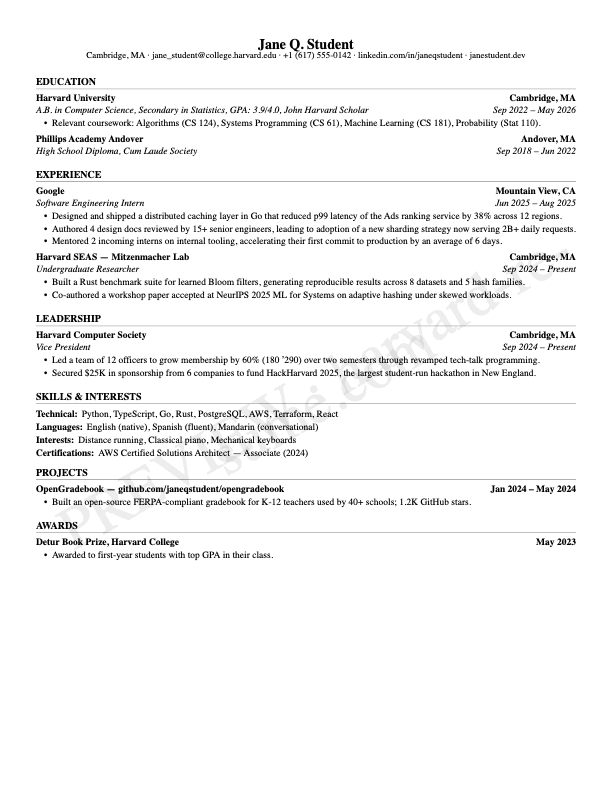
Sample in Harvard format
Strong vs weak bullets
Built dashboards in Tableau to track key business metrics
Built a self-serve Tableau dashboard on 40M+ order rows (Snowflake) tracking retention, AOV, and cohort LTV; adopted by 6 marketing and finance teams, replacing 4 weekly manual reports and cutting reporting turnaround from 3 days to under 1 hour
Names the tool, the data scale (40M rows), the warehouse (Snowflake), the metrics, the adoption (6 teams), and the time saved. A hiring manager infers you build production analytics that teams actually rely on — not one-off charts.
Analyzed customer churn and shared findings with the team
Ran cohort and survival analysis (SQL + Python) on 220K subscribers to isolate the top 3 churn drivers; surfaced that annual-plan users churning at month 11 cost $1.4M/yr, which drove a renewal-reminder campaign that lifted retention 6.2 points in two quarters
Specific method (cohort + survival), data scale (220K), a quantified problem ($1.4M/yr), and the concrete intervention plus result (+6.2 pts). It shows analysis that changed a decision, not a slide that got filed away.
Helped run A/B tests for the product team
Designed and read 18 A/B tests for the checkout funnel; flagged a sample-ratio mismatch invalidating an early 'winning' variant, then segmented results to find the real +8.4% conversion lift held only for returning users — preventing a costly full rollout and shaping a returning-user-only launch
Test volume (18), real experimentation rigor (caught an SRM, segmented for confounders), and a business save. Reading tests correctly is what separates a senior analyst from someone who just reports the p-value.
Created reports to support business decisions
Modeled the marketing funnel in dbt (12 staging + 4 mart models) feeding a Looker explore used in weekly exec reviews; the attribution view reallocated $300K of quarterly spend away from a channel shown to have 70% lower ROAS than reported
Analytics-engineering depth (dbt model counts), the BI surface (Looker explore for execs), and a dollar-quantified reallocation. Shows you work in the warehouse and your work reaches the executive table.
Mistakes specific to this role
- Listing every tool you've opened once (Tableau, Power BI, Qlik, Looker, Excel, SPSS, SAS). Recruiters trust depth — 1-2 BI tools you can be screen-shared and tested on beats a wall of logos.
- Bullets that end at the dashboard. 'Built a dashboard' is a deliverable; 'the dashboard drove a $300K reallocation' is an analyst. Always carry the bullet through to the decision.
- Claiming 'SQL' with no signal of depth. Add the proof in parentheses (window functions, query optimization, CTEs) or inside a bullet — interviewers will test it.
- Confusing yourself with a data scientist. Don't pad with 'machine learning' or 'deep learning' you don't use daily; analysts win on SQL, experimentation literacy, and stakeholder impact.
- Vanity metrics with no business tie. 'Dashboard had 500 views' means nothing; 'used by finance to set the quarterly forecast' means everything.
Your résumé starts here. Pay later.
Start composingFrequently asked
- Should I list SQL, Python, and R, or just SQL?
- SQL is non-negotiable and goes first with a depth cue (window functions, query tuning). List Python if you actually use pandas/analysis or automation — and back it with a bullet. List R only if you genuinely use it (most analyst roles don't); listing both Python and R without evidence reads as padding.
- How do I show impact when I 'just build dashboards'?
- Trace the dashboard to a decision. Who used it, how often, and what changed because of it — a budget shifted, a churn campaign launched, a manual report retired. The number you saved (hours, dollars, days of turnaround) is the impact; the dashboard is only the mechanism.
- Are certifications like Google Data Analytics or Tableau worth listing?
- For entry-level and career-switchers, yes — they signal you've built the baseline (Google Data Analytics, Tableau Desktop Specialist, dbt Analytics Engineering). Put them as a one-line entry under Skills. For mid-level and senior analysts, real experience outweighs them; keep them to a single line and never give them their own section unless you hold three or more.
- Data analyst vs data scientist — should my résumé look different?
- Yes. An analyst résumé leads with SQL depth, BI tools, experiment reading, and stakeholder-facing impact. A data scientist résumé leads with modeling and ML. Don't borrow the DS framing to look more advanced — analytics managers screen for the analyst skill set, and mismatched signals get you routed to the wrong loop or rejected.