Data & Infrastructure · 2026
Harvard Resume for Database Administrators
Your resume is a query plan: surface measurable uptime, recovery, and performance — not a list of database versions.
How do I write a Database Administrators resume in the Harvard format?
Database Administrators are hired by platform, data, and SRE teams who scan a resume first for blast radius and reliability: uptime nines, RPO/RTO on the recovery side, replication lag, and how much query latency or storage cost you cut. The Harvard one-page format forces you past a wall of engine logos (Oracle, PostgreSQL, SQL Server, MySQL) into concrete outcomes — faster queries, recoverable backups, zero-downtime migrations — measured in milliseconds, nines, and dollars. Lead with quantified reliability and tuning work, keep education and certifications tight, and make every bullet read like a tuned execution plan.
What recruiters look for
- Quantified availability: uptime nines (99.99%), failover time, replication lag held under target (e.g. < 1s), and RPO/RTO actually tested in DR drills
- Performance tuning depth: p95/p99 query latency cut, index strategy, partitioning, execution-plan and wait-stats analysis (not just "optimized queries")
- Backup and recovery rigor: backup strategy, point-in-time recovery (PITR), tested restores, and recovery time hit during a real incident
- Real migration scope: version upgrades, cloud lift-and-shift (RDS/Aurora/Cloud SQL/Azure SQL), schema changes at scale, with downtime and data-volume figures
- HA/DR architecture named explicitly: Always On AGs, Oracle Data Guard/RAC, PostgreSQL streaming replication, Patroni, read replicas, sharding
- Role-enabling certifications: Oracle OCP, Microsoft Azure Database Administrator Associate (DP-300), AWS Database Specialty, MongoDB DBA, PostgreSQL certifications
Required sections, in this order
Lead with reliability and performance, not an engine list
- Put a compact Experience section right after Education; open each bullet with the reliability or performance result (uptime, p99 latency, RPO/RTO, $ saved), not the engine name
- Cap a 'Technical Skills' block at the foot — group by Engines / HA-DR / Cloud / Tooling so the ATS matches without a 30-item soup
- State data scale inside the bullet, not on a skills line: '12 TB OLTP cluster, 40K transactions/sec peak' shows the reviewer your blast radius instantly
- Cut hobby tools and 'familiar with' entries — list only engines you would be paged at 3am to fix and could be grilled on in an interview
Make Education and certifications play Harvard-style
- Education first, one line each: degree, institution, graduation year — no GPA unless it is high and you graduated recently
- Place current, in-demand certs (OCP, DP-300, AWS Database Specialty) right under Education, with the issuing body and year
- Drop expired or deprecated certs; an Oracle 11g OCP or a SQL Server 2008 MCITP signals stale ops, not depth
- If you are self-taught or career-switching, lead with databases you ran in production and recovery wins — Harvard format rewards outcomes over pedigree
One page, ATS-clean, plain-text discipline
- No photo, no date of birth, no skill bars or charts — query optimizers don't have progress bars and neither does your resume
- Single column, standard fonts, no tables or text boxes — many ATS parsers shred two-column infra resumes into garbage
- Spell out the tool and its acronym once: 'High Availability (HA) with Always On Availability Groups' so both variants match
- Reverse-chronological order, action-verb bullets (Tuned, Migrated, Automated, Recovered) — every line earns its place or gets cut
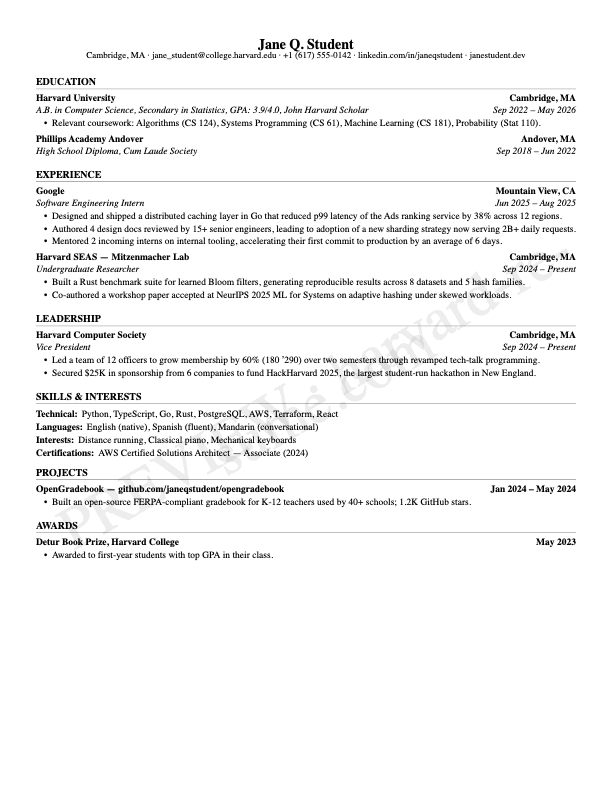
Sample in Harvard format
Strong vs weak bullets
Optimized slow queries and improved database performance.
Cut p99 query latency from 1.8s to 240ms on a 12 TB SQL Server OLTP cluster by redesigning the indexing strategy, eliminating 14 missing-index scans, and rewriting 6 hot stored procedures — sustaining 40K transactions/sec at peak with no schema downtime.
Names the engine, the data scale (12 TB), the before/after metric (p99 latency), the exact levers (indexing, stored procs), and throughput. The reviewer infers production-grade tuning in seconds.
Responsible for database backups and disaster recovery.
Rebuilt the backup and DR strategy across 30 PostgreSQL instances, implementing WAL-based point-in-time recovery and quarterly restore drills that cut RTO from 6 hours to 22 minutes and proved RPO < 5 minutes — recovering a corrupted 4 TB database during a real Sev-1 with zero data loss.
Turns a vague duty into tested RPO/RTO numbers, the exact mechanism (WAL PITR), the cadence (quarterly drills), and a real incident outcome (zero data loss). This is recovery rigor, not a checkbox.
Helped migrate databases to the cloud.
Led a near-zero-downtime migration of 18 production databases (9 TB) from on-prem Oracle to AWS Aurora PostgreSQL using DMS and logical replication, cutting licensing and infrastructure cost 41% (USD 380K/year) and holding cutover downtime to 90 seconds via a read-replica traffic switch.
Migration scope (18 DBs, 9 TB), the tooling (DMS, logical replication), the dollar outcome, and the safety mechanism (90-second cutover, replica switch). Production-grade migration discipline in one line.
Set up replication and high availability for the database.
Architected a multi-region HA topology with SQL Server Always On Availability Groups across 3 data centers, holding replication lag under 800ms and automating failover that brought uptime from 99.9% to 99.99% — reducing planned-maintenance downtime to zero through rolling secondary patching.
Names the HA tech (Always On AGs), the topology scale (3 data centers), the lag target, the uptime nines before/after, and the operational win (zero-downtime patching). Reads like an availability postmortem with a happy ending.
Mistakes specific to this role
- Listing every engine and version you ever touched as a flat keyword wall. Recruiters trust depth over breadth — group 4-6 categories and list only databases you could be grilled on.
- Describing duties instead of results ('responsible for backups'). Every bullet needs a number: uptime nines, p99 latency, RTO minutes, replication lag, or dollars saved.
- Hiding data and traffic scale. 'Managed databases' says nothing; '12 TB OLTP cluster, 40K TPS peak, 30 instances' shows the reviewer your real blast radius.
- Keeping expired or deprecated certs (Oracle 11g OCP, SQL Server 2008 MCITP). They signal you stopped learning — drop them and surface current role-enabling ones.
- Spilling onto two pages with junior task detail. Harvard discipline is one page — if a bullet has no metric or scale, it is filler; cut it.
Your résumé starts here. Pay later.
Start composingFrequently asked
- Should I list every database engine I've worked with, or just my strongest?
- Just your strongest. A flat wall of 20 engines and versions reads as shallow and clutters ATS matching. Group 4-6 categories (Relational, NoSQL, Cloud-managed, HA/DR, Tooling) and list only engines you could defend in a query-tuning or recovery interview. Depth wins: an Oracle/PostgreSQL/SQL Server stack you genuinely own beats a logo soup.
- How do I quantify DBA work when I don't 'ship features'?
- Your metrics are reliability and performance, not features. Quantify uptime (nines), RTO/RPO (minutes), replication lag (ms), p95/p99 query latency cut, backup-restore success rate, storage or licensing cost reduced ($ and %), and transactions/sec at peak. These are exactly what platform, data, and SRE hiring managers scan for first.
- Do I need certifications like Oracle OCP or Azure DP-300?
- Not mandatory, but they enable many roles and ATS filters — OCP for Oracle shops, DP-300 (Azure Database Administrator Associate) for Microsoft stacks, AWS Database Specialty for cloud-heavy teams. Place current certs under Education with issuer and year. Drop expired or deprecated ones; a lapsed cert signals stale skills, not credibility.
- How do I show cloud DBA experience versus traditional on-prem DBA?
- Name the managed service explicitly (RDS, Aurora, Cloud SQL, Azure SQL Database) and quantify what changed: cost cut by moving off licensed engines, downtime during migration, automated failover, or storage scaled on demand. Cloud DBAs are judged on cost engineering and migration discipline as much as tuning, so make those outcomes visible alongside any on-prem HA/DR work.