Healthcare · 2026
Harvard Resume for Dentists
Dental recruiters and group-practice owners scan for chair-side production, procedure mix, and license status before anything else. The Harvard format makes those signals impossible to miss.
How do I write a Dentists resume in the Harvard format?
Hiring DSOs, private practices, and academic clinics read a dentist's resume as evidence of clinical productivity and a clean license, not just a degree. They want to know your procedure mix, your monthly production, your chair time efficiency, and whether your credentials clear their malpractice carrier on day one. This guide adapts the one-page Harvard format for associate, owner, and specialist applications — and for hospital GPR/AEGD and residency CVs where research and case logs matter more.
What recruiters look for
- DDS or DMD with dental school and graduation year, plus active state license number and DEA registration
- NBDE Parts I/II or INBDE passed, and regional board (ADEX/WREB/CDCA) results
- Procedure mix and proficiency: endo (molar RCT), oral surgery (surgical extractions, implant placement), fixed/removable pros, clear aligners, same-day CEREC crowns
- Monthly or annual production and collections, often $60K-$120K+/month for a busy associate
- Software and tech fluency: Dentrix, Eaglesoft, Open Dental, CBCT (cone-beam), digital scanners (iTero, Primescan), CAD/CAM
- Current BLS/ACLS, malpractice history clean, and CE hours logged (most states require 20-40 per cycle)
Required sections, in this order
Section ordering and credentials
- Education first: DDS/DMD, dental school, year; add class rank or honors (OKU - Omicron Kappa Upsilon) only if strong
- Licensure & Certifications as its own block: active state license(s), DEA, NPI, board exams (INBDE), BLS/ACLS, conscious sedation permit if held
- Clinical Experience next, with practice type (FFS, PPO, DSO, FQHC) and patient volume per day
- Keep it to one page for associates; two pages acceptable only for specialists with publications
Quantifying clinical work
- Lead every bullet with a procedure and a number: cases completed, production generated, or chair-time saved
- State daily patient volume and your case acceptance or treatment-plan acceptance rate
- Name the specific systems and materials (e.g. ProTaper Gold files, 3M Filtek, Invisalign, Straumann/Nobel implants) so it reads as real chairside work
- Include redo/remake rates or clinical outcomes if you tracked them - low remake rates are a strong quality signal
What to cut
- Drop generic phrases like 'provided excellent patient care' - every dentist claims this
- Omit unrelated pre-dental jobs unless they show patient or business skills you still use
- No 'references available on request' line - it wastes a page on a one-page document
- Skip a skills list of basic operative procedures every dentist can do; highlight only differentiators (implants, sedation, molar endo)
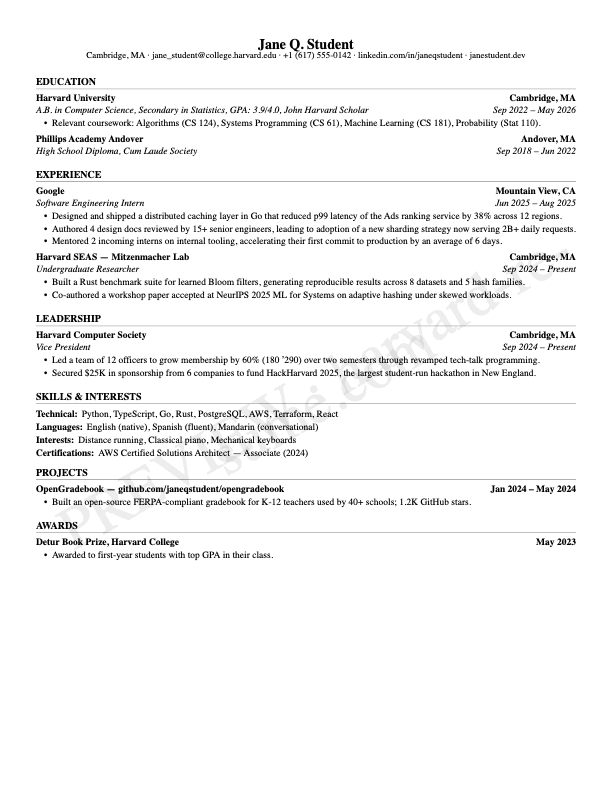
Sample in Harvard format
Strong vs weak bullets
Performed root canals and other procedures on patients
Completed 340+ endodontic cases over 18 months, including 90 molar RCTs using ProTaper Gold rotary and apex locators, achieving a 96% retention rate at 12-month recall with zero retreatments referred out
Names the procedure type, case count, the rotary system, and a measurable outcome (retention rate, zero retreatments) that signals clinical quality.
Helped grow the practice and saw a lot of patients
Generated $1.12M in annual production (collections 98%) seeing 22-26 patients/day across a 4-op PPO practice, growing personal production 31% YoY by adding same-day CEREC crowns and clear-aligner cases
Quantifies production, collections rate, daily volume, and the specific service lines that drove growth - exactly what a DSO or owner evaluates.
Placed dental implants and did surgery
Placed 140 Straumann and Nobel Biocare implants over 2 years guided by CBCT-planned surgical guides (coDiagnostiX), with a 98.5% osseointegration rate and full digital workflow from Primescan scan to delivery
Specifies implant systems, planning software, case volume, success metric, and the end-to-end digital workflow - reads as a surgically confident clinician.
Used dental software and kept good records
Standardized charting and recall in Dentrix for a 3-doctor practice, building a hygiene-recall protocol that lifted reappointment rate from 61% to 84% and recovered ~$140K/year in lapsed-recall production
Turns a routine software claim into a business outcome with a named system, a before/after metric, and dollar impact.
Mistakes specific to this role
- Listing procedures with no volume or outcomes - 'performed extractions' tells a recruiter nothing about whether you can run a column.
- Burying license status and DEA number. Hiring managers need to confirm you can practice in their state immediately.
- Omitting production and collections numbers for associate/DSO roles - this is the single most-read figure on the page.
- Writing two pages as a general associate. The Harvard discipline is one page; specialists with research are the only exception.
- Vague tech claims ('proficient in dental software') instead of naming Dentrix/Open Dental, your scanner, and CBCT experience.
Your résumé starts here. Pay later.
Start composingFrequently asked
- Should I put my production numbers on a dentist resume?
- Yes, for associate and DSO roles it is the most important figure. State monthly or annual production and your collections percentage. If your practice was fee-for-service vs heavy PPO, note it, since production reads differently across payer mixes.
- Do I list every state where I'm licensed?
- List active licenses with the state and that they are current; you don't need numbers on the resume itself (provide on the credentialing packet). If you're applying out of state, mention license-by-credential or board eligibility so they know your timeline to practice.
- How do I handle a resume as a new dental graduate with no production history?
- Lead with case logs from clinic and any externships: number of crowns, RCTs, extractions, and implants you completed, plus your INBDE pass and board (ADEX/WREB) results. Quantify clinic volume even if it was a school setting.
- Should specialists (ortho, endo, OMFS) use the same one-page format?
- Associates and generalists: one page. Specialists, academic, or hospital applicants can run two pages to fit residency, publications, and case volumes - but lead with the same procedure-and-number bullet discipline.