Software & Infrastructure · 2026
Harvard Resume for DevOps Engineers
Your résumé is a deploy: ship measurable reliability, not a tool checklist.
How do I write a DevOps Engineers resume in the Harvard format?
DevOps Engineers are hired by platform teams, SREs, and infra-heavy product orgs who scan your résumé for blast radius and reliability before anything else: deploy frequency, MTTR, uptime, and how much cloud spend you clawed back. The Harvard one-page format forces you past a wall of tool logos into outcomes — fewer incidents, faster pipelines, cheaper infra — measured in nines, minutes, and dollars. Lead with quantified reliability work, keep education and certs tight, and let every bullet read like a postmortem with a happy ending.
What recruiters look for
- Quantified reliability: uptime nines (99.95%), MTTR cut (45min → 8min), incident count reduced, deploy frequency (weekly → 30x/day)
- Real IaC and orchestration depth: Terraform, Kubernetes, Helm, ArgoCD, Ansible — with cluster scale (nodes, pods, regions) not just logos
- Cloud cost engineering: $ saved via rightsizing, spot/Savings Plans, autoscaling (e.g. cut AWS bill 38%, $420K/yr)
- CI/CD pipeline outcomes: build time reduced, deploy lead time, rollback automation, % test coverage gating releases
- Observability stack ownership: Prometheus/Grafana, Datadog, OpenTelemetry, SLO/SLI definitions, alert noise reduced
- Certifications that gate the role: CKA/CKAD, AWS Solutions Architect / DevOps Engineer Professional, Terraform Associate, GCP/Azure equivalents
Required sections, in this order
Lead with Reliability & Scale, Not a Tool Wall
- Put a tight Experience section first after Education; open each role's bullets with the reliability or cost outcome (MTTR, uptime, $ saved), not the technology
- Cap a 'Technical Skills' block at the bottom — group by Cloud / IaC / Orchestration / CI-CD / Observability so an ATS keyword-matches without a 30-item soup
- State infra scale in the bullet, not a skills line: '40-node EKS cluster, 1,200 pods, 3 regions' tells a reviewer your blast radius instantly
- Cut hobby projects and 'familiar with' tools — list only what you can be paged at 3am to fix and tested on in an interview
Make Education & Certs Work Harvard-Style
- Education first, one line each: degree, institution, graduation year — no GPA unless above 3.5 and you graduated recently
- Put active, in-demand certs (CKA, AWS DevOps Pro, Terraform Associate) directly under Education with the issuing body and year earned
- Drop expired or deprecated certs; a lapsed CKA or a Cisco cert from 2014 signals stale ops, not depth
- If self-taught or bootcamp, lead with shipped systems and certs — the Harvard format rewards outcomes over pedigree
One Page, ATS-Clean, Plain-Text Discipline
- No photo, no DOB, no graphics or skill bars — Kubernetes operators don't have progress bars and neither should your résumé
- Single column, standard fonts, no tables or text boxes — many ATS parsers shred multi-column infra résumés into garbage
- Spell the tool then the acronym once: 'Infrastructure as Code (IaC) with Terraform' so both keyword variants match
- Reverse-chronological, action-verb bullets (Re-architected, Automated, Migrated) — every line earns its place or it gets cut
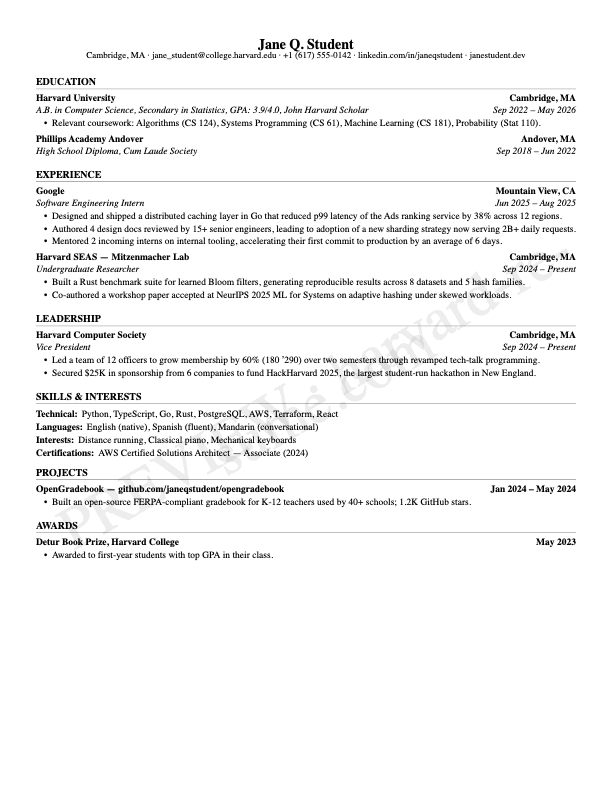
Sample in Harvard format
Strong vs weak bullets
Responsible for CI/CD pipelines and deployments using Jenkins.
Rebuilt the CI/CD pipeline from Jenkins to GitHub Actions with parallelized test stages, cutting median build time from 22min to 6min and lifting deploy frequency from weekly to 30+ deploys/day across 14 services.
Names the migration, the metric (build time and deploy frequency), and the scale (14 services). A reviewer reads 'this person owns the delivery pipeline end-to-end' in seconds.
Helped reduce AWS costs for the team.
Cut the AWS bill 38% ($420K/year) by rightsizing 60 over-provisioned EC2 instances, moving stateless workloads to Spot, and committing to Savings Plans — with a Terraform-enforced tagging policy to keep spend attributable.
Dollars and percent, the specific levers (Spot, Savings Plans, rightsizing), and the guardrail (tagging policy). This is FinOps maturity, not a vague 'helped'.
Improved system reliability and monitoring.
Drove production uptime from 99.5% to 99.97% by defining SLOs in Prometheus, automating rollbacks via Argo Rollouts, and cutting alert noise 70% — reducing MTTR on Sev-1 incidents from 45min to 8min.
Uptime nines, MTTR before/after, and the exact tooling (Prometheus, Argo Rollouts). It reads like a reliability postmortem and proves on-call competence.
Migrated infrastructure to Kubernetes.
Migrated 28 monolith-adjacent services to a 40-node EKS cluster with Helm and ArgoCD GitOps, achieving zero-downtime cutover behind a traffic-shifting Ingress and cutting per-service provisioning time from 3 days to 20 minutes.
Cluster scale (40 nodes), the GitOps stack (Helm, ArgoCD), the safety mechanism (zero-downtime, traffic-shifting), and a provisioning-speed metric. Production-grade migration discipline in one line.
Mistakes specific to this role
- Listing 30+ tools as a flat keyword wall. Recruiters trust depth over breadth — group 4-6 categories and only list tools you can be paged on and tested on.
- Describing duties instead of outcomes ('responsible for monitoring'). Every bullet needs a number: nines of uptime, minutes of MTTR, dollars saved, or deploys per day.
- Hiding the infra scale. 'Managed Kubernetes' is meaningless; '40-node EKS, 1,200 pods, 3 regions' tells the reviewer your actual blast radius.
- Keeping stale or deprecated certs (lapsed CKA, 2014 Cisco). They signal you stopped learning — drop them and surface current, role-gating certs.
- Going two pages with junior detail or hobby projects. Harvard discipline is one page — if a bullet has no metric and no scale, it's filler, cut it.
Your résumé starts here. Pay later.
Start composingFrequently asked
- Should I list every cloud and tool I've touched, or just my strongest?
- Just your strongest. A flat wall of 30 tools reads as shallow and clutters ATS matching. Group 4-6 categories (Cloud, IaC, Orchestration, CI/CD, Observability) and list only tools you can defend in a system-design or troubleshooting interview. Depth beats breadth — one Terraform/Kubernetes/AWS stack you genuinely own outperforms a logo soup.
- How do I quantify DevOps work when I don't 'ship features'?
- Your metrics are reliability and velocity, not features. Quantify uptime (nines), MTTR (minutes), deploy frequency (per day/week), change-failure rate, build/pipeline time saved, and cloud cost cut ($ and %). These DORA-style metrics are exactly what platform and SRE hiring managers scan for first.
- Do I need certifications like CKA or AWS DevOps Professional?
- They're not mandatory but they gate a lot of roles and ATS filters, especially CKA/CKAD for Kubernetes shops and AWS DevOps Engineer Professional for AWS-heavy infra teams. Put current certs under Education with issuer and year. Drop lapsed or deprecated ones — an expired cert signals stale skills, not credibility.
- Can a DevOps résumé really fit on one page with all the infra detail?
- Yes, and it should. The Harvard one-page rule forces you to cut duties and tool soup down to quantified outcomes. Use scale-in-the-bullet ('40-node EKS cluster') instead of a separate paragraph, cap skills at a grouped footer, and let metrics do the talking. Reviewers spend ~7 seconds — one dense, outcome-driven page beats two pages of filler.