Marketing · 2026
Harvard Resume for Digital Marketing Specialists
Marketing résumés drown in buzzwords. The Harvard format forces CAC, ROAS, and pipeline onto one page recruiters trust.
How do I write a Digital Marketing Specialists resume in the Harvard format?
Digital marketing hiring is metrics-first and buzzword-fatigued. Recruiters at agencies, SaaS scale-ups, and DTC brands scan for one thing in the first 8 seconds: did you move a number — ROAS, CAC, MQLs, organic traffic — and can you prove the channel you owned. The Harvard format works because it kills the adjective soup ('passionate, results-driven, dynamic') and forces every line to carry a platform, a metric, and a result.
What recruiters look for
- Channel ownership named explicitly — paid social (Meta Ads), paid search (Google Ads), SEO, lifecycle/email, or full-funnel — not vague 'digital channels'
- Spend managed and efficiency: monthly/annual budget, ROAS or MER, and CAC payback in months
- Platform-level tooling: GA4, Google Ads, Meta Ads Manager, HubSpot/Marketo, Klaviyo, Ahrefs/Semrush, Looker Studio
- Certifications that still carry weight: Google Ads Search/Measurement, GA4 (Skillshop), Meta Blueprint, HubSpot Inbound/Email
- Attribution literacy — UTM discipline, MMM vs last-click, post-iOS14 conversion API / server-side tracking
- Quantified outcomes tied to revenue or pipeline (MQL→SQL rate, CPL, organic sessions, email-driven revenue), not vanity reach
Required sections, in this order
Header & channel framing
- Add a one-line tagline under your name: e.g., 'Growth Marketer · Paid Social + Lifecycle · B2B SaaS · 5 yrs'
- Link a portfolio only if it shows real campaigns or a Looker Studio dashboard — never a 404 or template
- No photo, DOB, or 'references available on request'; use that space for a metric
Experience bullets
- Lead each role with the channel and the budget you owned ('$1.2M/yr paid social')
- Every bullet: platform + spend or audience size + the efficiency metric (ROAS, CAC, CPL) + the result
- Include one bullet on a test you ran — a creative, audience, or landing-page A/B test with the lift and the decision
Skills & certifications
- Group: Channels · Platforms/Tools · Analytics · Certifications — 6–10 items each, not 25
- List GA4, the ad platforms, your CRM/ESP (HubSpot, Klaviyo, Marketo), and SEO tools (Ahrefs, Semrush) by name
- Put certs on one line; skip generic 'social media management' and 'digital marketing strategy'
Sample in Harvard format
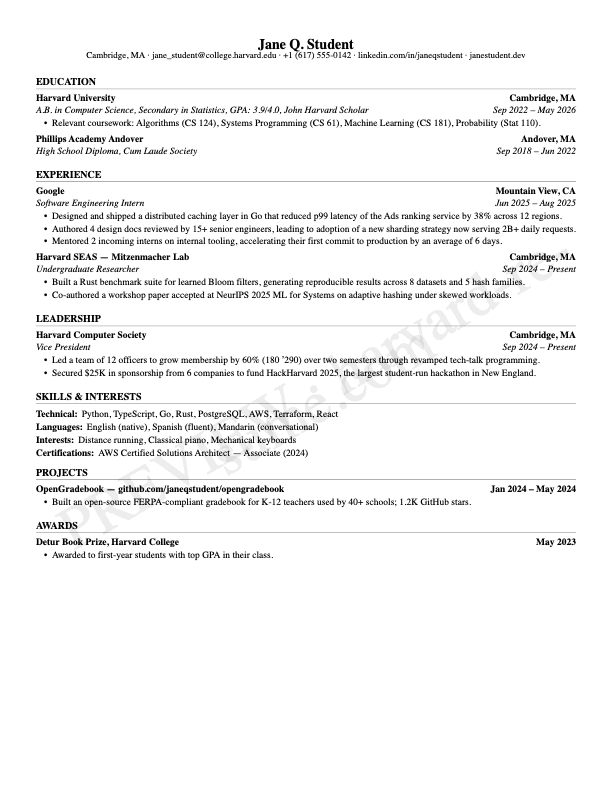
Strong vs weak bullets
Managed paid social campaigns and improved results
Scaled Meta and TikTok Ads spend from $80K to $420K/month while improving blended ROAS from 2.1x to 3.4x, by restructuring campaigns to Advantage+ and shipping a UGC creative testing pipeline of 30+ variants/month
Names the platforms (Meta, TikTok), the spend scale ($80K→$420K), the efficiency metric (ROAS 2.1x→3.4x), and the lever (Advantage+ restructure + UGC testing). A reviewer infers real budget ownership in 4 seconds.
Ran email campaigns that engaged our customers
Rebuilt the Klaviyo lifecycle program (welcome, abandoned-cart, win-back flows) for a 180K-subscriber DTC list, lifting email-attributed revenue from 18% to 31% of total and cutting unsubscribe rate by 40%
Specific ESP (Klaviyo), the flows owned, list size (180K), and two metrics that matter to a DTC hiring manager — revenue share and deliverability health.
Worked on SEO and grew website traffic
Led an SEO content program of 60 articles targeting bottom-funnel keywords, growing non-branded organic sessions from 22K to 95K/month in 9 months and sourcing $1.1M in pipeline tracked via GA4 + HubSpot
Names the program scope (60 articles, BoFu intent), the metric (non-branded organic 22K→95K), the timeframe, and the revenue tie-in with the attribution stack.
Improved our lead generation and conversion rates
Cut blended CPL from $74 to $41 across Google and LinkedIn Ads by killing 12 underperforming ad groups and rebuilding landing pages, while raising MQL→SQL conversion from 14% to 23% over two quarters
Funnel-level fluency: CPL down ($74→$41), the channels, the specific action (killed 12 ad groups), and the downstream quality metric (MQL→SQL), which is what separates a spender from a growth marketer.
Mistakes specific to this role
- Listing reach/impressions as your headline metric. Recruiters discount vanity numbers — lead with ROAS, CAC, CPL, or revenue.
- Buzzword soup: 'results-driven, passionate, growth-hacker, ninja'. Replace each adjective with a number you moved.
- Claiming every channel. 'SEO, SEM, social, email, content, PR, affiliate, influencer' reads as junior. Show depth in 1–2, competence in the rest.
- Omitting the tools. A digital marketing résumé with no GA4, ad platform, or CRM/ESP named is unscannable by ATS and recruiters alike.
- Quoting account-level ROAS you didn't own. If you supported a campaign, say 'supported' — inflated ownership gets caught in the interview.
Your résumé starts here. Pay later.
Start composingFrequently asked
- Which certifications are actually worth listing?
- Google Ads (Search + Measurement), GA4 via Skillshop, Meta Blueprint, and HubSpot (Inbound or Email) still signal baseline competence. List them on one line under Skills. Skip pay-to-pass 'masterclass' certificates — they read as filler.
- How do I show results when I can't share exact client revenue (agency/NDA)?
- Use percentages and ratios instead of absolute dollars: 'improved ROAS 62%', 'cut CPA 38% on a 6-figure monthly budget'. This keeps the bullet quantified without breaching an NDA.
- Should I include a portfolio or campaign samples?
- Yes if you have a clean Looker Studio dashboard, a public case study, or shippable creative. Link it as one contact-line entry. Don't link a personal blog with no traffic — it's a credibility hit, not signal.
- I'm a generalist — should I niche down on my résumé?
- Lead with your strongest channel in the tagline and first two bullets (it's what gets scanned), then let the rest of your experience show breadth. Recruiters hire for a specific channel gap; pattern-match to it first, prove range second.