Economics · 2026
Harvard Resume for Economists
From central banks to consulting and tech — what hiring managers scan for in an economist's one page.
How do I write a Economists resume in the Harvard format?
Economist hiring splits sharply by track. Central banks and IMF/World Bank panels read for methodological rigor and policy judgment; consultancies (NERA, Cornerstone, Analysis Group) read for litigation-grade modeling; and tech (Amazon, Uber, Airbnb) read for causal inference shipped into product. The Harvard format keeps your degree, your methods, and your quantified impact in the top third of one page — which is exactly where every panel looks first.
What recruiters look for
- Method stack named explicitly: DiD, IV, RDD, synthetic control, structural/BLP, panel fixed effects — not "advanced econometrics"
- Tooling depth: Stata, R, Python (pandas/statsmodels), SQL, MATLAB/Dynare for macro, plus Git for reproducible pipelines
- JOE/AEA market signal for PhDs: job-market paper, field, and references line; or RA experience under a named PI
- Quantified policy or business impact: bps moved, elasticity estimated, $ damages quantified, forecast error reduced
- Publications or working papers (NBER, IZA, SSRN) with field and co-author context
- Domain match: labor, IO, macro/monetary, trade, public, or econometrics/causal-inference for tech
Required sections, in this order
Header & track framing
- One-line tagline under your name signaling track: e.g. "PhD Economics · Applied Micro / Causal Inference · Labor & IO"
- Link Google Scholar, SSRN, or a personal site with your job-market paper (PhD/research roles)
- No photo, no DOB — and drop the objective; lead with Education for new PhDs/RAs
Methods & tools section
- List identification strategies you've actually run (DiD, IV, RDD, event study, synthetic control, structural estimation)
- Group software: Stata · R · Python · SQL · MATLAB/Dynare · LaTeX — and note reproducibility (Git, Make)
- Skip vague entries like "data analysis" or "strong quantitative skills"
Research / Experience bullets
- Lead each bullet with the question and the identification strategy, then the result and its magnitude
- For RAs: name the PI, the paper/project, and the share of the pipeline you owned (cleaning, estimation, exhibits)
- Include working papers and Revise & Resubmits — list journal and field even pre-publication
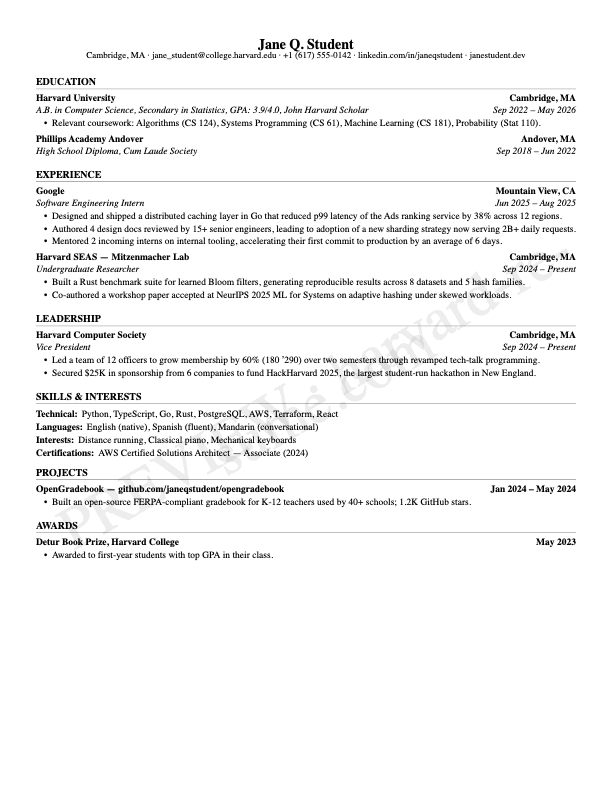
Sample in Harvard format
Strong vs weak bullets
Analyzed labor market data to study minimum wage effects
Estimated the employment effect of a $2.00 minimum-wage increase using a difference-in-differences design across 47 contiguous county pairs (2010–2019 QCEW), finding a precisely-estimated null (−0.4%, SE 0.6%) that reshaped the client's regulatory comment letter
Names the identification strategy (DiD), the data (QCEW county pairs), the estimate with its standard error, and the downstream policy use. A panel infers credible causal work in seconds.
Built forecasting models for the macro team
Built a Bayesian VAR with 14 macro indicators to nowcast quarterly GDP; reduced mean absolute forecast error 22% versus the team's prior AR benchmark and shipped it into the monthly monetary-policy briefing
Specific model (BVAR), specific scope (14 indicators), a benchmarked metric (MAE −22%), and real institutional adoption (policy briefing).
Worked as a research assistant on several projects
As RA to Prof. [Name] (NBER WP 31xxx), owned the full Stata pipeline for a 38M-row IRS panel — cleaning, IV estimation, and all 9 exhibits — cutting the build-to-table cycle from 3 days to 4 hours via a reproducible Makefile
Names the PI and paper, the data scale (38M rows), the methods (IV), the deliverables (9 exhibits), and an efficiency metric with the reproducibility tooling.
Provided economic analysis for an antitrust case
Quantified $310M in overcharge damages in a price-fixing matter using a reduced-form before-during-after regression with firm fixed effects; survived a Daubert challenge and underpinned the $74M settlement
Litigation economics signal: dollar damages, the model (FE regression), the legal milestone (Daubert), and the settlement it supported.
Mistakes specific to this role
- Writing "advanced econometrics" instead of naming the actual identification strategy. Panels want to know if you can run an RDD, not that you've heard of one.
- Listing software you opened once. Claim Stata, R, or Python only if you can be screen-shared and asked to debug a regression live.
- Burying the job-market paper. For PhDs it should be visible in the top third with field and one-line result, not in a footnote.
- Reporting point estimates with no precision. Always pair the magnitude with a standard error, confidence interval, or significance — economists distrust bare numbers.
- Stretching to two pages for an academic CV when the role wants a one-page résumé. Tech and consulting want the Harvard one-pager; keep the 6-page CV for academic and gov panels only.
Your résumé starts here. Pay later.
Start composingFrequently asked
- One-page résumé or a full academic CV?
- It depends on the track. Tech (Amazon, Uber), consulting (NERA, Analysis Group), and most policy/industry roles want a one-page Harvard résumé. Academic, IMF/World Bank, and central-bank research panels expect the multi-page CV with full publications. When in doubt, lead with the one-pager and offer the CV on request.
- Should I list my job-market paper if it's unpublished?
- Yes — for PhDs on the market it's the single most important line. Put the title, your field, and a one-sentence result (the headline estimate) near the top. "Working paper" or "Job-market paper" status is expected and not a weakness.
- How do I show coding skill without overclaiming?
- Name the language and the concrete thing you built: "Stata pipeline for a 38M-row panel" or "Python (statsmodels) event-study package". Mention Git/reproducibility — tech and modern policy shops increasingly screen for it. Don't list a language you can't debug under questioning.
- Do publications matter if I'm targeting industry, not academia?
- They help as a rigor signal but aren't decisive. Industry and tech weight shipped impact and causal-inference depth over journal placement. List one or two strong working papers (NBER/IZA/SSRN) with field, then spend your remaining lines on quantified business or policy outcomes.