Engineering · 2026
Electrical Engineer Resume (Harvard Format)
Show the systems you designed, the loads you sized, and the standards you signed off on — quantified.
How do I write a Electrical Engineer Resume (Harvard Format) resume in the Harvard format?
Electrical engineering hiring managers scan for evidence you can take a design from schematic to silicon — or from one-line diagram to energized switchgear — without a single avoidable revision or safety violation. A strong Harvard-format resume names the voltage classes, standards (NEC, IEC 61508, IPC-A-610), and tools (AutoCAD Electrical, Altium, ETAP, MATLAB/Simulink) you actually worked with, then quantifies the watts saved, defects reduced, and schedules beaten. Keep it to one page and let measured outcomes — not adjectives — carry your candidacy.
What recruiters look for
- PE licensure or active EIT/FE status, plus the jurisdictions you're licensed in (many utility and consulting roles list 'PE required')
- Standards fluency: NEC (NFPA 70), IEEE 1584 arc-flash, IEC 61508/61131-3, UL, and IPC-A-610 for board-level work
- Hands-on tool depth — Altium/OrCAD/KiCad for PCB, AutoCAD Electrical/Revit MEP for power, ETAP/SKM for studies, MATLAB/Simulink and LTspice for analysis
- Power-systems competence: short-circuit, load-flow, coordination, and arc-flash studies, plus voltage classes worked (480V, 4.16kV, 13.8kV, 115kV)
- Product-side signals: design-for-manufacturability, first-pass yield, EMC/EMI pre-compliance (FCC Part 15, CISPR 32), and DFMEA participation
- Quantified outcomes — efficiency gains (%), BOM cost reduced ($), board respins avoided, downtime cut, or projects energized on schedule
Required sections, in this order
Header & Technical Summary
- Lead with your discipline and credential: 'Electrical Engineer, PE (CA, NV) — Power Systems & Protection' so the gating filter clears in one line.
- List a tight Technical Skills block grouped by category: Design (Altium, AutoCAD Electrical), Analysis (ETAP, MATLAB/Simulink, LTspice), Standards (NEC, IEEE 1584, IPC-A-610), and Hardware (oscilloscope, JTAG, power analyzers).
- Name your domain — power distribution, embedded/PCB, controls/PLC, RF, or renewables — because a generalist header reads as junior to a specialist reviewer.
- Skip a generic objective; if you include a summary, make it one line that states voltage class or product domain plus your strongest quantified result.
Experience — XYZ Bullets That Energize
- Use the Harvard XYZ formula: accomplished [X] measured by [Y] by doing [Z]. Anchor every bullet to a metric an engineer respects — efficiency %, dB margin, ppm defect rate, or kW reduced.
- Distinguish what you owned from what the team shipped: 'Owned the protection coordination study' beats 'Helped on a project.'
- Quantify scale and stakes: number of circuits, board layers, megawatts, or production units affected — scale signals seniority faster than years do.
- Show standards and review discipline (design reviews passed, UL submissions, AHJ approvals, zero failed inspections) — compliance is a hireable signal in this field.
Projects, Education & Credentials
- For early-career engineers, a Projects section with a senior design / capstone (e.g., a 3-phase inverter, BMS, or motor-control board) carries real weight — describe it in XYZ form with measured results.
- State degree, institution, and graduation; include GPA only if 3.5+ and relevant coursework (Power Electronics, Control Systems, Electromagnetics) only if it fills a gap.
- List licensure and certs precisely: 'EIT (FE Electrical passed, 2024)', PE number/state, plus tools certs (Altium Certified, AutoCAD).
- Add patents, IEEE publications, or open-source hardware (with a link) — concrete artifacts beat self-described 'strong fundamentals.'
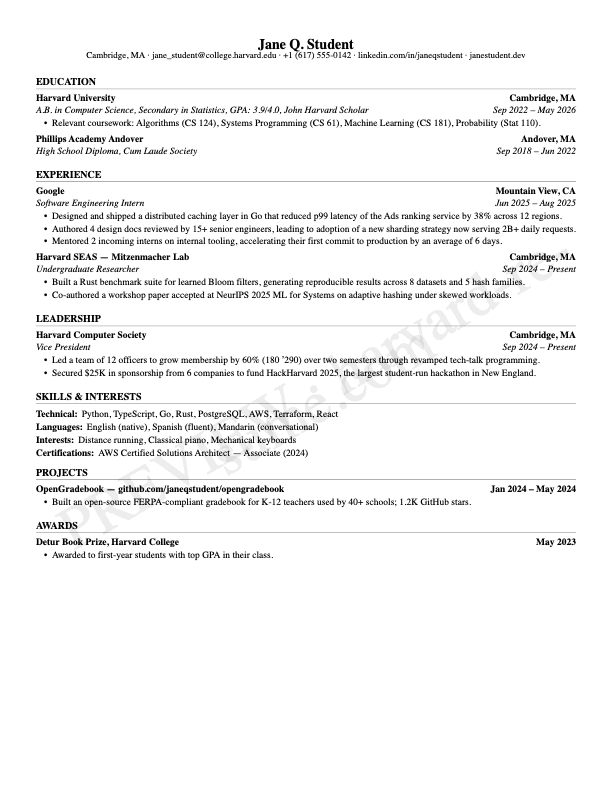
Sample in Harvard format
Strong vs weak bullets
Designed PCBs for various products and helped reduce costs
Designed a 6-layer mixed-signal PCB in Altium for a 48V battery management system, achieving 99.2% first-pass yield across 12,000 units and cutting BOM cost 18% ($4.30/board) by consolidating to a single buck-boost controller
Names the tool, layer count, voltage, yield, volume, and a dollar-quantified cost reduction with the design lever that drove it.
Worked on power systems and did some studies for the facility
Led the arc-flash and short-circuit coordination study (IEEE 1584) for a 13.8kV substation in ETAP, re-labeling 240 buses and lowering incident energy below 8 cal/cm² at 92% of panels — closing the audit with zero NEC 110.16 violations
Cites the standard, voltage class, tool, scope (bus count), the safety metric, and a clean compliance outcome a hiring manager can verify.
Improved the efficiency of a power converter design
Redesigned a 500W AC-DC flyback converter's snubber and synchronous rectification in LTspice and bench, raising peak efficiency from 87% to 93.4% and passing CISPR 32 Class B EMC pre-compliance with 6dB margin on first scan
Quantifies power rating, efficiency delta, the EMC standard, and the dB margin — the metrics that prove real power-electronics competence.
Programmed PLCs and helped automate a production line
Programmed a Rockwell ControlLogix PLC (IEC 61131-3 structured text) to automate a 14-station assembly line, reducing cycle time 22% (47s to 36.7s) and unplanned downtime 31% via added interlock diagnostics
Names the platform, the programming standard, line scale, and two production metrics — cycle time and downtime — that map directly to plant ROI.
Mistakes specific to this role
- Listing tools as a wall of acronyms with no proof — 'Altium, ETAP, MATLAB' means little until a bullet shows what you designed or analyzed with each.
- Omitting licensure status: not stating EIT/FE/PE leaves consulting and utility reviewers guessing, and many roles auto-filter for it.
- Vague safety/standards language — 'ensured compliance' instead of the specific code (NEC 110.16, IEEE 1584, UL 508A) and the audit/inspection result.
- Burying the voltage class or product domain so a reviewer can't tell if you do 5V embedded or 115kV transmission — they're entirely different jobs.
- Spilling onto two pages with coursework and soft skills; a Harvard resume is one page, and bench/field results should crowd out 'team player' filler.
Your résumé starts here. Pay later.
Start composingFrequently asked
- Do I need a PE license on my resume for an electrical engineering job?
- Not for most product, embedded, or hardware roles — but for utility, MEP consulting, and any work that involves stamping drawings, a PE is often required or strongly preferred. Always state your exact status (FE passed / EIT / PE #state), because reviewers filter on it and a blank is read as 'no license.'
- How do I quantify electrical engineering work that isn't obviously numeric?
- Almost everything has a metric: efficiency (%), defect rate (ppm or first-pass yield), dB margin on EMC/SNR, BOM cost ($), board respins avoided, MW/kV handled, cycle time, downtime, or inspections passed. Pick the number your interviewer would care about and put it in the Y of your XYZ bullet.
- Should power-systems and PCB/embedded engineers write the resume differently?
- Yes. Power-systems resumes should foreground voltage classes, studies (load-flow, short-circuit, arc-flash), standards (NEC, IEEE), and tools like ETAP/SKM. PCB/embedded resumes should foreground Altium/KiCad, layer counts, yield, EMC pre-compliance, and firmware/HDL where relevant. Tailor the Technical Skills block and headline to the domain you're targeting.
- I'm a new grad with no industry experience — what fills the page?
- Your senior design or capstone, internships, and personal hardware projects, all written in XYZ form with measured results (efficiency, yield, range, accuracy). Add your FE/EIT status, relevant coursework only if it closes a gap, and any IEEE involvement or open-source hardware with a link. Concrete artifacts beat a long skills list.