Skilled Trades 2026
Electrician Resume Guide (Harvard Format)
Wire your résumé like a panel schedule: every circuit labeled, every load calculated, nothing left to guess.
How do I write a Electrician Resume Guide (Harvard Format) resume in the Harvard format?
Electrician hiring managers scan for three things in the first ten seconds: a current license classification, code competency (NEC/NFPA 70E), and proof you finish jobs that pass inspection on the first walkthrough. A Harvard-format resume forces you onto one disciplined page where your Journeyman or Master license, your conduit-bending and troubleshooting wins, and your safety record do the talking. Whether you run residential service calls, pull feeders on commercial fit-outs, or terminate motor controls in an industrial plant, every bullet should read like a closed-out work order — quantified, code-compliant, and inspection-ready.
What recruiters look for
- License classification and number: Journeyman or Master Electrician, plus state/jurisdiction and active continuing-education hours (e.g., TX TDLR, CA C-10 context, IBEW card)
- NEC (NFPA 70) currency and NFPA 70E arc-flash / lockout-tagout (LOTO) qualification, plus OSHA 10/30 cards
- Hands-on system breadth: single-/three-phase, 120/208V and 277/480V, conduit (EMT/rigid/PVC) bending, panel and switchgear termination, motor controls, VFDs, and PLC interfacing
- Quantified throughput and quality: devices/fixtures installed per day, first-pass AHJ inspection rate, callback/punch-list rate, and rework hours
- Test-instrument fluency: megohmmeter (insulation resistance), clamp meter, phase rotation meter, thermal imaging, and torque verification to manufacturer spec
- Specialty exposure that commands a premium: solar PV (NABCEP), EV charging (EVITP), low-voltage/structured cabling, fire alarm, or generator/ATS commissioning
Required sections, in this order
Header, License Line & Summary
- Put your license classification, number, and jurisdiction in the header or a one-line credentials band — recruiters and the AHJ both verify this first; a Master ticket or active Journeyman card belongs above the fold, not buried in skills.
- Write a 2-line summary anchored to your sector and voltage class (e.g., 'Journeyman Electrician, 8 yrs commercial fit-out, 277/480V three-phase, zero recordable incidents over 11,000 hours').
- List a compact 'Certifications & Tickets' line: OSHA 30, NFPA 70E, CPR/First Aid, NABCEP/EVITP, and CEU completion year so it reads as current.
- Drop the objective and the generic 'hardworking team player' — that real estate is for a quantified safety or productivity stat.
Experience Bullets (Harvard XYZ Formula)
- Every bullet = accomplished [X] measured by [Y] by doing [Z]: e.g., installed, terminated, troubleshot, commissioned — then attach a number and the code or method.
- Quantify what a foreman actually tracks: square footage roughed-in, devices/circuits/fixtures per shift, first-pass inspection rate, downtime reduced, and punch-list items per job.
- Show code and safety as outcomes, not adjectives: 'passed AHJ rough-in on first inspection across 14 of 14 floors' beats 'NEC compliant'.
- Lead with the verb, cut 'responsible for,' and keep each bullet to one line so a one-page layout survives.
Skills, Certifications & Tools
- Group skills by category so an ATS and a hiring foreman both parse them: Distribution (panels, switchgear, feeders), Controls (motor starters, VFDs, PLC I/O), Test/Diagnostics (megger, clamp meter, thermal), and Code/Safety (NEC, NFPA 70E, LOTO).
- Name the manufacturers and platforms you've actually wired: Square D/Schenider, Eaton, Siemens, Allen-Bradley, plus BMS or SCADA exposure if you have it.
- List specialty certs that unlock higher-bill work — NABCEP (solar), EVITP (EV), fire-alarm (NICET), structured cabling (BICSI) — only if current.
- Keep it scannable: no skill bars or percentages; the AHJ doesn't certify you at '80% conduit bending.'
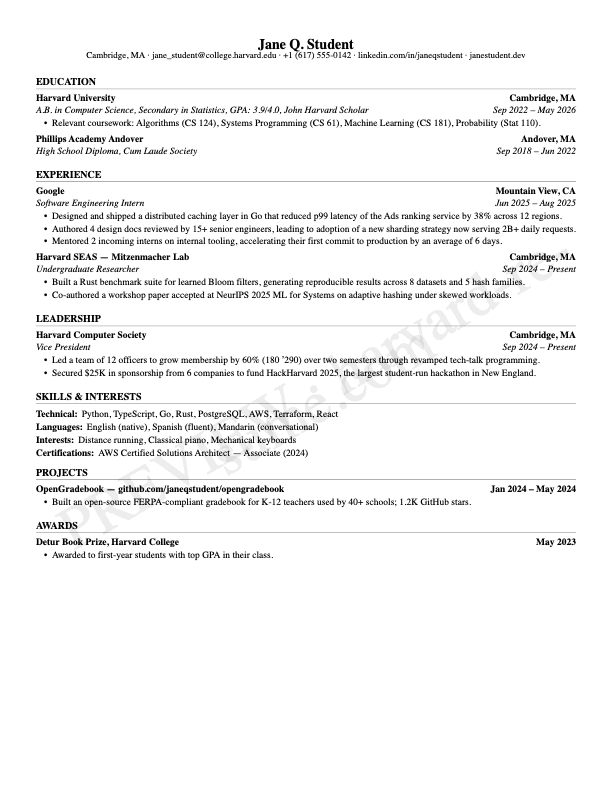
Sample in Harvard format
Strong vs weak bullets
Responsible for wiring and electrical work on commercial buildings.
Roughed-in and terminated 277/480V three-phase distribution across a 6-story, 92,000 sq ft office fit-out, passing AHJ inspection on the first walkthrough for 6 of 6 floors and trimming punch-list items 40% versus the prior crew baseline.
Names the voltage class, scale (sq ft, floors), the quality metric (first-pass inspection), and a comparative improvement — exactly what a project foreman tracks.
Did troubleshooting on machines and fixed electrical problems.
Diagnosed recurring 480V motor faults on 12 production VFD drives using megohmmeter insulation testing and thermal imaging, cutting unplanned line downtime from 9 hrs/month to under 1.5 hrs and avoiding ~$48K in lost output.
Specifies the system (480V/VFDs), the diagnostic instruments, a before/after downtime metric, and dollar impact — proving troubleshooting depth, not just 'fixed problems.'
Installed solar panels and electrical equipment for customers.
Installed and commissioned 38 residential rooftop PV systems (5–11 kW) to NEC Article 690, achieving 100% first-pass utility interconnection approval and a sub-2% callback rate across 14 months as NABCEP-certified lead.
Anchors to the relevant NEC article, gives system count and size range, and reports interconnection and callback rates — the numbers that signal a clean, code-correct installer.
Trained new electricians and helped the team stay safe.
Mentored 5 apprentices through OSHA 30 and NFPA 70E arc-flash qualification, sustaining a zero-recordable-incident record across 18,000+ crew labor hours and reducing first-year apprentice rework by 30%.
Quantifies people developed, the safety standards taught, an incident-free hour count, and a measurable quality gain — turning 'helped the team' into leadership evidence.
Mistakes specific to this role
- Burying or omitting your license classification and number — recruiters and the AHJ verify it first, so a hidden Journeyman/Master ticket reads as 'unlicensed' at a glance.
- Writing duty lists ('responsible for pulling wire, installing panels') instead of quantified outcomes like devices/shift, first-pass inspection rate, or downtime reduced.
- Claiming 'NEC compliant' as a skill — compliance is the baseline; show it as a result (first-pass inspections, zero corrections) instead.
- Listing every tool you own while omitting test instruments (megger, clamp meter, thermal) and platforms (Square D, Allen-Bradley) that actually signal skill level.
- Letting the resume sprawl past one page or padding it with skill-percentage bars — foremen scan fast and distrust gimmicks the AHJ would never certify.
Your résumé starts here. Pay later.
Start composingFrequently asked
- Where do I put my electrician license on a Harvard-format resume?
- Put the classification, number, and jurisdiction in your header or a single credentials line directly under your name — e.g., 'Licensed Journeyman Electrician #XXXX (TX, active)'. Both the hiring foreman and the Authority Having Jurisdiction verify it first, so it should never be buried inside a skills block. Add your continuing-education / CEU completion year so it reads as current rather than lapsed.
- Should I list NEC and NFPA 70E if I haven't memorized every code?
- Yes — nobody memorizes the whole code book; AHJs expect you to look it up. List NEC (NFPA 70) currency and NFPA 70E arc-flash/LOTO qualification because they signal you work to standard. The stronger move is to prove it as an outcome in your bullets: 'passed first-pass rough-in inspection 12 of 12' demonstrates code competence far better than the words 'code compliant.'
- How do I quantify electrician work when I don't track formal metrics?
- Reconstruct numbers from work orders, daily logs, and your foreman's reports: devices or fixtures per shift, square footage roughed-in, number of panels/circuits terminated, first-pass inspection rate, callback/punch-list count, and any downtime you reduced. Even an honest estimate ('~25 fixtures/day across a 40,000 sq ft warehouse') beats an unquantified duty and gives the reader a sense of pace and scale.
- Do specialty certifications like NABCEP or EVITP belong on the resume?
- Absolutely, if they're current — they unlock higher-bill solar PV and EV-charging work and instantly differentiate you. List them on your certifications line with the year, and back at least one with a results bullet (interconnection approval rate, systems commissioned). Don't list expired or in-progress certs as if active; the credential is verifiable and a mismatch costs you trust.