Engineering & Sustainability 2026
Environmental Engineer Resume (Harvard Format)
Show recruiters you can model contaminant fate, run a permit through the agency, and cut emissions on a real budget.
How do I write a Environmental Engineer Resume (Harvard Format) resume in the Harvard format?
Environmental engineering hiring managers want proof you can carry a project from a Phase II ESA through a remedial design that a state regulator will actually sign off on — not a list of standards you once read. A one-page Harvard-format resume forces you to lead with quantified outcomes: tons of CO2e cut, NPDES limits met, permits secured, and dollars saved. This guide shows how to turn permitting, remediation, and EHS work into bullets a reviewer trusts in six seconds.
What recruiters look for
- PE license (or EIT/FE passed) and discipline — water resources, environmental, or civil — plus state of registration
- Hands-on regulatory work: CWA/NPDES, CAA Title V, RCRA, CERCLA, NEPA, SDWA, and the specific permits you've actually filed
- Modeling and design tools: AERMOD/CALPUFF for air dispersion, HEC-RAS/HEC-HMS for hydrology, EPANET/SWMM, MODFLOW/RT3D, GIS (ArcGIS Pro)
- Remediation experience with quantified scope: pump-and-treat, ISCO, bioremediation, SVE, plus mass removed or plume reduction achieved
- Compliance and EHS metrics: TRI/Tier II reporting, ISO 14001, air emissions inventories, audit findings closed, reportable incidents avoided
- Project delivery signals: CapEx managed, schedule adherence, multidisciplinary teams led, and stakeholder/agency relationships
Required sections, in this order
Lead the header with license, discipline, and a scannable summary
- Put PE (with state and number) or EIT next to your name — recruiters filter on it before reading a single bullet
- Name your concentration explicitly: air quality, water/wastewater, remediation, solid waste, or sustainability — generalist headers read as junior
- If you have a one-line summary, quantify it: 'Environmental engineer with 6 yrs in Superfund remediation; $14M in remedial designs delivered on schedule'
- List your registrations and key certs (PE, ENV SP, 40-hr HAZWOPER, PMP) where a scanner expects them, not buried at the bottom
Build experience bullets on the Harvard XYZ formula
- Every bullet: accomplished [X] measured by [Y] by doing [Z] — lead with the outcome (mass removed, permit secured, $ saved), not the task
- Anchor each bullet to a regulation, model, or standard so a technical reviewer trusts it: NPDES, AERMOD, RCRA Subtitle C, ISO 14001
- Quantify with field-credible units: tons CO2e, gallons/day treated, % plume reduction, mg/L below limit, days under permit deadline
- Show ownership scope — design authority, agency negotiation, CapEx, or team size — so the bullet reads as engineering, not support
Curate projects, tools, and education for one-page density
- Add a tight Projects or Technical section listing models (AERMOD, HEC-RAS, MODFLOW, EPANET) and platforms (ArcGIS, AutoCAD Civil 3D) you actually used
- For new grads, lead with capstone/thesis quantified: 'Designed a 0.5 MGD constructed wetland reducing BOD load 78% for a 12k-person municipality'
- Cite codes and frameworks employers screen for: NEPA EIS/EA, Clean Water Act 404, Title V, GHG Protocol, TCEQ/CARB/state-specific rules
- Keep it to one page — cut coursework lists and soft-skill filler; every line should prove you can deliver a compliant, buildable design
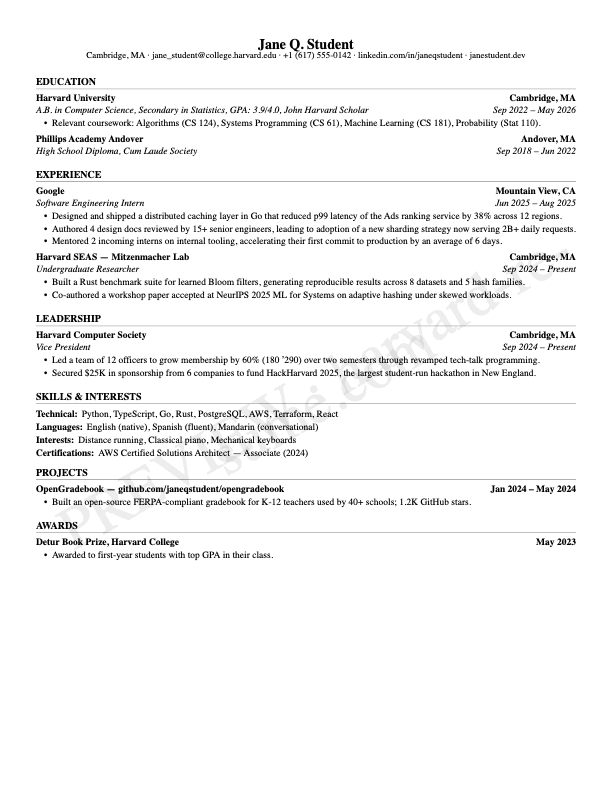
Sample in Harvard format
Strong vs weak bullets
Helped with site remediation at a contaminated facility.
Designed and commissioned a dual-phase extraction system at a RCRA corrective-action site, removing 4,200 lbs of chlorinated VOC mass and cutting the groundwater plume 62% over 18 months, closing 3 of 5 monitoring wells below MCLs.
Names the technology (DPE), the regulatory driver (RCRA), and mass/plume/well metrics a remediation reviewer recognizes immediately.
Worked on air permits for the plant.
Secured a CAA Title V minor-modification permit for a 120 MMBtu/hr boiler by running AERMOD dispersion modeling that demonstrated PM2.5 and NOx below NAAQS, clearing agency review in 90 days versus a 180-day baseline.
Specifies the permit type, the source size, the model, the pollutants, and a schedule outcome — the exact triad a permitting lead is judged on.
Improved the company's environmental compliance.
Built an ISO 14001 air-emissions inventory and TRI reporting workflow across 4 facilities, closing 11 of 11 audit findings and eliminating 2 prior NOV exposures, while documenting a 9,800-ton CO2e annual reduction.
Ties a management system (ISO 14001) to concrete reporting (TRI), audit closure, NOV risk, and a quantified emissions cut.
Designed a stormwater system for a development project.
Engineered a 38-acre stormwater management plan in HEC-HMS and SWMM, sizing 3 bioretention basins to attenuate the 100-year peak by 41% and meet the NPDES MS4 permit, approved by the state DEQ on first submittal.
Shows the hydrologic models, the design intent (peak attenuation), the regulatory target (MS4 permit), and a first-pass approval signal.
Mistakes specific to this role
- Listing regulations you've 'familiarized yourself with' instead of permits you actually filed, modeled, or defended before an agency
- Writing task bullets ('responsible for monitoring') instead of outcomes ('cut plume 62%') — no metrics means no engineering judgment shown
- Burying or omitting your PE/EIT status and discipline, forcing recruiters to guess your licensure track
- Naming software as a skills dump (15 tools) with no project showing you used AERMOD or MODFLOW to reach a result
- Spilling onto a second page with coursework, every standard, and soft skills — diluting the few bullets that prove you ship compliant designs
Your résumé starts here. Pay later.
Start composingFrequently asked
- Should I put my PE or EIT on an environmental engineering resume?
- Yes — put it right next to your name with the state. PE is a hard filter for design-authority roles, and EIT/FE-passed signals you're on track. If you're still pre-FE, say 'FE exam scheduled' so reviewers know your timeline rather than assuming nothing.
- How do I quantify remediation or compliance work that feels hard to measure?
- Use field-standard units: mass removed (lbs/kg of contaminant), plume reduction (%), concentration vs. MCL (mg/L), gallons/day treated, tons CO2e cut, audit findings closed, permit days saved, or CapEx managed. Even an estimate with a clear method beats a vague 'improved compliance.'
- Which tools and models matter most to list?
- List the ones tied to your specialty and back them with a result: AERMOD/CALPUFF (air), HEC-RAS/HEC-HMS, EPANET/SWMM (water/hydrology), MODFLOW/RT3D (groundwater), and ArcGIS Pro plus AutoCAD Civil 3D. A scanner wants to see the model named inside a bullet, not floating in a skills list.
- Can an environmental engineering resume really fit on one page?
- Yes, and the Harvard format expects it. Lead with 4-6 quantified bullets per recent role, cut older or unrelated jobs to one line, drop coursework, and let projects carry your modeling depth. One dense page of outcomes beats two pages of responsibilities.