Wealth Management · 2026
Harvard Resume for Financial Advisors
Advisor hiring is book- and trust-driven. The Harvard format puts AUM, licenses, and client retention where a hiring partner scans first.
How do I write a Financial Advisors resume in the Harvard format?
Financial-advisor hiring runs on three currencies: licenses, a portable book of business, and evidence you can keep clients. Branch managers at Morgan Stanley, Merrill, Edward Jones, Fisher, and independent RIAs scan for AUM, net new assets, client retention, and a clean BrokerCheck record in the first 8 seconds. The Harvard format compresses all of that into the top third of a single page — and that compression is exactly what a recruiter who reads 200 résumés a week rewards.
What recruiters look for
- Active licenses listed by number — Series 7, Series 66 (or 63 + 65), plus state insurance/life & health
- CFP®, ChFC®, CFA, or CPA/PFS — designation marks shown correctly, with 'CFP® candidate' dated if in progress
- Book size and quality — AUM managed, number of households, average account size, net new assets per year
- Retention and growth metrics — client retention %, referral-driven growth, ROA (revenue on assets / production)
- Planning depth — retirement, estate, tax, insurance; CRM and planning tools named (Salesforce, Redtail, eMoney, MoneyGuidePro, Orion, Black Diamond)
- Clean compliance signal — no BrokerCheck disclosures, fiduciary / fee-based experience stated explicitly
Required sections, in this order
Licenses, designations & the contact line
- List active registrations explicitly: 'Series 7, Series 66, CA Life & Health Insurance' — never just 'fully licensed'
- Put CFP® / ChFC® after your name on the contact line; show in-progress credentials honestly: 'CFP® candidate — exam Nov 2026'
- No photo, no DOB — but DO add LinkedIn; a sparse profile is a red flag for a relationship-driven role
- If switching firms with a book, hint at portability ('fee-based, advisory-led practice') without breaching protocol
Experience bullets — lead with assets and clients
- Open each role with the book you owned: AUM, household count, average account size
- Quantify growth, not just maintenance: net new assets, organic growth %, referral conversion
- Show planning craft AND retention — 'built 60+ comprehensive financial plans' plus '97% client retention'
- Name the practice model: fee-based fiduciary, commission, hybrid; high-net-worth vs mass-affluent segment
Skills & tools that actually get tested
- Planning software: eMoney, MoneyGuidePro, RightCapital; portfolio: Orion, Black Diamond, Morningstar
- CRM the firm uses: Salesforce Financial Services Cloud, Redtail, Wealthbox — name it, don't say 'CRM proficient'
- Products and competencies: managed portfolios, annuities, 401(k)/QDIA, trust & estate, tax-loss harvesting
- Skip 'excellent communication skills' — replace with a referral or retention number that proves it
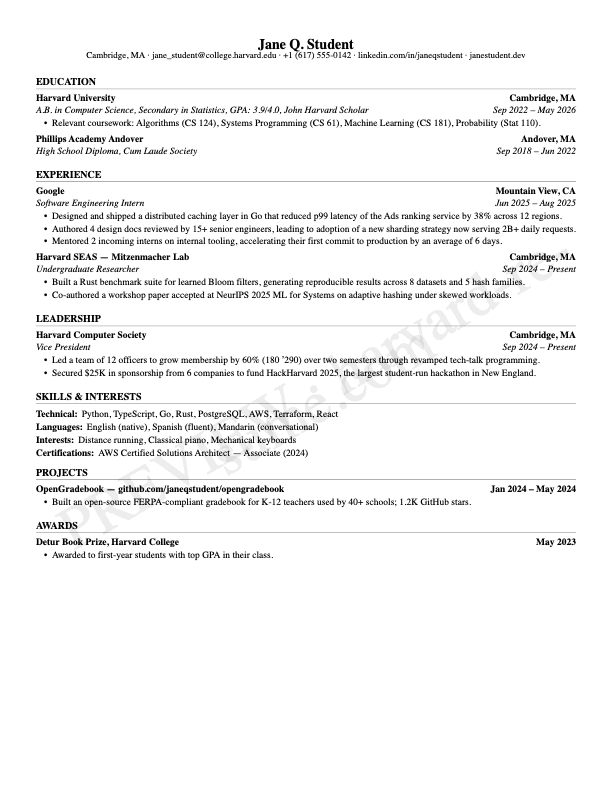
Sample in Harvard format
Strong vs weak bullets
Managed a portfolio of clients and helped them with their financial goals
Managed a $142M fee-based book across 168 high-net-worth households (avg. account $845K); grew AUM 19% YoY through organic referrals while sustaining 96% client retention over 5 years
Names book size ($142M), segment (HNW), household count, average account, growth rate, and retention — the exact five numbers a branch manager triangulates to gauge a portable practice.
Brought in new clients and grew the business
Sourced $28M in net new assets in 2025 (top 8% of the region's advisors) by converting 41 401(k) rollovers and 22 centers-of-influence referrals from 3 CPA and estate-attorney partnerships
NNA is the metric wirehouses rank on. Pairing the dollar figure with the rollover/COI channel mix proves the growth is repeatable, not a one-off lucky quarter.
Created financial plans for clients including retirement planning
Built 70+ comprehensive financial plans in MoneyGuidePro covering retirement, tax, and estate; restructured a $4.3M pre-retiree portfolio to a Roth-conversion + bond-ladder strategy projected to cut lifetime tax drag by ~$310K
Moves from 'made plans' to a named tool, a volume, and a single flagship case with a quantified tax outcome — exactly the planning depth a fee-based RIA wants to see.
Passed my licensing exams and got certified
Earned CFP® and passed Series 7 & 66 within 14 months of joining; completed 200+ hours of eMoney and tax-planning CE while ramping a book from $0 to $38M AUM as a new advisor
Turns credentials into a velocity story: licenses + CE hours + a from-zero book in a defined window signals a self-starter who builds, not just maintains.
Mistakes specific to this role
- Hiding the numbers. 'Grew the business' with no AUM, NNA, or retention figure reads as someone with no book worth moving — list the assets.
- Writing 'fully licensed' instead of the actual registrations. Recruiters need to see Series 7, Series 66 (or 63/65), and state insurance lines spelled out.
- Misusing the CFP® mark or claiming a designation you only started. State 'CFP® candidate' with the exam date — compliance will catch the rest.
- Listing 'Microsoft Office' and 'communication skills' as skills. Replace with eMoney, Salesforce FSC, Orion, and a retention or referral number.
- Ignoring compliance signal. If your BrokerCheck is clean and you work fee-based/fiduciary, say so — it shortcuts a question every manager will ask.
Your résumé starts here. Pay later.
Start composingFrequently asked
- Should I put my actual AUM and client numbers on a résumé?
- Yes — AUM, household count, net new assets, and retention are the core of advisor hiring. Round sensibly ('$140M+' not '$142,347,901') and never disclose individual client names or identifying details. Vague résumés get screened out for being un-quantifiable.
- How do I list a CFP® I'm still studying for?
- Write 'CFP® candidate — sitting for the exam March 2026' in Education or under your name. Never imply you hold the mark before you pass and complete the experience requirement; FINRA-regulated firms verify everything.
- Do recruiters check BrokerCheck before they call me?
- Almost always. A clean record is a quiet asset — note 'no disclosures' if you like. If you have a disclosure, don't bury it; be ready to explain it factually in the screen, because they will already know.
- Is one page realistic with 15+ years of advisory experience?
- Yes, and it's expected. Lead with current book and the last two roles; compress earlier experience to title, firm, and dates. A two-page advisor résumé usually signals an inability to prioritize — the same skill you sell to clients.