Creative & Design · 2026
Harvard Resume for Graphic Designers
Show the metric behind the mockup — recruiters hire designers who move conversion, not just pixels.
How do I write a Graphic Designers resume in the Harvard format?
Graphic designers are hired by in-house brand teams, agencies, marketing departments and product studios — and the first thing a creative director or recruiter does is scan for a portfolio link and proof you can ship on brief. A Harvard-format one-pager keeps your experience tight and quantified so the resume earns the click to your portfolio instead of competing with it. The format's education-first, no-photo, metric-driven discipline reads as the same restraint you bring to a layout.
What recruiters look for
- A live portfolio URL above the fold (Behance, personal site, or Dribbble) — no link means no callback for most creative roles
- Tool fluency named precisely: Adobe Creative Suite (Illustrator, Photoshop, InDesign), Figma, After Effects, and where relevant Webflow or Procreate
- Business impact, not just deliverables: conversion lift, engagement rate, brand-consistency at scale, asset turnaround time
- Evidence of working to brand guidelines and design systems, not one-off art — component libraries, templates, brand kits
- Cross-functional collaboration with marketing, copy, and dev (handoff via Figma, asset specs, print-ready files)
- Range across mediums: digital (social, web, email), print (packaging, collateral), and brand identity work
Required sections, in this order
Lead with the portfolio and a tight summary
- Put your portfolio URL in the header next to email and LinkedIn — make it the most prominent link on the page; a designer with no visible portfolio gets skipped.
- Use a 2-line summary only if you have a specialty worth signaling (brand identity, motion, packaging) — otherwise cut it and let the bullets work.
- List your tool stack in a one-line Skills block: name the Adobe apps, Figma, motion and prototyping tools — recruiters keyword-match these for ATS.
- Skip the 'creative, detail-oriented' adjectives; the layout and the metrics prove it better than the words do.
Make the Experience section show shipped impact
- Every bullet should answer 'what changed in the business because of this design?' — opens, clicks, conversion, time saved, brand reach.
- Quantify volume: number of assets shipped per sprint, campaigns supported, SKUs designed, or pages in a system — scale signals seniority.
- Name the deliverable type (landing page, packaging, brand system, ad set) so a creative director can picture the work before opening the portfolio.
- Group freelance and contract work under one 'Freelance Designer' entry with notable clients rather than scattering one-off gigs.
Education, tools and the one-page cut
- Education-first if you're a recent grad (BFA, design diploma, bootcamp) — list relevant coursework like typography or UX; move it below experience once you have 3+ years.
- Certifications belong in a compact line: Adobe Certified Professional, Google UX Design Certificate, or HubSpot — only if real and current.
- Cut high-school, hobbies, and any project older than ~6 years; a one-page Harvard resume forces you to show only your strongest, most recent work.
- No photo, no graphic flourishes in the resume PDF itself — keep it clean and ATS-readable; save the visual flex for the portfolio you link to.
Sample in Harvard format
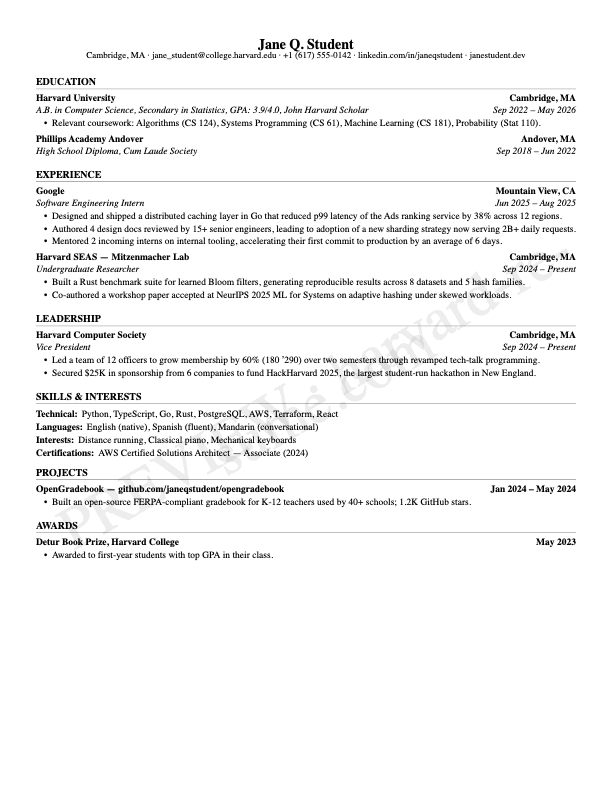
Strong vs weak bullets
Designed graphics for social media and marketing campaigns.
Designed and shipped 120+ social and paid-ad assets per quarter across Instagram and Meta Ads, lifting average click-through rate from 1.4% to 2.6% and cutting agency spend by $18K/year by bringing the work in-house.
Names the channels, the volume, the CTR metric, and the cost saved. A creative director reads 'this person ships at pace and understands the funnel' in seconds.
Created a new brand identity for the company.
Led a full rebrand for a 40-person SaaS company — logo, type system, and a 60-component Figma design library — adopted across 5 teams, reducing off-brand asset production by 70% in the first two quarters.
Shows scope (full system, not one logo), scale (60 components, 5 teams), and a measurable consistency outcome rather than a vague 'refresh.'
Worked on packaging design for product launches.
Designed retail packaging for 24 SKUs across 3 product launches, delivering print-ready dielines on a 2-week turnaround that hit 100% of on-shelf dates with zero pre-press reprints.
Quantifies SKUs, turnaround, and reliability (zero reprints) — the operational signals a brand or CPG team cares about, not just the aesthetic.
Improved the company's marketing templates and assets.
Built a templated asset system in Figma and Canva for the marketing team, cutting average campaign-graphic turnaround from 3 days to 4 hours and enabling 6 non-designers to self-serve on-brand collateral.
Turns 'made templates' into a time and leverage metric, showing you scaled the design function instead of just doing the tasks.
Mistakes specific to this role
- No portfolio link, or a dead/locked one. For a designer this is disqualifying — recruiters won't email you to ask for it.
- Designing the resume itself like a poster — multi-column, colored backgrounds, icons. It breaks ATS parsing and signals you can't follow a clean brief.
- Listing software as a bar-chart skill rating ('Photoshop 90%'). It reads as filler; name the tools plainly and let the work prove proficiency.
- All-deliverable bullets with no outcome ('made flyers, banners, and logos'). Without a metric or audience, a reviewer can't tell good design from busy design.
- Cramming 8 years of every freelance gig onto the page. Curate like you'd curate a portfolio — your 6-8 strongest, most recent pieces of experience.
Your résumé starts here. Pay later.
Start composingFrequently asked
- Should my resume be visually designed, or plain?
- Keep the resume PDF clean, single-column, and ATS-readable — that's where the Harvard format wins. Your visual skill belongs in the portfolio you link to. A plain resume plus a strong portfolio outperforms a 'designed' resume that an ATS can't parse and a recruiter finds gimmicky.
- Where do I put my portfolio link?
- In the header, on the same line as your email and LinkedIn, as the most prominent link. Use a short, memorable URL (yourname.com or behance.net/yourname). If you only have one link to give, make it the portfolio, not LinkedIn.
- How do I quantify creative work that isn't obviously measurable?
- Tie design to the business: engagement or CTR on the campaign, conversion on the landing page, assets shipped per sprint, turnaround time, SKUs or pages designed, brand-consistency improvements, or cost saved by bringing work in-house. There's almost always a number adjacent to the work.
- Do I need a degree to be a graphic designer on paper?
- No — strong portfolios beat credentials in design. List a BFA or design diploma if you have one, but a bootcamp, an Adobe/Google certificate, and demonstrable shipped work are fully legitimate. Lead with experience and the portfolio; let education support, not gate, the application.