Human Resources · 2026
Harvard Resume for Human Resources (HR)
From recruiter to HRBP to CHRO — the Harvard format puts headcount scaled, retention moved, and SHRM/PHR creds where hiring managers scan first.
How do I write a Human Resources (HR) resume in the Harvard format?
HR is the one field where your résumé is read by people who write résumé rubrics for a living — talent acquisition partners, HR directors, and CHROs who screen hundreds of these a week. They scan the top third for three things: your HR certification (SHRM-CP/SCP or PHR/SPHR), the HRIS/ATS systems you actually operate (Workday, SuccessFactors, Greenhouse), and headcount scale. The Harvard one-page format wins here because HR people distrust the bloated, buzzword-heavy résumés they reject every day; a clean, education-first, quantified page signals you practice the discipline you'd enforce.
What recruiters look for
- Active HR certification named explicitly: SHRM-CP/SHRM-SCP or HRCI PHR/SPHR (and the year — lapsed certs are a red flag)
- HRIS / ATS / HCM systems operated, not 'familiar with': Workday, SAP SuccessFactors, UKG, ADP, BambooHR, Greenhouse, Lever, Workable
- Quantified scale: headcount supported (e.g. 1,200 FTEs across 4 sites), reqs closed, time-to-fill in days, annual hiring volume
- Retention & engagement metrics moved: turnover %, eNPS, offer-acceptance rate, 90-day retention, regrettable-attrition reduction
- Compliance and ER depth: EEOC, FMLA, ADA, FLSA, I-9/E-Verify, multi-state employment law, investigations closed
- Specialization signal: full-cycle recruiting vs. HRBP vs. Total Rewards/comp vs. L&D vs. HR Ops — the page should declare a lane
Required sections, in this order
Header & specialization framing
- Add a one-line descriptor under your name declaring your lane and scale: 'HRBP · 1,200 FTEs · Tech & Manufacturing · SHRM-SCP'
- Put your certification on the contact line or in a dedicated top slot — TA partners scan for it first; do not bury it under Skills
- No photo, no DOB, no marital status — ironic to violate the very EEOC norms you'd enforce; HR reviewers notice immediately
- Optional LinkedIn URL only (no Instagram/personal); HR is a referral-heavy field and your network is part of the signal
Experience bullets — lead with people outcomes
- Open each role by naming the population you supported (FTE count, sites, business units) so scale is set before the verb
- Convert soft work into hard metrics: 'reduced time-to-fill from 52 to 31 days', 'cut voluntary turnover from 24% to 15%', 'closed 18 ER investigations with zero litigation'
- Show the full talent lifecycle if you're generalist: sourcing → offer → onboarding → retention → offboarding, one quantified bullet each
- Include one bullet on a program you built or scaled (DEI, comp band redesign, performance-review overhaul) — HR leaders hire builders, not ticket-closers
Skills, systems & certifications section
- List HRIS/ATS/HCM platforms by name and group them: HCM/HRIS · ATS · Payroll/Benefits · Analytics (e.g. Visier, Tableau)
- Name the employment-law and compliance frameworks you operate under (EEOC, FMLA, ADA, FLSA, GDPR if global) — not 'compliance knowledge'
- Give certifications their own line with the issuing body and status year: 'SHRM-SCP (2024)', 'PHR (HRCI, 2023)', 'CCP (WorldatWork)'
- Cut generic filler — 'team player', 'strong communicator', 'people person'. Every HR reviewer has rejected these 1,000 times
Sample in Harvard format
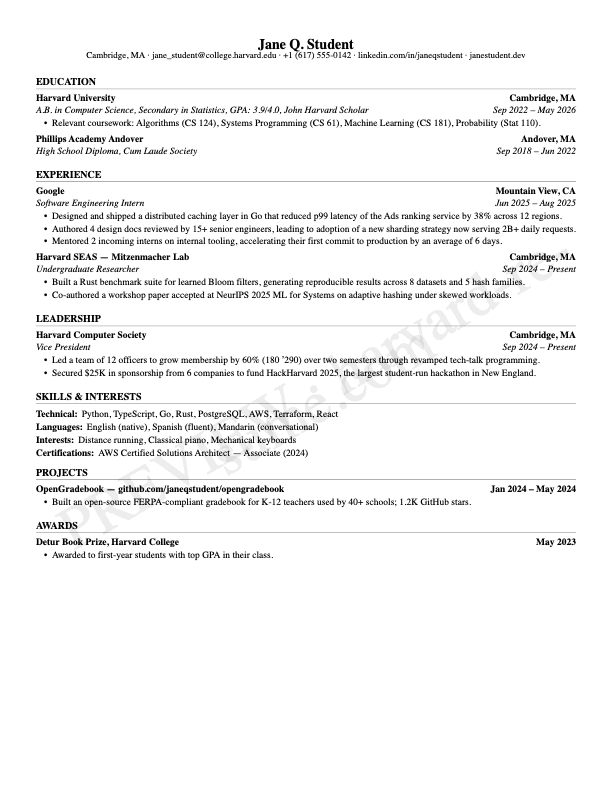
Strong vs weak bullets
Responsible for recruiting and helped fill open positions across the company
Owned full-cycle recruiting for a 1,200-FTE tech org across 4 sites; redesigned the Greenhouse intake and structured-interview process, cutting average time-to-fill from 52 to 31 days while lifting offer-acceptance from 71% to 89% on 240 annual hires
Names the scale (1,200 FTEs, 4 sites), the system (Greenhouse), and two hard metrics (time-to-fill, offer-acceptance) against real volume (240 hires/yr). A TA director infers operator-level command in seconds, not 'helped'.
Worked to improve employee retention and reduce turnover
Launched a stay-interview and manager-coaching program for 850 FTEs after exit-data flagged manager quality as the top driver; reduced regrettable attrition from 24% to 15% in 12 months, saving an estimated $2.1M in replacement cost
Shows the diagnosis (exit-data root cause), the intervention, and quantifies both the people outcome (24%→15%) and the dollar value ($2.1M). This is the HRBP-as-business-partner signal leaders pay for.
Handled employee relations issues and investigations
Managed 18 complex ER investigations annually (harassment, ADA accommodation, FMLA disputes) end-to-end; standardized intake-to-resolution at 9 days and closed all with zero adverse legal findings across 2 years
ER is litigation-exposed, so the number that matters is risk avoided. Naming case types, volume (18/yr), cycle time (9 days), and 'zero adverse findings' signals you reduce legal exposure — exactly what a CHRO is buying.
Led the implementation of a new HR system
Led the Workday HCM migration off legacy ADP for 1,500 employees across 3 countries; ran the 7-month project on budget, trained 40 people-managers on self-service, and drove adoption to 94% within the first review cycle
HRIS migrations are where HR ops careers are made or broken. Platform named (Workday), scope (1,500 EEs, 3 countries), timeline, and an adoption metric (94%) prove you can run change at scale, not just file tickets.
Mistakes specific to this role
- Listing 'recruiting, onboarding, employee relations, benefits, payroll' as a wall of duties with zero numbers. HR reviewers reject this exact résumé daily — a bullet without a metric is invisible.
- Hiding your SHRM/PHR certification at the bottom or omitting the year. It's the first thing a TA partner looks for; lead with it and keep it current.
- Saying you're 'proficient in HR systems' instead of naming them. 'Workday, Greenhouse, ADP' is testable in an interview; 'HRIS-savvy' is not — and you'll be asked.
- Including a photo, age, or marital status. You enforce EEOC norms; violating them on your own résumé signals you don't actually internalize the compliance you'd own.
- Claiming to be a generalist with no declared lane. At mid-senior level, 'I do a bit of everything' reads as junior — pick HRBP, TA, Total Rewards, or HR Ops and make the page argue for it.
Your résumé starts here. Pay later.
Start composingFrequently asked
- Should I lead with my SHRM or PHR certification, or list it under Education?
- Put it where it's scanned first: either on the contact line (e.g. 'Jane Doe, SHRM-SCP') or in a short Certifications block in the top third. HR reviewers filter on credential before they read a single bullet. Always include the year and issuing body, and never list a lapsed cert as if it's active.
- How do I quantify HR work that feels 'soft', like culture or engagement?
- Translate it into the metrics your function already tracks: turnover %, regrettable attrition, eNPS, engagement-survey participation and score, time-to-fill, offer-acceptance rate, 90-day retention, internal-mobility rate, and replacement-cost dollars saved. If you ran a program, state the population it covered and the before/after number. Every HR initiative has a number — find it.
- I'm moving from recruiting into a broader HRBP role. How should the résumé show that?
- Make your most recent and most strategic bullets the strongest, since they're scanned first. Keep your recruiting wins (time-to-fill, hiring volume) but reframe at least two bullets around business partnership: workforce planning, manager coaching, org design, or a retention program you owned. Your declared lane in the header should say HRBP, not Recruiter.
- Do I need to list every HRIS and ATS I've ever touched?
- No — depth beats breadth, and HR interviewers test what you claim. List the 3-5 platforms you can genuinely speak to (e.g. Workday, Greenhouse, ADP) and the modules you actually ran. A short, honest, named list is far stronger than a 12-tool dump you can't defend when an interviewer probes the configuration.