Manufacturing & Operations · 2026
Harvard Resume for Industrial Engineers
Industrial engineering hiring is metric-obsessed. The Harvard format puts your OEE gains, cycle-time cuts, and Six Sigma savings on one scannable page.
How do I write a Industrial Engineers resume in the Harvard format?
Industrial engineering is the most quantitative discipline a résumé screener will read all day, and hiring managers at automotive, CPG, pharma, logistics, and electronics plants expect it. They scan the first third for one thing: did you move a number — OEE, scrap rate, cycle time, throughput, or cost-per-unit — and by how much. The Harvard format forces exactly that compression, so your continuous-improvement impact, not your job duties, leads every line.
What recruiters look for
- Lean Six Sigma certification stated by belt (Green Belt, Black Belt) with the certifying body (ASQ, IISE) — not just "Six Sigma knowledge"
- Quantified process gains: OEE points, scrap/PPM reduction, cycle-time and takt-time cuts, throughput and yield improvement, $ saved per year
- Named methodologies and tools you actually ran: value-stream mapping, SMED, kaizen, DMAIC, 5S, kanban, TPM, Poka-Yoke
- Software fluency stated explicitly: SAP/Oracle ERP, Minitab, AutoCAD/SolidWorks, Arena/FlexSim simulation, Power BI/Tableau, Excel VBA, MES
- Standards exposure where relevant: ISO 9001, IATF 16949 (auto), Good Manufacturing Practices/FDA (pharma/food), OSHA safety
- Scope signals: line/cell size, headcount supervised, SKUs, units/day, plant or DC square footage, capital project budget owned
Required sections, in this order
Header & technical-skills framing
- Add a Technical Skills block engineers can place above Experience: Methodologies · ERP/MES · Statistical & CAD tools · Standards
- Name certifications by belt and body on the contact line region or a short Certifications line (e.g., "ASQ Certified Six Sigma Green Belt")
- List the simulation, statistical, and ERP software by name — a generic "proficient in industry software" gets skipped
- No photo, no DOB, no marital status — keep it one page
Experience bullets that read like a control chart
- Lead each bullet with the verb-and-metric: "Cut scrap rate from 4.1% to 1.3%…", not "Responsible for quality"
- Pair the methodology with the result — DMAIC project → defect reduction → annualized $ savings
- Show scope: line speed, units/day, SKU count, headcount, or capital budget so the reviewer sizes your impact
- Include one safety or ergonomics bullet (recordable-incident reduction, OSHA) — plants weight it heavily
Projects & capstone section (strong for new grads)
- New grads: include 2-3 capstone or co-op/internship projects with a measured outcome and the tool used (Arena, Minitab, AutoCAD)
- Each project: one-line problem statement, your role, the methodology, and the quantified result (time, cost, defects, utilization)
- Name competition or research credentials if notable: IISE, SME, a published time-study, or a Kaizen event you led
- Link a portfolio only if it shows real artifacts — VSM maps, simulation models, control charts — not slideware
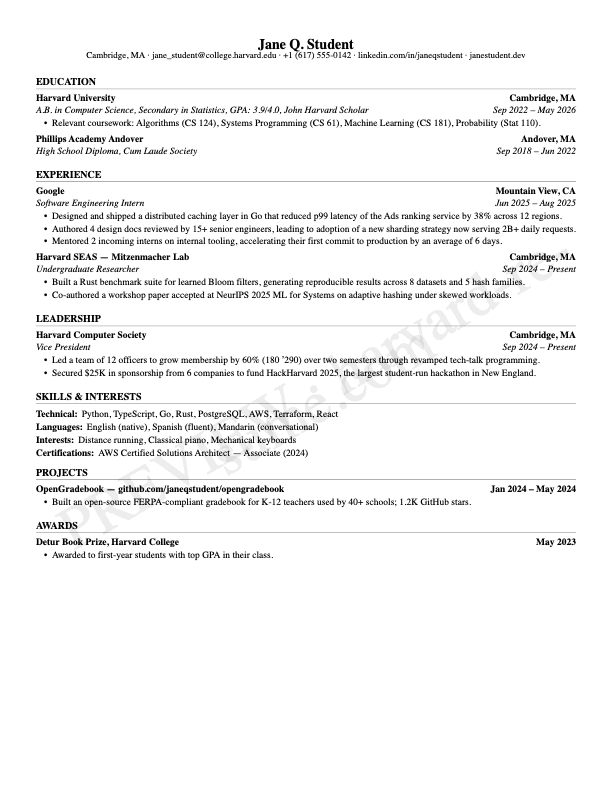
Sample in Harvard format
Strong vs weak bullets
Worked on improving the production line efficiency
Led a DMAIC project on the bottleneck assembly cell, raising OEE from 62% to 81% across 3 shifts by re-balancing 11 workstations and applying SMED to cut changeover from 47 to 12 minutes; added 1,400 units/day with no capital spend
Names the method (DMAIC, SMED), the headline metric (OEE +19 pts), the scope (3 shifts, 11 stations), and the business outcome (1,400 units/day, zero capex). A plant manager sizes your impact in four seconds.
Helped reduce defects and improve quality on the line
Reduced solder-defect PPM from 3,200 to 540 on a 1.2M-unit/year SMT line by running a Six Sigma root-cause study in Minitab and installing 4 Poka-Yoke fixtures; saved $310K/yr in rework and scrap
Specific defect metric (PPM), the analytical tool (Minitab), the countermeasure (Poka-Yoke), the volume (1.2M units/yr), and dollar impact ($310K/yr). It reads like someone who actually ran the study.
Worked on the warehouse layout and inventory
Redesigned the 85,000-sq-ft DC slotting and pick path using FlexSim simulation and ABC analysis, lifting pick productivity 28% (118 → 151 lines/hr) and cutting average order cycle time from 6.2 to 4.1 hours across 9,400 SKUs
Names the tool (FlexSim), the technique (ABC slotting), the scale (85K sq ft, 9,400 SKUs), and two hard metrics (lines/hr, cycle time). Logistics recruiters scan for exactly this.
Implemented Lean practices and 5S in the plant
Rolled out 5S and daily kaizen across 6 production cells (140 operators), embedding tiered standard work that cut average cycle time 17% and lowered the OSHA recordable rate from 4.8 to 1.9 per 200K hours over 14 months
Lean is easy to claim and hard to prove — this shows the spread (6 cells, 140 operators), a productivity metric (cycle time -17%), and a safety metric (recordable rate halved), which plants weight heavily.
Mistakes specific to this role
- Writing duty-based bullets ("responsible for process improvement") instead of leading with the number you moved. Every line needs a metric.
- Claiming "Six Sigma" without the belt or certifying body. State "ASQ Certified Green Belt" or omit — vague claims read as padding.
- Listing software as a wall of acronyms with no depth. Name the 5-7 tools you can be tested on (SAP, Minitab, FlexSim) and show one in a bullet.
- Omitting scope. "Reduced cycle time 20%" on a 12-unit/day pilot is not the same as on a 30,000-unit/day line — give the reviewer the denominator.
- Forgetting safety and standards. Plants in auto (IATF 16949), pharma (GMP), and food expect at least one compliance or safety signal.
Your résumé starts here. Pay later.
Start composingFrequently asked
- Where do I put my Lean Six Sigma certification — and does belt color matter?
- Yes, belt matters. State it explicitly with the body: "ASQ Certified Six Sigma Black Belt" or "IISE Lean Green Belt." Put it in a short Certifications line near the top or in your Technical Skills block. A Black Belt earns a top-third placement; a Yellow Belt sits in Skills.
- I'm a new grad with only co-op and capstone experience. How do I fill a Harvard one-pager?
- Lead with quantified co-op/internship projects and your capstone, each with a tool and a measured result (e.g., "reduced station cycle time 22% via a time-study and line balance in Arena"). A Projects section is fully accepted for IE new grads — recruiters know your impact came from school and internships.
- Should I tailor the résumé toward manufacturing vs. supply chain vs. consulting?
- Yes — IE fans out into very different roles. For plant/manufacturing, lead with OEE, scrap, SMED, and safety. For supply chain/logistics, lead with inventory turns, fill rate, slotting, and cycle time. For ops consulting, lead with $ savings, client scope, and the methodology. Reorder bullets, don't rewrite the whole thing.
- Do I need to show specific software, or is "proficient in industry tools" enough?
- Name them. Industrial engineering screens hard on tooling: SAP or Oracle ERP, Minitab for statistics, AutoCAD/SolidWorks for layout, Arena or FlexSim for simulation, and Power BI/Tableau for reporting. List the 5-7 you can defend in an interview and demonstrate at least one inside an experience bullet.