Design & Built Environment · 2026
Harvard Resume for Interior Designers
Interior design hiring runs on portfolio plus résumé in parallel. The one-page résumé is where you prove you can specify, document, and deliver a project on budget — not just style a room.
How do I write a Interior Designers resume in the Harvard format?
Interior design hiring is portfolio-first, but the résumé does the first filter — typically 6–10 seconds where a principal or design director scans for project type (residential vs. hospitality vs. corporate), software stack, NCIDQ status, and whether you can actually run FF&E, construction documents, and a budget. The Harvard format suits designers well: it forces years of projects down to the square footage, dollar values, and on-time-on-budget outcomes that signal you can be trusted with a client and a contractor.
What recruiters look for
- NCIDQ certification (or 'eligible / sitting [date]') for commercial and contract roles; LEED AP or WELL AP a strong plus
- CIDA-accredited degree, and for kitchen/bath roles an NKBA credential (AKBD/CKD)
- Documented software stack: Revit, AutoCAD, SketchUp + Enscape/V-Ray, with 3ds Max, Bluebeam, and Studio Designer / DesignFiles for specs and billing
- Project scope quantified in square footage and construction/FF&E budget, not adjectives
- Evidence you produced real deliverables — CDs, finish schedules, FF&E packages, code/ADA review — not just mood boards
- Sector fit named (high-end residential, hospitality, healthcare, workplace, retail) matched to the firm's book of work
Required sections, in this order
Header customisation
- Portfolio URL as the second contact-line entry, right after email — a 404 here is the most common silent rejection
- Optional one-line tagline under your name: e.g., 'Interior Designer · NCIDQ · Hospitality + Workplace · 7 yrs'
- List NCIDQ / LEED AP / WELL AP / NKBA credentials after the name only if current; otherwise put them in Skills with status and date
Experience bullets — interior-design specific
- Lead with the project type, square footage, and budget; the visual result is the portfolio's job, not the bullet's
- Quantify what you produced (CD sets, FF&E line items specified, finish schedules) and what you delivered (on budget, on schedule, value engineered)
- Pair a hard outcome (budget held, schedule met, sell-through) with a craft outcome (a specification or detail you owned end to end)
Skills section content
- Software: 5–8 you use weekly — Revit, AutoCAD, SketchUp, Enscape, Bluebeam, Studio Designer — not the entire Adobe suite
- Technical: space planning, construction documents, FF&E specification, building codes, ADA/accessibility, sustainability (LEED/WELL)
- Domain: vendor and trade relationships, procurement, millwork/casework detailing, lighting and finish specification — only what you've actually done
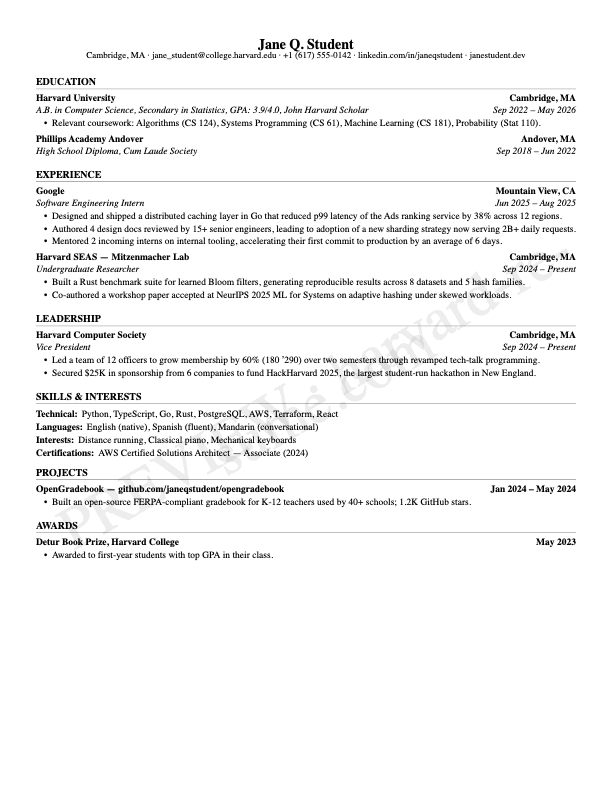
Sample in Harvard format
Strong vs weak bullets
Designed a boutique hotel and helped pick the finishes
Led interior design for an 84-key boutique hotel (62,000 SF) on a $4.1M FF&E budget; specified all guestroom and lobby finishes, lighting, and casework, produced the full CD set in Revit, and delivered the package 3 weeks ahead of the GC's bid deadline with zero RFIs on finish schedules
Names sector (boutique hotel), scale (84 keys / 62k SF), budget ($4.1M), the deliverable (full CD set in Revit), and a hard quality signal (zero RFIs, ahead of schedule). A principal infers you can be left alone with a project.
Worked on FF&E and stayed within budget
Specified and procured FF&E for a 9-floor (118,000 SF) corporate HQ workplace fit-out — 1,400+ line items across furniture, lighting, and finishes — and value-engineered the package to land 6% under the $2.3M budget while holding the design intent through three rounds of GC pricing
Quantifies the FF&E scope (1,400+ items / 9 floors / 118k SF), the budget ($2.3M), and the outcome (6% under) with the discipline that matters to commercial firms: holding design intent through value engineering.
Did residential projects and made clients happy
Managed 11 concurrent high-end residential projects (avg. $350K construction value) from concept through installation; ran client presentations in SketchUp + Enscape, achieved 94% spec sell-through on first presentation, and held average project margin at 32% across the studio's busiest year
Concurrency (11 projects), deal size (avg. $350K), the tools used client-facing (SketchUp + Enscape), a designer-specific KPI (94% sell-through), and a business outcome (32% margin) — exactly what a residential studio principal judges.
Made sure designs met code and accessibility requirements
Owned code and accessibility review across a 22,000 SF ambulatory clinic, coordinating ADA clearances, egress, and FGI healthcare guidelines with the architect of record; cleared plan-check on first submission, avoiding an estimated 4–6 week permitting delay
Replaces vague 'met code' with named standards (ADA, egress, FGI), the sector (healthcare), the scope (22k SF), and a measurable outcome (first-submission plan-check, weeks of delay avoided).
Mistakes specific to this role
- A 'design philosophy' paragraph at the top. Save it for the portfolio's about page; the résumé is for scope and outcomes.
- Describing the aesthetic ('a warm, layered, timeless palette') instead of the project — square footage, budget, deliverables, and your role.
- Listing every Adobe and rendering app you've ever opened. Name the 5–8 tools you'd be tested on, led by Revit, AutoCAD, and SketchUp.
- Hiding NCIDQ status. If you're eligible or sitting the exam, say so with a date — commercial firms screen on it.
- No portfolio link, or one that 404s or opens a 200 MB PDF. The single most common reason a talented designer never gets the call.
Your résumé starts here. Pay later.
Start composingFrequently asked
- Do I need NCIDQ on my interior design résumé?
- For commercial, contract, healthcare, and hospitality roles it's close to mandatory — many states require it to use the 'interior designer' title and to stamp/submit drawings. If you're not certified yet, write 'NCIDQ eligible' or 'sitting [exam date]'. For pure residential it matters less, but it still reads as a credibility signal.
- Should I send a portfolio PDF, a website, or both?
- A link to a fast website or a hosted, paginated portfolio (under ~20 MB) — not a giant email attachment. Put the URL on the contact line. The site signals you can curate and self-publish; reserve the heavy PDF for when a firm asks for it directly.
- How do I show projects from a firm where I wasn't the lead?
- Name your actual role and the deliverables you owned: 'produced CD set and FF&E schedule for...', 'detailed the millwork and reception casework', 'managed procurement for 600+ line items'. Never imply you led a project you supported — principals know how studios staff jobs and will catch it.
- Which metrics actually belong on an interior design résumé?
- Square footage and construction/FF&E budget on every project bullet; then sector-specific KPIs — spec sell-through and project margin for residential, on-budget/on-schedule and RFI counts for commercial, plan-check pass rate for code-heavy work, and number of concurrent projects to show throughput.