Media & Journalism · 2026
Journalist Resume: Harvard Format Guide
Prove your reporting moves audiences, breaks news, and survives a fact-check — on one page.
How do I write a Journalist Resume: Harvard Format Guide resume in the Harvard format?
Newsroom editors skim for proof you can find, verify, and publish stories that move audiences before the competition does. A Harvard-format journalist resume turns vague 'reported on local issues' lines into quantified bylines — pageviews, scoops broken first, corrections rate, and the beats you own. Lead with output an editor can verify in a clip search, not adjectives about your 'passion for storytelling.'
What recruiters look for
- Verifiable output: byline count, beat ownership, and a clips/portfolio link (Authory, Muck Rack, or personal site) editors can check
- CMS and publishing fluency — WordPress, Arc XP, Chorus, or proprietary newsroom systems — plus SEO basics (headline testing, metadata, Google Trends)
- Audience and engagement metrics: monthly pageviews, average time-on-page, newsletter open rates, and traffic from search vs. social
- Sourcing and verification discipline: FOIA/public-records requests filed, on-the-record sourcing, fact-check pass rate, and a clean corrections record
- Multimedia range: shooting and editing video/audio (Adobe Premiere, Audition), CapCut for social, data tools (Excel, Datawrapper, Flourish), and basic HTML
- Ethics and legal literacy — SPJ Code of Ethics, libel/defamation awareness, embargo handling, and anonymous-source protocols
Required sections, in this order
Header, Beat Summary & Clips Link
- Put a live portfolio link (Muck Rack, Authory, or personal domain) in the header next to email and city — editors click it before they read bullet two.
- Replace a generic objective with a one-line beat summary: 'Investigative reporter covering municipal finance; 40+ bylines/year, two stories cited in city-council hearings.'
- Name your beats explicitly (politics, health, courts, tech) — recruiters filter for beat fit, and 'general assignment' reads as junior if you have specialization.
- List languages and locations served; bilingual reporting and on-the-ground coverage of a specific region are concrete differentiators.
Experience Bullets in Harvard XYZ Form
- Use 'Accomplished X, measured by Y, by doing Z' — quantify with pageviews, scoops broken first, time-to-publish, or downstream impact (policy change, retraction forced).
- Lead with the strongest verb-plus-metric: 'Broke,' 'Investigated,' 'Filed,' 'Produced' — never 'Responsible for covering.'
- Show range across the news cycle: a breaking-news bullet (speed), an enterprise/investigative bullet (depth), and an engagement bullet (audience growth).
- Credit collaboration honestly but claim your contribution: 'Co-reported a 6-part series' is fine; specify which records you pulled or sources you developed.
Skills, Tools & Recognition
- Group skills concretely: Reporting (FOIA, SEC filings, data analysis), Production (Premiere, Audition, Datawrapper), CMS/SEO (Arc XP, WordPress, Google Trends).
- List awards and fellowships with the granting body and year — SPJ, regional SPJ Mark of Excellence, Dow Jones News Fund, Pulitzer-entered work — not vague 'award-winning.'
- Include measurable side-output: a newsletter you grew, a podcast's download count, or freelance bylines in named outlets.
- Add a 'Selected Clips' line with 2-3 headline + outlet + one-line impact, so the page doubles as a curated reel.
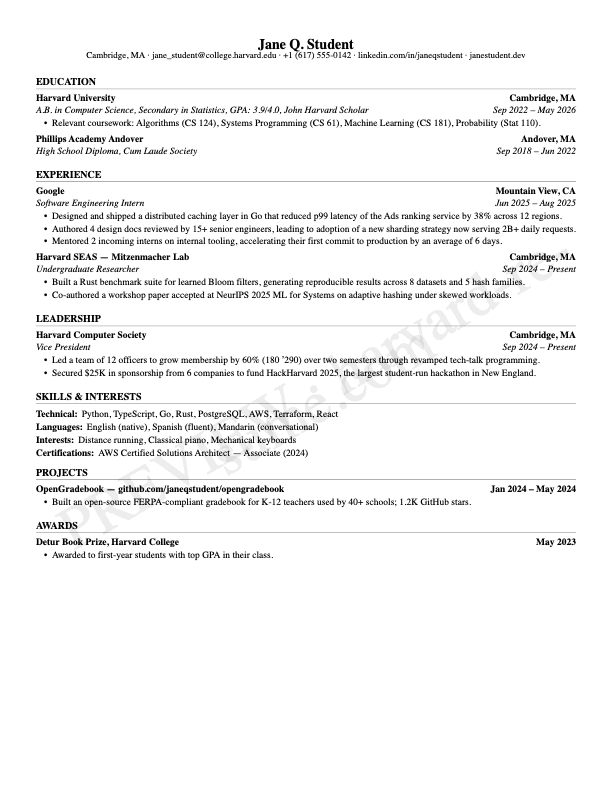
Sample in Harvard format
Strong vs weak bullets
Wrote articles about local government and current events for the newspaper.
Owned the city-hall beat, publishing 120+ bylines/year that drove 1.4M annual pageviews; broke the $3.2M contracting scandal first, forcing a council audit two weeks before competitors picked it up.
Quantifies output (bylines), audience (pageviews), the scoop (broke first), and downstream impact (forced audit) — all verifiable in a clip search.
Used public records to investigate a story.
Filed 14 FOIA requests over four months and built an Excel database of 2,800 permit records to expose a zoning-favoritism pattern, a 4,500-word investigation cited in two state-legislature hearings.
Names the method (FOIA), the scale (14 requests, 2,800 records, 4,500 words), and the impact (cited in hearings) — proof of investigative rigor, not just effort.
Helped grow the newsletter and social media following.
Launched and wrote a twice-weekly local-news newsletter, growing it from 0 to 11,000 subscribers in 9 months at a 47% open rate — 18 points above the newsroom's media-industry benchmark.
Shows audience-building with a real channel, hard numbers, and a benchmarked open rate that proves the growth was quality, not list-padding.
Produced video content for the website.
Shot and edited 60+ short-form vertical videos in Premiere and CapCut, lifting the outlet's average article time-on-page from 1:10 to 2:35 and adding 240K monthly TikTok views to the brand.
Demonstrates multimedia production with named tools and two engagement metrics (time-on-page lift, platform reach), signaling modern newsroom value.
Mistakes specific to this role
- Listing 'covered news' with no numbers — editors can't tell 5 bylines from 500; always quantify output, audience, or impact.
- Omitting a clips link, forcing the editor to Google you. A dead or missing portfolio link reads as 'no recent work.'
- Claiming team scoops as solo work; editors verify bylines and will catch inflation — specify your exact contribution instead.
- Burying multimedia and data skills in a dense paragraph when newsrooms specifically filter for Premiere, Datawrapper, and CMS experience.
- Spilling to two pages with old internships and class projects; keep the Harvard one-page discipline and lead with your strongest recent clips.
Your résumé starts here. Pay later.
Start composingFrequently asked
- Should I link a portfolio or paste clips into the resume?
- Link, don't paste — a Harvard resume stays one page. Put a live Muck Rack, Authory, or personal-site URL in the header, then add a 'Selected Clips' line with 2-3 headline-plus-outlet entries. Editors will click through to verify; the resume's job is to earn that click.
- How do I quantify journalism work without sounding like a marketer?
- Use newsroom-native metrics, not vanity numbers: bylines per year, pageviews, time-on-page, scoops broken first, FOIA requests filed, corrections rate, and downstream impact (a policy reversed, an official resigning). These read as craft, not self-promotion, because every editor knows what they cost to earn.
- I'm a freelancer with bylines across many outlets — how do I structure it?
- List 'Freelance Journalist' as one role with the named outlets as a sub-line (e.g., 'bylines in The Atlantic, Wired, local NPR affiliate'), then bullet your best 3-4 stories by impact and metric. Lead with the most recognizable outlet and the story with the clearest downstream effect.
- How do I show verification and ethics on a resume?
- Bake it into bullets rather than listing it as a soft skill: cite a clean corrections record, on-the-record sourcing percentages, fact-check pass rates, or FOIA work. A line like 'maintained a 0.3% correction rate across 300+ published pieces' signals rigor far better than 'detail-oriented.'