Law · 2026
Harvard Resume for Law School Applicants
Law school admissions weigh academic signal heavily. LSAT, GPA, and writing differentiation go up top.
How do I write a Law School Applicants resume in the Harvard format?
Law school applications are decided largely on numbers — LSAT, GPA, and softs are the standard frame. The résumé's job is to surface academic seriousness, writing depth, and any unusual leadership or research that explains why you'd be a distinctive addition to the class.
What recruiters look for
- LSAT score (175+ for T14, 170+ for T20)
- GPA from a serious major (history, philosophy, political science, classics)
- Honors thesis / journal publication / law review at undergrad
- Moot court, mock trial, or debate competition success
- Writing samples beyond the application essay (op-eds, journal articles)
Required sections, in this order
Education section
- LSAT in the Education section, italicised next to degree
- GPA + major + honors / Phi Beta Kappa
- Honors thesis title + advisor (if applicable)
- Law-relevant coursework only if you majored in something unusual
Experience emphasis
- Pre-law experience: bullets emphasise writing, research, argumentation
- Quantify research outputs (briefs drafted, cases researched, citations used)
- For non-traditional applicants: highlight career change motivation in one bullet per role
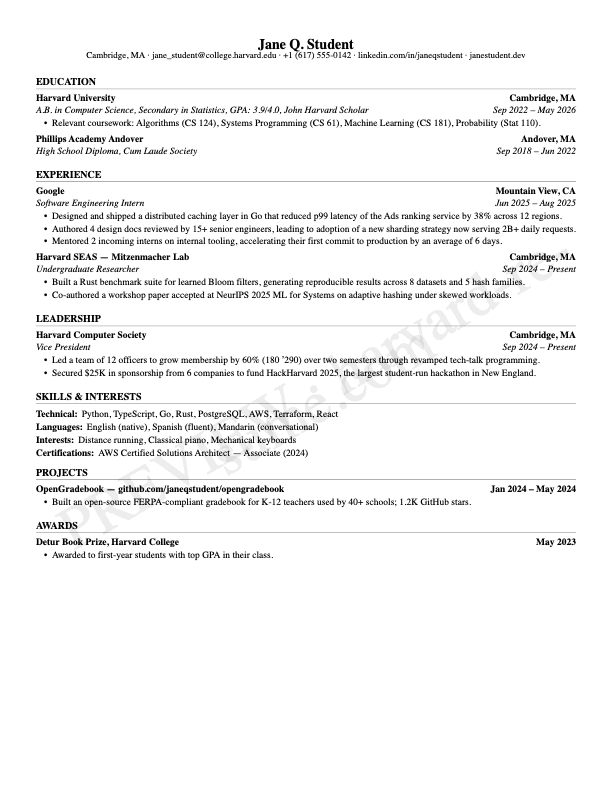
Sample in Harvard format
Strong vs weak bullets
Worked as a paralegal at a law firm
Paralegal · Sullivan & Cromwell LLP, Litigation Group, NYC · drafted 14 motions and 8 deposition outlines in support of $XB cross-border M&A litigation; researched 200+ case citations across federal circuits; cited by associates in 3 successful summary judgment motions
Specific drafting outputs + deal context + research scale + downstream impact (cited in motions). A committee sees future law-student fluency.
Member of moot court team
Moot Court Member · Northwestern Pre-Law Society · ranked top-8 nationally at ABA National Negotiation Competition 2024; co-authored 35-page brief on antitrust precedent; argued before a panel of federal judges (semi-final)
Competition placement, brief length, subject matter, and audience seniority. Distinguishes from 'member of moot court' which appears on many résumés.
Volunteered at a legal aid clinic
Volunteer · Boston Asylum & Immigration Law Center · 200 hours: interviewed 18 asylum applicants in Spanish; drafted 6 affidavits and supporting briefs; trained 4 incoming volunteers on documentation protocols
Hours, client count, languages used, drafting work, and training (= leadership) all in one bullet.
Mistakes specific to this role
- Listing LSAT below 165 unless it's near the school's median.
- Hiding GPA above 3.7 in a footer. Surface it boldly in Education.
- Generic 'attention to detail' or 'strong analytical skills' bullets — these are assumed.
- Listing all moot court / mock trial competitions you entered. Only list those where you placed.
Your résumé starts here. Pay later.
Start composingFrequently asked
- Where do publications in undergrad law journals go?
- Under a Publications section between Education and Experience if you have 2+. Single publication can go in Education under thesis or in Experience under the relevant role.
- Should I include character & fitness disclosures here?
- Never on the résumé. The application has its own C&F section.
- How do non-traditional applicants frame a career change?
- Don't write a 'why law' paragraph on the résumé (that's the personal statement). But one bullet per recent role can include law-adjacent work that signals motivation (regulatory work, contract negotiation, advocacy).