Supply Chain & Logistics 2026
Logistics Coordinator Resume (Harvard Format)
Show you keep freight moving on time, on budget, and on the dock — with the numbers to prove it.
How do I write a Logistics Coordinator Resume (Harvard Format) resume in the Harvard format?
A Logistics Coordinator resume has to prove you can orchestrate carriers, inventory, and warehouse flow without dropping a shipment — and that you read a freight invoice as fast as a dispatch board. Recruiters at 3PLs, manufacturers, and e-commerce ops scan for the systems you run (SAP, Oracle TMS, Manhattan WMS), the lanes and volumes you've handled, and hard metrics like OTIF, dwell time, and cost per shipment. This guide turns 'coordinated shipments' into quantified Harvard-format bullets that survive an ATS and a supply-chain manager's eye.
What recruiters look for
- Hands-on use of named systems: TMS (Oracle OTM, MercuryGate, project44), WMS (Manhattan, Blue Yonder, SAP EWM), and ERP modules (SAP MM/SD, Oracle SCM)
- Core KPIs owned, not just mentioned: OTIF %, on-time delivery, dwell/detention hours, fill rate, freight cost per unit/shipment, and inventory accuracy
- Mode and scope literacy: LTL/FTL, parcel, intermodal, ocean FCL/LCL, air freight, and reverse logistics — with carrier and lane counts
- Compliance and documentation: BOL, ASN/EDI 856, customs/Incoterms 2020, HAZMAT/IATA/DOT, and C-TPAT awareness
- Continuous-improvement credentials: Six Sigma Yellow/Green Belt, APICS/ASCM CSCP or CLTD, Lean, and demonstrated cycle-time or cost reductions
- Cross-functional throughput signals: shipments/orders per day handled, carrier disputes resolved, and SLA performance vs. target
Required sections, in this order
Header & Summary
- Place name, city/metro, phone, professional email, and LinkedIn on one line — recruiters route by region for warehouse/DC roles, so include your metro.
- Skip the generic objective; use a 2-line positioning summary naming your strongest mode and a flagship metric (e.g., 'Logistics Coordinator managing 40+ LTL/FTL lanes at 98.2% OTIF').
- Mirror the job posting's exact terms — TMS, OTIF, 3PL, EDI — so the ATS keyword match fires before a human ever reads it.
Experience (XYZ Bullets)
- Lead every bullet with a strong verb (Coordinated, Negotiated, Expedited, Routed, Reconciled) and a number — daily shipment volume, dollars of freight spend, or a KPI delta.
- Tie work to outcomes the business cares about: cost savings, OTIF gains, reduced detention, or fewer claims — not just tasks you performed.
- Quantify scale even for support work: 'processed 150+ inbound ASNs/day' or 'audited $1.2M in monthly carrier invoices' shows the throughput you can handle.
- Order bullets by impact within each role, leading with cost or service-level wins over routine duties.
Skills, Tools & Education
- Group skills by category: Systems (SAP EWM, Manhattan WMS, MercuryGate TMS), Modes (LTL, FTL, intermodal, parcel), and Compliance (Incoterms 2020, HAZMAT, EDI 856).
- List certifications with issuer and year: ASCM CLTD, APICS CSCP, Six Sigma Green Belt, OSHA forklift, or freight-broker license.
- Keep education concise — degree, school, year — and add relevant coursework or a supply-chain capstone only if you're early-career.
- Add Excel depth (pivot tables, VLOOKUP/Power Query) and any SQL or Power BI you use for freight and inventory reporting.
Sample in Harvard format
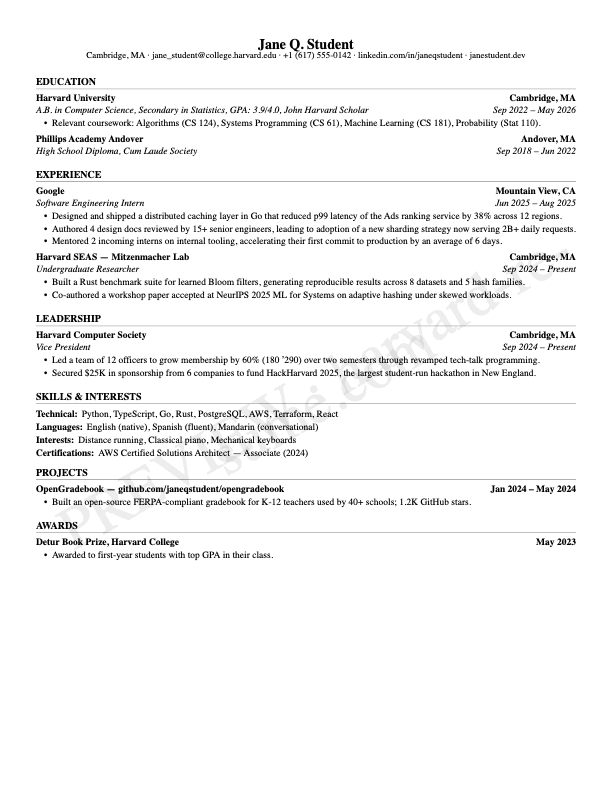
Strong vs weak bullets
Responsible for coordinating shipments with carriers.
Coordinated 120+ daily LTL/FTL shipments across 45 lanes and 12 carriers, sustaining 98.4% OTIF while cutting average dwell time from 6.2 to 3.1 hours via dock-appointment scheduling in MercuryGate TMS.
Names volume, mode, lane/carrier count, the OTIF metric, a quantified dwell improvement, and the specific TMS — proving real ownership, not a vague duty.
Helped reduce freight costs for the company.
Negotiated and re-routed 22 underperforming LTL lanes by benchmarking rates in Oracle OTM, reducing freight cost per shipment 14% ($310K annualized) with no decline in on-time delivery.
Quantifies the cost reduction in percent and dollars, names the system, and protects the service-level tradeoff recruiters worry about.
Worked with the warehouse team on inventory accuracy.
Reconciled inbound ASNs (EDI 856) against POs in SAP EWM for 9,000+ SKUs, raising inventory accuracy from 94.1% to 99.3% and cutting cycle-count discrepancies 67% over two quarters.
Shows the exact document/standard (EDI 856), the ERP, SKU scale, and two before/after accuracy metrics tied to a clear timeframe.
Handled customer issues and shipment problems.
Resolved 30+ weekly carrier exceptions and OS&D claims, recovering $48K in detention and damage credits over six months and lifting customer SLA compliance from 91% to 97%.
Turns vague 'issues' into OS&D/detention specifics with claim counts, recovered dollars, and an SLA improvement — the language a logistics manager uses.
Mistakes specific to this role
- Listing duties ('responsible for scheduling deliveries') instead of quantified outcomes — recruiters can't tell a high-throughput coordinator from a clerk without numbers.
- Omitting the systems you actually operate; a resume with no named TMS/WMS/ERP fails the ATS keyword screen for most logistics roles.
- Using vague metrics like 'improved efficiency' instead of OTIF %, cost per shipment, dwell hours, or fill rate that the role is literally measured on.
- Spilling onto a second page; Harvard format demands one tight page, so cut hobbies, full addresses, and stale pre-2015 roles.
- Ignoring compliance keywords (Incoterms, HAZMAT, C-TPAT, EDI) that hiring managers in regulated or cross-border logistics screen for first.
Your résumé starts here. Pay later.
Start composingFrequently asked
- Which metrics matter most on a Logistics Coordinator resume?
- Lead with OTIF (on-time-in-full), on-time delivery %, freight cost per shipment or per unit, dwell/detention hours, inventory accuracy, and fill rate. Pair each with scale — shipments per day, lanes, SKUs, or annual freight spend — so the number means something. If you reduced a cost or improved a service level, show the before-and-after.
- Should I list TMS and WMS systems even if I only used them briefly?
- Yes — name every system you've touched (Oracle OTM, MercuryGate, Manhattan, SAP EWM, Blue Yonder) because ATS filters and recruiters keyword-match on them. Just be honest about depth: put your strongest platforms in a dedicated Systems line and keep lighter exposure in context within a bullet.
- How do I write a logistics resume with no formal coordinator title yet?
- Translate adjacent experience — shipping/receiving, dispatch, warehouse, or customer service — into logistics language and metrics: shipments processed, carriers contacted, inventory counted, SLA hit. Add a relevant certification (ASCM CLTD, OSHA forklift, Six Sigma Yellow Belt) and a project or capstone to signal you're moving toward the coordinator scope.
- Do certifications like CSCP or CLTD really help?
- They help most when you lack years of experience or want to move into planning-heavy roles. ASCM/APICS CLTD and CSCP signal you understand end-to-end supply chain, and a Six Sigma belt signals process improvement. List them with issuer and year, but never let a cert replace quantified results in your experience bullets.