AI & Machine Learning · 2026
Harvard Resume for Machine Learning Engineers
Recruiters scan for models in production, not Kaggle notebooks — ship measurable inference, not a framework list.
How do I write a Machine Learning Engineers resume in the Harvard format?
Machine Learning Engineers are hired by ML platform teams, applied-science orgs, and product teams who scan your résumé for one thing first: did your models ship to production and move a metric? The gap between a data scientist's notebook and an MLE's served model is exactly what recruiters at companies like OpenAI, Scale AI, and any series-B with a recommender are screening for — training pipelines, serving latency, A/B-tested lift, and inference cost. The Harvard one-page format forces you past a wall of framework logos into outcomes measured in AUC points, milliseconds at p99, and dollars per million inferences.
What recruiters look for
- Models actually in production with online metrics: A/B-tested lift (CTR, conversion, retention), AUC/F1/precision@k improvement, offline-to-online correlation
- Serving and latency engineering: p99 inference latency, throughput (QPS), GPU utilization, quantization/distillation, ONNX/TensorRT/Triton, batching
- MLOps depth, not just modeling: training pipelines (Kubeflow, Airflow, SageMaker), feature stores (Feast, Tecton), model registry, CI/CD for models, drift monitoring
- Framework and scale specifics: PyTorch/TensorFlow/JAX, distributed training (DDP, FSDP, DeepSpeed), data volume (TB), parameter count, training cost ($/run)
- Inference cost engineering: $ per million predictions cut, GPU hours saved via batching/caching/distillation, spot/Inferentia/quantization savings
- Credentials that gate the role: relevant MS/PhD in CS/ML/Stats, top-tier publications (NeurIPS/ICML/CVPR), or shipped models with real traffic in lieu of pedigree
Required sections, in this order
Lead with Shipped Models, Not a Framework Wall
- Put a tight Experience section first after Education; open each bullet with the production outcome (online lift, latency cut, cost saved), not 'used PyTorch'
- State the model and scale in the bullet: 'fine-tuned a 7B-param LLM on 40M support tickets' tells a reviewer the real blast radius instantly
- Cap a grouped 'Technical Skills' block at the bottom — Modeling / MLOps / Serving / Data — so the ATS keyword-matches without a 25-item soup
- Cut Kaggle medals and tutorial-grade projects unless top-50 or genuinely novel; recruiters discount competitions that never saw production traffic
Make Education, Research & Certs Work Harvard-Style
- Education first, one line each: degree, institution, year — list a thesis or specialization (NLP, CV, RL) only if it maps to the target role
- List peer-reviewed publications with venue and year (NeurIPS, ICML, EMNLP); a first-author paper at a top venue outweighs most certs
- Add cloud/ML certs (AWS ML Specialty, GCP Professional ML Engineer, TensorFlow Developer) under Education with issuer and year — useful for ATS, secondary to shipped work
- If you transitioned from data science or SWE, lead with the first model you owned end-to-end from training to serving
One Page, ATS-Clean, Metric-Dense
- No photo, no DOB, no skill bars or radar charts — a 0.87 AUC is a number, not a progress bar
- Single column, standard fonts, no tables or text boxes — ATS parsers shred multi-column ML résumés into garbage and lose your metrics
- Spell out the term then the acronym once: 'Retrieval-Augmented Generation (RAG)', 'Mean Time To Detect (MTTD)' so both variants match
- Reverse-chronological, action-verb bullets (Trained, Deployed, Quantized, A/B-tested) — every line carries a model, a metric, or it gets cut
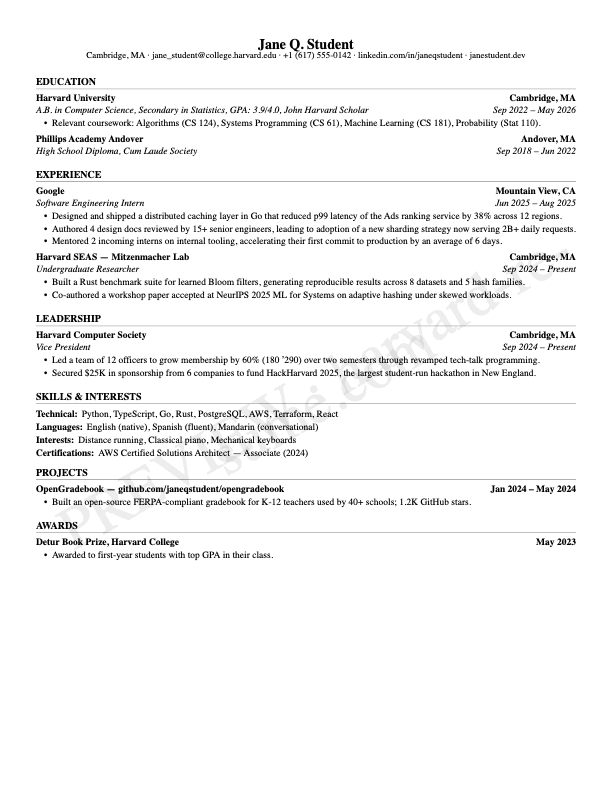
Sample in Harvard format
Strong vs weak bullets
Built a machine learning model to improve recommendations.
Shipped a two-tower retrieval model in PyTorch to the homepage recommender, lifting click-through rate 11.4% and add-to-cart 6.2% in a 4-week A/B test across 8M weekly users; served at p99 28ms behind a Triton + ONNX runtime.
Names the architecture (two-tower retrieval), the online metric from a real A/B test (CTR +11.4%), the scale (8M users), and the serving stack and latency (Triton, p99 28ms). A reviewer infers production ML in seconds.
Worked on reducing the cost of model inference.
Cut inference cost 62% ($310K/year) by distilling a 1.3B-param model to 350M, quantizing to INT8 with TensorRT, and adding dynamic batching — holding accuracy within 0.4 F1 of the teacher while raising throughput from 140 to 520 QPS per GPU.
Dollars and percent, the exact levers (distillation, INT8, dynamic batching), and the guardrail (accuracy within 0.4 F1). This is serving maturity, not a vague 'worked on cost'.
Set up a pipeline for training models.
Built an end-to-end training pipeline in Kubeflow with a Feast feature store and automated drift monitoring, cutting model retraining from a 3-day manual process to a 4-hour automated run and catching a 9-point precision drop before it hit production.
Names the MLOps stack (Kubeflow, Feast), the velocity win (3 days → 4 hours), and the reliability payoff (caught a 9-point precision drop). It reads like real platform ownership, not a notebook.
Fine-tuned a large language model for the support team.
Fine-tuned a 7B-param LLM with LoRA on 40M anonymized support tickets and deployed it behind a RAG layer, deflecting 34% of Tier-1 tickets and cutting median handle time from 8.5min to 3.2min while keeping hallucination rate under 2% via grounded retrieval.
Model size and method (7B, LoRA), data scale (40M tickets), the business outcome (34% deflection, handle time cut), and a quality guardrail (hallucination under 2%). Production LLM discipline in one line.
Mistakes specific to this role
- Listing models you only ran in a notebook. Recruiters screen for production traffic — if a model never served a real user or moved a metric, it's a project, not an accomplishment.
- Reporting only offline metrics. 'Improved AUC to 0.91' is weak without the online result; pair offline lift with the A/B-tested business metric (CTR, conversion, retention).
- Framework-listing instead of outcomes ('experienced in PyTorch, TensorFlow, scikit-learn'). Every bullet needs a number: AUC/F1 lift, p99 latency, QPS, or $ of inference cost cut.
- Hiding the scale and cost. 'Trained a model' is meaningless; '7B params, 40M examples, $4K/run on 8×A100' tells the reviewer your real footprint.
- Going two pages with coursework, every Kaggle entry, and 'familiar with' tools. Harvard discipline is one page — if a bullet has no model and no metric, it's filler, cut it.
Your résumé starts here. Pay later.
Start composingFrequently asked
- How do I show I'm an ML Engineer and not just a data scientist?
- Emphasize what happens after the notebook: models you deployed to production, the serving stack (Triton, TorchServe, SageMaker endpoints), latency and throughput at scale, training pipelines (Kubeflow, Airflow), and online A/B-tested results. Data scientists analyze; MLEs ship and serve. Lead every bullet with a production outcome, not an offline metric, and name the infrastructure you owned.
- Do I need a PhD or top-tier publications to get screened in?
- No. A PhD and a NeurIPS/ICML first-author paper help for research-scientist tracks, but for applied MLE roles, shipped models with real traffic and measurable lift outweigh pedigree. If you have publications, list them with venue and year; if you don't, lead with end-to-end models you trained, deployed, and A/B-tested. Many strong MLEs hold an MS or transitioned from SWE.
- Should I list certifications like AWS ML Specialty or GCP Professional ML Engineer?
- They help with ATS filters and AWS/GCP-heavy teams, but they're secondary to shipped work. Put current cloud/ML certs under Education with issuer and year. One production model with A/B-tested lift outperforms three certs — don't let a cert list crowd out your serving and pipeline accomplishments.
- How do I quantify ML work when results are probabilistic or experiments fail?
- Use the metrics the field is judged on: offline (AUC, F1, precision@k, RMSE), online (A/B-tested CTR/conversion/retention lift), systems (p99 latency, QPS, GPU utilization), and cost ($ per million inferences, GPU hours saved). For experiments that didn't ship, frame the learning or the guardrail — e.g. 'built an eval harness that caught a 9-point precision regression before release.' Reviewers reward rigor and impact, not just wins.