Marketing · 2026
Harvard Resume for Marketing Managers
The hiring manager wants pipeline and CAC, not 'passionate storyteller' — your Harvard one-pager has to prove you moved a number.
How do I write a Marketing Managers resume in the Harvard format?
Marketing Manager roles are filled by VPs of Marketing, growth leads, and demand-gen directors who scan for one thing in the first six seconds: did you own a channel or a number and move it. They want to see pipeline sourced, CAC or ROAS, and the stack you ran (HubSpot, Salesforce, GA4, Google Ads). The Harvard one-page format forces you to cut the agency-speak and lead every bullet with a measured business result.
What recruiters look for
- Pipeline ownership: marketing-sourced and marketing-influenced pipeline in $, MQL→SQL conversion, and revenue attributed to your programs
- Efficiency metrics they can defend to finance: CAC, blended ROAS, cost-per-MQL, payback period, and LTV:CAC ratio
- Concrete stack fluency: HubSpot or Marketo, Salesforce, GA4, Google Ads, Meta Ads Manager, Looker/Tableau, and an SEO tool (Ahrefs/Semrush)
- Channel depth, not a laundry list — proof you actually scaled paid search, lifecycle email, content/SEO, or ABM rather than 'managed all channels'
- Cross-functional leadership: managing a team or agency budget, partnering with sales on SLAs, and owning a quarterly demand number
- Certifications that signal rigor: Google Ads / Analytics (GA4), HubSpot Inbound, Meta Blueprint, or a Pragmatic/Reforge growth credential
Required sections, in this order
Lead with a Results-First Experience block
- Put Experience near the top under Education and make every bullet open with the metric: '$2.4M pipeline,' '38% lower CAC,' '4.1x ROAS' — not 'Responsible for.'
- Title each role by scope, not vanity: 'Marketing Manager — Demand Generation (team of 4, $1.2M annual budget)' tells a reviewer your level instantly.
- Group bullets by the outcome that matters (pipeline, efficiency, brand/share) so a hiring VP can map you to their open gap in seconds.
- Cut anything you can't quantify or defend in an interview — a vague 'increased brand awareness' bullet costs you credibility on a one-pager.
Make Skills a stack, not a vibe
- List the actual platforms you operate, grouped: Martech (HubSpot, Marketo, Salesforce), Analytics (GA4, Looker, Mixpanel), Paid (Google Ads, Meta, LinkedIn Campaign Manager), SEO (Ahrefs, Semrush).
- Name the channels you can own end-to-end (paid search, lifecycle/CRM email, content/SEO, ABM) so the role's primary channel jumps out.
- Add certifications inline — Google Analytics (GA4), Google Ads Search, HubSpot Inbound, Meta Blueprint — they're fast trust signals for screeners.
- Drop generic soft skills ('team player,' 'creative'); the bullets should prove those, and the one-page Harvard format has no room for filler.
Keep Education and format Harvard-clean
- Education first with degree, institution, graduation year, and GPA only if 3.5+ or recent; add an MBA or marketing concentration if relevant to the level you're targeting.
- No photo, no date of birth, no full address — a city/metro line is enough and keeps the ATS and the reviewer focused on results.
- One page, reverse-chronological, consistent tense (past for prior roles, present for current), and a single clean font — this is the Harvard discipline.
- If you ran a notable side project or a portfolio (a blog you grew, a newsletter, a brand you launched), add one tight line with the metric, not a paragraph.
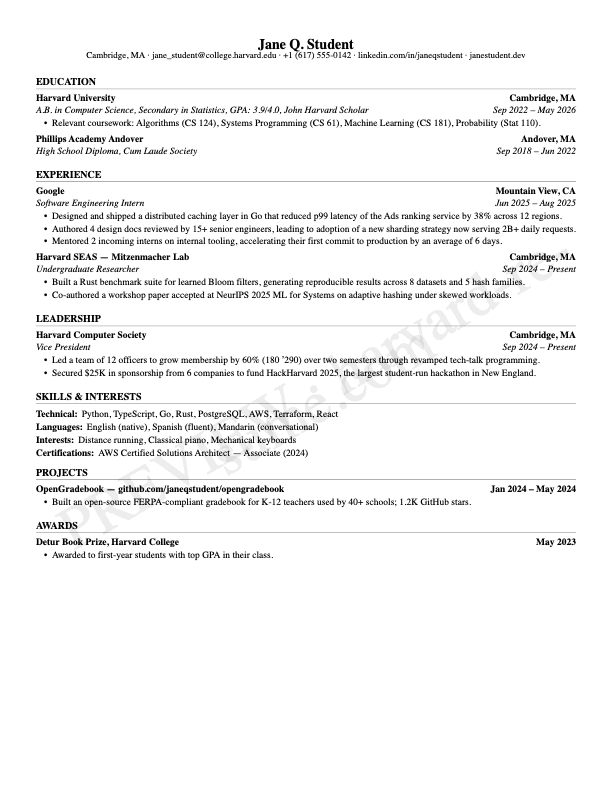
Sample in Harvard format
Strong vs weak bullets
Managed paid advertising campaigns across multiple channels to drive growth.
Scaled paid search and Meta from $40K to $180K/month while improving blended ROAS from 2.3x to 4.1x, sourcing $2.4M in pipeline and cutting cost-per-MQL by 31% over three quarters.
Names the channels, the budget scaled, the efficiency gain (ROAS), the pipeline in dollars, and the timeframe. A demand-gen director sees a P&L-literate operator in four seconds.
Ran email marketing and improved engagement with our audience.
Rebuilt the lifecycle email program in HubSpot across 9 segments, lifting MQL→SQL conversion from 14% to 23% and adding $610K in influenced pipeline per quarter with a 5-touch nurture sequence.
Specifies the tool, the segmentation work, the conversion metric that maps to revenue, and the dollar impact — 'engagement' alone proves nothing to a hiring manager.
Grew the company blog and SEO traffic significantly.
Grew organic traffic 142% YoY (18K→44K monthly sessions) by shipping 60 SEO briefs targeting bottom-funnel keywords, driving 1,100 inbound trials/quarter at a 78% lower CAC than paid.
Replaces 'significantly' with a YoY figure, the production volume, and ties traffic to trials and a CAC comparison — it proves SEO drove revenue, not just pageviews.
Led the marketing team and managed the budget.
Led a team of 4 and a $1.2M annual budget to hit 112% of the quarterly pipeline target for 5 consecutive quarters, reallocating spend to ABM that lifted enterprise win-rate from 19% to 27%.
Quantifies team size, budget, target attainment, and a strategic reallocation with a win-rate outcome — it shows leadership measured by results, the Harvard XYZ formula in action.
Mistakes specific to this role
- Leading bullets with responsibilities ('Responsible for managing campaigns') instead of outcomes — recruiters want the number you moved, not your job description.
- Listing every tool and channel you've ever touched. Depth wins: prove you scaled 2-3 channels rather than claiming you 'managed all of them.'
- Vanity metrics with no business link — impressions, followers, and 'engagement' mean nothing without pipeline, conversion, or CAC attached.
- Burying pipeline and revenue. If you sourced or influenced pipeline, that dollar figure belongs in the first bullet of each role, not the last.
- Spilling onto a second page with agency jargon. The Harvard one-pager is a forcing function — if a bullet doesn't carry a metric, cut it.
Your résumé starts here. Pay later.
Start composingFrequently asked
- I work in brand or content, not demand gen — how do I quantify my impact?
- Tie your work to a downstream number you can defend: organic traffic and trials from content, share-of-voice or branded search lift from brand campaigns, NPS or pipeline-influence from a rebrand. Even brand roles can show YoY traffic, sign-up, or influenced-pipeline figures — pick the metric closest to revenue.
- Should I list certifications like Google Ads or HubSpot on a one-page resume?
- Yes, but inline and compact — a single 'Certifications' line under Skills with Google Analytics (GA4), Google Ads, HubSpot Inbound, and Meta Blueprint. They're fast trust signals for screeners and ATS keyword matches, and they cost you one line, not a section.
- How do I handle a career mix of B2B and B2C, or agency and in-house?
- Don't dilute — frame each role to the job you're targeting. For a B2B demand role, foreground pipeline, MQL→SQL, and CAC; for a B2C growth role, foreground ROAS, retention, and LTV. The Harvard one-pager lets you re-sequence bullets per application without rewriting your history.
- Is it okay to include a portfolio link or a side project?
- Yes — one line. A link to a portfolio, a newsletter you grew, or a brand you launched signals operator instincts, but only with a metric attached ('grew newsletter to 12K subs, 41% open rate'). Skip it if it's hobby-level; the one-pager has no room for filler.