Engineering · 2026
Harvard Resume for Mechanical Engineers
From design intern to lead — what aerospace, automotive, and manufacturing recruiters actually scan for on a mechanical engineer's résumé.
How do I write a Mechanical Engineers resume in the Harvard format?
Mechanical engineering hiring is credential-heavy and project-anchored. Recruiters at firms like Boeing, GM, Tesla, Caterpillar, and defense or HVAC contractors scan three things in the first 8 seconds: your ABET-accredited degree, the CAD/CAE tools you actually own, and whether your bullets carry real numbers — tolerances, cost reductions, cycle-time savings. The Harvard one-page format puts education and quantified impact in the top third, exactly where a mechanical hiring manager looks first.
What recruiters look for
- ABET-accredited BSME (and P.E. / EIT/FE status, or P.E. eligibility date)
- CAD/CAE tools named explicitly: SolidWorks, CATIA, Creo, NX, ANSYS, Abaqus — not "3D modeling software"
- GD&T fluency (ASME Y14.5) and tolerance-stack experience called out by standard
- Quantified outcomes: cost-per-unit reduced, weight saved (g/kg), cycle time, scrap rate, FOS/safety factor, DFM savings
- Manufacturing-process depth: CNC, injection molding, sheet metal, casting, welding, additive — plus DFMA and Six Sigma / Lean
- Domain match: aerospace (AS9100), automotive (IATF 16949/APQP/PPAP), medical (ISO 13485), or energy/HVAC
Required sections, in this order
Header & credentials line
- Put P.E., EIT, or "FE passed" right after your name or on the contact line — it's the first filter for many roles
- List the ABET accreditation of your degree in Education; recruiters at federal/defense contractors check it
- No photo, no DOB; add a portfolio link only if it shows real CAD renders or capstone work
Technical Skills (group, don't dump)
- Group by category: CAD (SolidWorks, Creo) · CAE/FEA-CFD (ANSYS, Abaqus) · Manufacturing (CNC, injection molding) · Standards (GD&T ASME Y14.5, ASME BPVC)
- List tools you can be tested on in an interview — 5-8 per group, not an exhaustive list of everything you've opened once
- Call out simulation depth specifically: static structural, modal, thermal, fatigue, CFD — not just "FEA"
Projects / Capstone (essential for new grads)
- New grads and switchers: 2-3 entries with the design problem, your role, the tools, and the measured result
- Lead each with the deliverable: a tested prototype, a passing FOS, a manufacturable part — then the number
- Include FSAE/Baja, senior capstone, or research only if you owned a subsystem and can defend the analysis
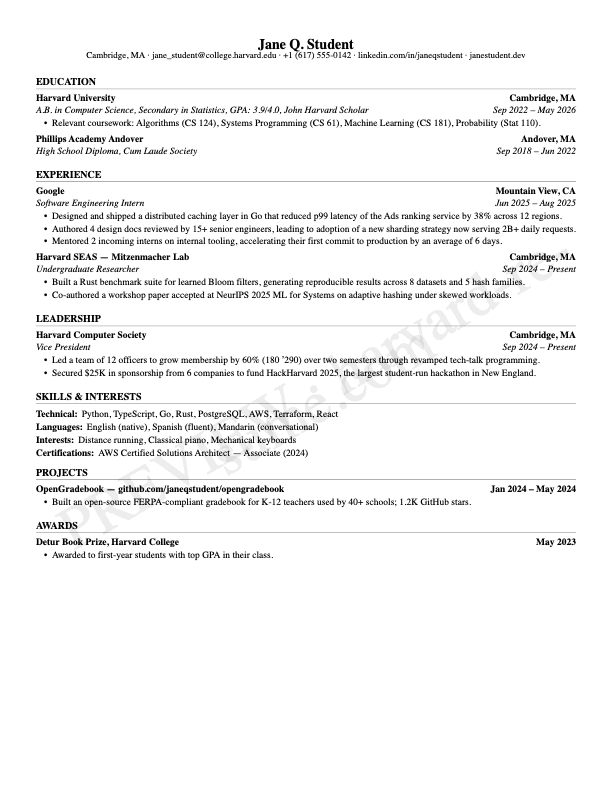
Sample in Harvard format
Strong vs weak bullets
Designed parts in SolidWorks and helped reduce manufacturing costs
Redesigned a die-cast aluminum bracket in SolidWorks applying DFM and GD&T (ASME Y14.5), cutting part mass 31% (480g → 330g) and unit cost $4.20 → $2.65 across 120K annual units, validated with ANSYS static-structural analysis at FOS 2.4
Names the tool, the process (die-casting, DFM), the standard (Y14.5), and stacks three metrics — mass, unit cost at real volume, and a defensible safety factor. A reviewer infers production-grade design judgment in 4 seconds.
Worked on improving a product's reliability through testing
Led root-cause analysis on a gearbox failing at 40K cycles; ran fatigue FEA in Abaqus and DOE on 6 factors, then revised the spline fillet radius — raising B10 life to 250K cycles and cutting field warranty claims 18% YoY
Shows the failure-analysis loop engineers are judged on: a measured failure point, the simulation tool, a structured DOE, and a business outcome (warranty claims) — not just "improved reliability."
Helped the team meet production deadlines and reduce waste
Drove a Lean kaizen on a CNC machining cell as Green Belt; cut changeover time 52% (45→22 min) via SMED and reduced scrap rate from 6.1% to 1.8%, recovering ~$210K in annual material cost across 3 part families
Quantifies process engineering the way a plant manager reads it: changeover time, scrap rate, and dollars recovered, anchored to a recognized methodology (SMED, Green Belt).
Did thermal analysis for an electronics enclosure
Performed CFD thermal analysis (ANSYS Fluent) on a 350W power-electronics enclosure; redesigned the heat-sink fin array and airflow path to drop junction temperature 22°C below the 85°C derating limit, eliminating a forced-air fan and $1.10/unit
Engineering-specific metric (junction temp vs. a named derating limit) plus a design decision with a cost consequence — exactly the trade-off thermal interviewers probe.
Mistakes specific to this role
- Listing every CAD package you've touched. Depth beats breadth — 2-3 tools you can model a part in live during an interview, not 9 logos.
- Vague bullets with no engineering units. "Improved efficiency" is invisible; "raised thermal efficiency 8% / saved 14kg / FOS 2.1" gets read.
- Hiding the P.E./FE status in a buried line. If you've passed the FE or hold a P.E., it belongs at the top — it's a hard filter for many postings.
- Omitting the manufacturing process. "Designed a bracket" says little; "design-for-injection-molding bracket, 2-cavity tool" tells a recruiter you understand how parts get made.
- Burying GD&T and standards. Saying you're "detail-oriented" is worthless next to "GD&T per ASME Y14.5, tolerance stack-ups, ASME BPVC Sec. VIII."
Your résumé starts here. Pay later.
Start composingFrequently asked
- Should I list my FE/EIT if I haven't passed the P.E. yet?
- Yes — list "FE passed (EIT)" and, if relevant, your P.E. eligibility year. Many civil-adjacent, energy, and consulting roles screen for P.E. track. For pure product-design or R&D roles it matters less, but it never hurts to show the FE.
- How do I show CAD/simulation skills without it looking like a tool dump?
- Group them by category (CAD, FEA/CFD, manufacturing, standards) and list 5-8 per group you can actually be tested on. Then prove depth in your bullets — one bullet that names ANSYS, a load case, and a safety factor beats listing ten packages.
- I'm a new grad with no industry experience — what fills the page?
- Your senior capstone, FSAE/Baja, research, or internships, written as real engineering bullets with tools and measured results. Lead Education with your ABET degree and relevant coursework, then a Projects section where you owned a subsystem and can defend the analysis.
- Should I keep it to one page if I have 8+ years of experience?
- For most mechanical roles, yes — the Harvard discipline forces you to lead with your highest-impact, most quantified work. Two pages are acceptable for senior/principal or heavily-published R&D engineers, but every bullet must still carry a number or a named standard.