Network & Infrastructure · 2026
Harvard Resume for Network Engineers
From NOC analyst to network architect — what hiring managers actually scan for in a packet-pushing résumé.
How do I write a Network Engineers resume in the Harvard format?
Network engineering is judged on reliability you can prove. Hiring managers and infrastructure leads at ISPs, hyperscalers, MSPs, and enterprise NetOps teams scan the top third for certs (CCNP/CCIE, JNCIE, AWS ANS), the scale you've operated (sites, devices, Gbps, users), and whether you can speak in uptime, latency, and packet loss rather than 'maintained the network.' The Harvard one-page format forces you to lead with measured outcomes — exactly how an on-call engineer's work is actually evaluated.
What recruiters look for
- Certifications named with tier: CCNA → CCNP Enterprise → CCIE, JNCIA/JNCIP/JNCIE, Aruba ACMP, AWS Advanced Networking, PCNSE
- Vendor + protocol fluency stated explicitly: Cisco IOS-XE/NX-OS, Juniper Junos, Arista EOS, BGP, OSPF, EIGRP, MPLS, VXLAN/EVPN, BFD
- Scale of the environment: # of sites, device count, throughput in Gbps/Tbps, user/endpoint count, multi-region
- Reliability metrics: uptime/SLA (99.99%), MTTR, change-failure rate, packet loss, p99 latency reduced
- Automation maturity: Ansible/Netmiko/Nornir, Terraform for cloud networking, Python, NetBox as source of truth, CI/CD for config
- Security & segmentation signal: firewalls (Palo Alto, Fortinet), NAC/802.1X, microsegmentation, zero-trust, SD-WAN deployments
Required sections, in this order
Header & certifications
- List active certs on the contact line or a dedicated one-liner: 'CCNP Enterprise · JNCIP-SP · AWS Advanced Networking'
- Include cert ID/expiry only if the recruiter explicitly asks — otherwise it wastes a line
- No photo, no DOB; optional GitHub/GitLab link if you publish automation playbooks
Experience bullets (lead with reliability)
- Open each role with the environment scale: '40 sites, 1,200 devices, 3 data centers, 18 Gbps WAN'
- Pair every change with its outcome metric: uptime gained, MTTR cut, latency reduced, tickets eliminated
- Show the on-call and incident dimension — you fixed it AND you prevented the recurrence
Skills section (grouped, not a 40-item dump)
- Group by category: Routing/Switching · WAN/SD-WAN · Security · Cloud Networking · Automation · Monitoring
- Name protocols and platforms you can be whiteboarded on — BGP, OSPF, MPLS, VXLAN/EVPN, not 'networking protocols'
- List automation tooling separately (Python, Ansible, Terraform, NetBox) — it's now a tier-1 differentiator
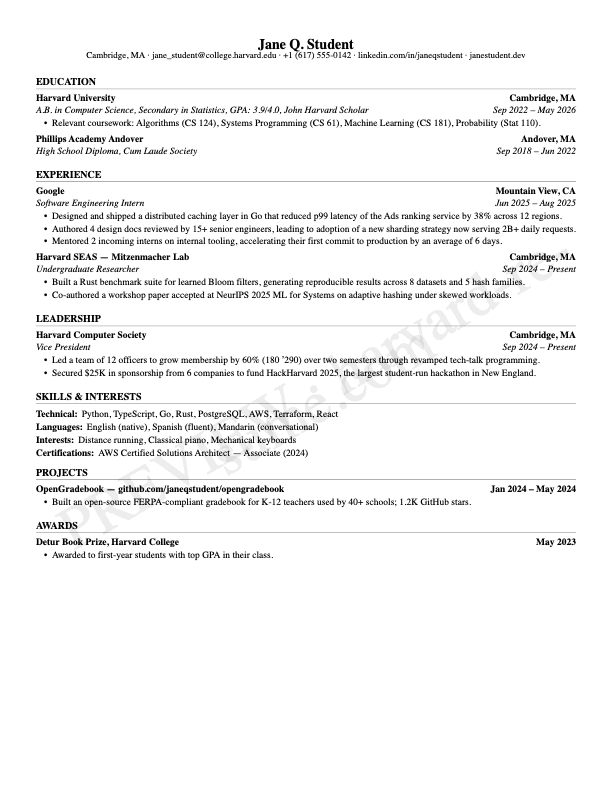
Sample in Harvard format
Strong vs weak bullets
Responsible for maintaining the company network and fixing issues
Operated a 42-site enterprise WAN (1,100 Cisco/Arista devices, 14 Gbps aggregate) at 99.98% uptime; cut mean-time-to-resolution from 47 to 12 minutes by deploying SNMP/syslog telemetry into Grafana with automated alert correlation
Names the scale (42 sites, 1,100 devices, 14 Gbps), the reliability metric (99.98%), and the engineered improvement (MTTR 47→12 min) with the tooling that delivered it. A lead infers production NetOps maturity in seconds.
Migrated the data center network to a new architecture
Led migration of two data centers from legacy STP to a VXLAN/EVPN spine-leaf fabric on Arista EOS; designed the underlay (eBGP) and overlay, validated with a phased cutover, and reduced east-west latency 38% with zero unplanned downtime across 320 racks
Specific architecture (VXLAN/EVPN spine-leaf), specific platform (Arista EOS), specific control plane (eBGP underlay), and a measured result (38% latency, zero downtime, 320 racks) — signals real design ownership, not just rack-and-stack.
Automated some of the network configuration tasks
Built an Ansible + Nornir automation pipeline (Python, NetBox as source of truth) that pushed validated config to 600+ switches; cut provisioning time per site from 6 hours to 25 minutes and dropped change-related incidents 71% over two quarters
Names the exact stack (Ansible, Nornir, NetBox, Python), the fleet size (600+ switches), and two outcome metrics (6h→25min, -71% incidents). Automation is the strongest 2026 differentiator and this proves it end-to-end.
Worked on improving network security and segmentation
Rolled out 802.1X NAC and microsegmentation across 8,000 endpoints behind Palo Alto NGFWs; designed VLAN/policy zones that contained a ransomware lateral-movement attempt to a single segment, reducing the blast radius and avoiding an estimated $400K in downtime
Concrete controls (802.1X, microsegmentation, Palo Alto), real scale (8,000 endpoints), and a business-language outcome (contained blast radius, $400K avoided). Security-aware network engineers command a premium and this bullet proves it.
Mistakes specific to this role
- Writing 'maintained network infrastructure' with no scale or metric — it reads as a help-desk ticket, not engineering. Always state devices, Gbps, sites, or uptime.
- Dumping 40 acronyms into Skills (every protocol you've heard of). List the 12-15 you can be whiteboarded on; padding signals the opposite of depth.
- Listing an expired CCNA as your headline cert. Lead with your highest current cert; an expired one below it is a credibility hit.
- Ignoring automation entirely. A 2026 network résumé with zero Python/Ansible/Terraform reads as 'CLI-only' and screens out of senior roles.
- Confusing responsibilities with achievements. 'Managed firewalls' is a duty; 'cut firewall rule-base by 60% eliminating 2,000 shadowed rules' is an achievement.
Your résumé starts here. Pay later.
Start composingFrequently asked
- I have a CCIE — should it dominate the résumé?
- Put it prominently in the header (it's a top-tier signal), but don't let it carry the whole page. A CCIE with vague bullets loses to a CCNP with quantified uptime and automation work. The cert opens the door; the metrics close the interview.
- How do I show on-call / incident experience without it sounding like firefighting?
- Frame it as prevention, not heroics. Instead of 'resolved outages,' write 'reduced P1 incidents 40% by root-causing recurring BGP flaps and deploying BFD + route dampening.' Leads want engineers who eliminate the on-call page, not just answer it.
- Should I include home-lab or certification-study projects?
- Yes, if you're early-career or switching in — a GNS3/EVE-NG lab building a multi-area OSPF or BGP-EVPN topology shows hands-on depth. Add a short Projects line with the topology and what you automated. Skip it once you have 3+ years of production scale to cite.
- Cloud networking or traditional routing/switching — which do I emphasize?
- Lead with whatever the target role weights. For enterprise/ISP roles, emphasize BGP/OSPF/MPLS and physical scale. For cloud/platform roles, foreground VPC/Transit Gateway, AWS Advanced Networking, Terraform, and hybrid connectivity (Direct Connect/ExpressRoute). Most strong candidates show both, weighted to the job.