Healthcare 2026
Nutritionist / Dietitian Resume (Harvard Format)
Show outcomes, not appointments: a Harvard-format resume that proves you move clinical and behavioral metrics.
How do I write a Nutritionist / Dietitian Resume (Harvard Format) resume in the Harvard format?
Whether you are a clinical RDN managing enteral feeds on a med-surg floor or a community nutritionist running WIC counseling, recruiters skim for credentials, caseload, and measurable patient outcomes before anything else. This guide shows how to translate counseling sessions, MNT plans, and population programs into one-page Harvard-format bullets that quantify impact — A1c reductions, panel coverage, no-show rates — instead of just listing duties.
What recruiters look for
- Active RD/RDN credential (CDR) plus state licensure (LDN/LD), with CDR registration number and license state listed near your name
- Specialty board certs that match the role: CSP (pediatric), CSR (renal), CSO (oncology), CSOWM (obesity/weight management), or CDCES for diabetes care
- Medical Nutrition Therapy (MNT) depth: NCP/NCPT (Nutrition Care Process), enteral/parenteral (TPN) calculations, and the Academy's eNCPT terminology
- EHR and tooling fluency: Epic or Cerner charting, plus diet-analysis tools like Nutritionist Pro, ESHA Food Processor, or Cronometer
- Quantified caseload and outcomes: patients/day, A1c or LDL reductions, % of panel meeting goals, readmission or malnutrition-coding impact
- Population/program reach for community roles: WIC, SNAP-Ed, Head Start, or school wellness, with participants served and grant or budget figures
Required sections, in this order
Header & Credentials (get screened in)
- Put credentials in the exact order CDR uses — 'Jane Doe, MS, RDN, LDN, CDCES' — so ATS and recruiters parse them instantly; never abbreviate RDN to 'nutritionist' if you hold the credential
- List your CDR registration number and license state once (header or a one-line Credentials block) so a recruiter can verify without emailing you
- Lead with a one-line summary tied to a setting and caseload, e.g. 'Clinical RDN, acute care, ~18 inpatient consults/day' — not a generic 'passionate about wellness' objective
- Reserve a tight Skills line for tools and modalities (Epic, NCP, TPN, motivational interviewing) — keep it scannable, not a 30-word keyword dump
Experience — quantify every bullet (XYZ formula)
- Use the Harvard XYZ pattern: accomplished [X outcome] measured by [Y metric] by doing [Z action]. Every bullet should carry a number — caseload, %, mg/dL, days, or dollars
- Anchor clinical bullets to validated outcomes: A1c/HbA1c drops, LDL or weight change, malnutrition diagnoses captured for accurate DRG coding, or reduced length of stay
- For outpatient/private practice, quantify panel size, retention, no-show rate, and revenue or new referrals generated, not just 'counseled clients'
- Lead with strong past-tense verbs (Implemented, Reduced, Standardized, Counseled) and cut filler like 'responsible for' or 'helped with'
Education, Certs & One-Page Discipline
- List the ACEND-accredited degree and your dietetic internship/supervised practice (with hours if recent) — these gate eligibility and recruiters look for them
- Group active board certs (CSP, CSR, CSO, CDCES) and CEUs under a Certifications block; drop expired or in-progress items unless you note the exam date
- Keep it to one page: a new-grad or mid-career RDN should rarely exceed a single page — prune CE webinars and old part-time roles to make room for outcomes
- Use consistent date formatting, reverse-chronological order, and 0.5-inch margins so the document reads as clean and professional at a glance
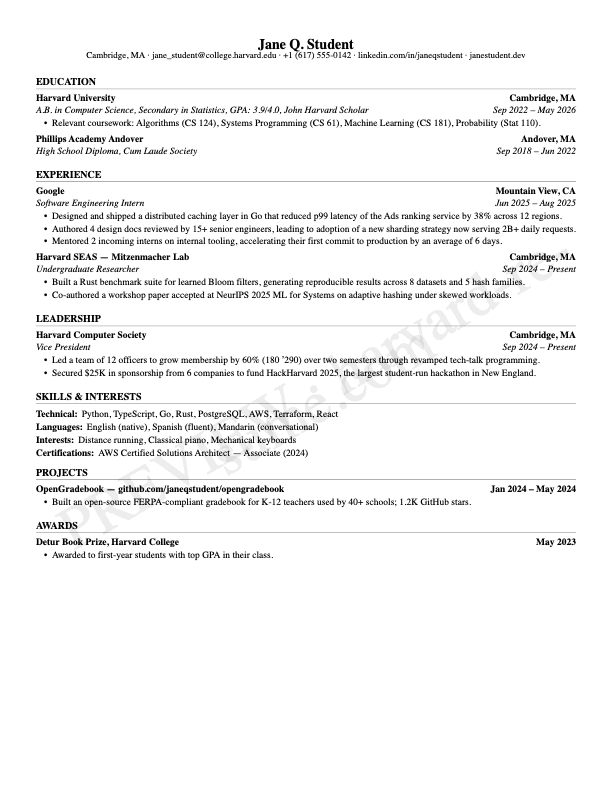
Sample in Harvard format
Strong vs weak bullets
Provided nutrition counseling to patients with diabetes.
Lowered mean HbA1c by 1.4 points across a 60-patient type-2 diabetes panel over 6 months by delivering biweekly MNT sessions with carb-counting and CGM-guided coaching.
Names the clinical metric (HbA1c), panel size, timeframe, and the specific intervention (MNT, carb-counting, CGM).
Worked with the care team on tube feeding for ICU patients.
Optimized enteral feeding for ~15 ICU patients/week by calculating goal-rate TPN/EN formulas and adjusting per indirect calorimetry, cutting feeding interruptions 30% and improving caloric goal attainment to 92%.
Quantifies caseload, names the technical method (calorimetry, EN/TPN), and reports two outcome metrics.
Helped run the WIC nutrition program in the community.
Grew WIC counseling participation 25% (to 1,200 monthly visits) by launching bilingual group sessions and a no-show recall workflow, reducing missed appointments from 22% to 9%.
Shows program reach, a growth percentage, absolute volume, and a process improvement with a before/after no-show rate.
Created meal plans and educational materials for clients.
Built 40+ condition-specific meal plans and a CKD-stage education toolkit in ESHA Food Processor, adopted clinic-wide and cited in a 12% rise in patient-reported diet adherence.
Names the tool (ESHA), the volume, the clinical domain (CKD staging), and ties the deliverable to an adherence outcome.
Mistakes specific to this role
- Calling yourself a 'nutritionist' when you hold the RDN — and vice versa; misusing the protected credential signals you do not know the field's scope-of-practice lines
- Listing duties ('counseled patients', 'documented in EHR') with zero numbers — recruiters cannot distinguish a 5-patient day from a 25-patient day
- Omitting your CDR registration number and state license, forcing the recruiter to chase verification before they can move you forward
- Burying outcomes in dense paragraphs instead of crisp XYZ bullets, or spilling onto a second page with CE webinars and high-school activities
- Generic 'passionate about healthy living' summaries that any layperson could write — say nothing about MNT depth, setting, or caseload
Your résumé starts here. Pay later.
Start composingFrequently asked
- Should I write 'Nutritionist' or 'Dietitian/RDN' on my resume?
- Use the credential you actually hold. If you completed an ACEND program and passed the CDR exam, you are a Registered Dietitian Nutritionist — write 'RDN' (or 'RD'), since it is a protected credential employers screen for. Reserve 'nutritionist' for roles where you hold a non-RD nutrition certification, and never imply RDN status you do not have.
- How do I quantify counseling work that does not have obvious metrics?
- Tie bullets to caseload (patients/day or panel size), clinical markers (A1c, LDL, weight, albumin), behavior change (adherence %, goal attainment), and operational figures (no-show rate, retention, referrals). Even 'counseled ~120 clients/quarter with 78% returning for follow-up' is far stronger than 'provided counseling.'
- Which certifications should I highlight beyond the RDN?
- Lead with the board cert that matches the job: CSP for pediatrics, CSR for renal/dialysis, CSO for oncology, CSOWM for weight management, and CDCES for diabetes care. List CDR-tracked CEUs only if space allows; recruiters care more about specialty certs and EHR fluency than a long CE list.
- Can a dietitian resume really fit on one page?
- Yes — and it should for new grads and most mid-career RDNs. Keep credentials, a one-line summary, two to four roles with quantified bullets, education with your dietetic internship, and a tight certifications block. Cut webinars, redundant clinical rotations, and unrelated jobs to protect the one-page Harvard discipline.