Healthcare 2026
Occupational Therapist Resume (Harvard Format)
A Harvard-format resume for occupational therapists that proves outcomes, not just caseload — FIM gains, NBCOT credentials, and discharge throughput on one disciplined page.
How do I write a Occupational Therapist Resume (Harvard Format) resume in the Harvard format?
Occupational therapy hiring managers scan for proof that you move patients toward independence, document defensibly, and hit productivity without sacrificing care quality. A Harvard-format resume forces you to lead with measurable outcomes — FIM/GG self-care gains, evaluation volume, and setting-specific competencies — instead of listing generic 'provided therapy' duties. This guide shows OTs across acute care, SNF, inpatient rehab, outpatient, pediatrics, and home health how to translate daily practice into quantified, one-page evidence.
What recruiters look for
- Active state OT license plus NBCOT certification (OTR), and any specialty creds — CHT, SCEM/SCFES, BCP, ATP (RESNA), CLT, or CKTP
- Setting fluency: acute care, inpatient rehab (IRF), SNF, outpatient, pediatrics/EI, home health, school-based, or hand therapy
- Outcome metrics: FIM/GG self-care and mobility gains, Section GG coding accuracy, Barthel/COPM scores, fall-reduction rates, and length-of-stay impact
- Documentation and EMR fluency: Epic, Cerner, PointClickCare, Net Health (Casamba/Optima), WebPT, and MDS 3.0 / PDPM-aware charting
- Productivity standards met (often 85-95%) alongside defensible, audit-ready notes and CPT-accurate billing (97165-97168, 97530, 97535)
- Caseload scale and complexity: patients/day, diagnoses (CVA, TBI, SCI, ortho, hand, autism/sensory), and supervision of COTAs, students, or aides
Required sections, in this order
Header, Licensure & Credential Block
- Place credentials in your name line exactly as boards list them: 'Maria Lopez, OTR/L, CHT' — recruiters search for 'OTR/L' and specialty initials verbatim.
- Add a tight Licensure/Certifications line: state license number state(s), NBCOT cert date, plus CPR/BLS, and current CEU compliance status.
- List specialty certs with the issuing body and year (CHT — HTCC 2023; ATP — RESNA 2022) so credentialing teams can verify fast.
- Keep contact, city/state, and LinkedIn one line; no full address, photo, or headshot — it wastes one-page real estate and triggers ATS noise.
Experience — XYZ Bullets With Patient Outcomes
- Open every bullet with an action verb and a measurable result: FIM/GG point gains, percent of patients discharged home, fall reduction, or LOS reduction.
- Name the setting, diagnosis mix, and caseload (e.g., 'acute care, 9-12 patients/day, CVA/TBI/ortho') so the reader places your skill level instantly.
- Quantify documentation and billing discipline: productivity percentage, chart-audit pass rate, Section GG accuracy, denial-overturn rate.
- Show leadership scope: COTAs/students supervised, program built (low-vision, lymphedema, splinting), or interdisciplinary rounds led.
Education, Fieldwork & Skills
- List your MOT/OTD or BS in OT with school, location, and graduation year; new grads add GPA if 3.5+ and a one-line capstone/thesis.
- Detail Level II fieldwork as mini-roles with the setting and a quantified outcome — this is the strongest evidence a new-grad OT has.
- Group skills by clinical domain: assessments (COPM, MoCA, Berg, sensory profiles), modalities (splinting/orthotics, NMES, manual therapy), and EMRs.
- Include relevant CEUs or training (NDT, SI certification, LSVT BIG, Saebo, vision rehab) when they map to the target setting.
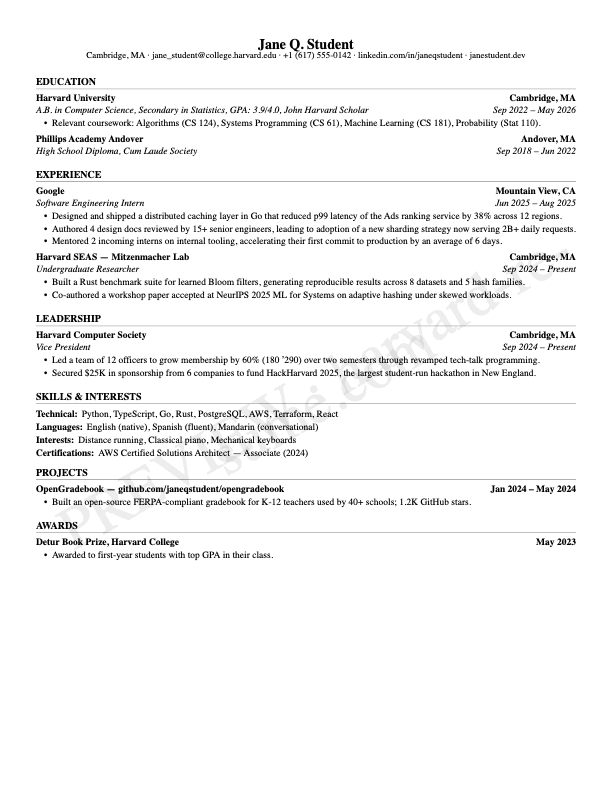
Sample in Harvard format
Strong vs weak bullets
Provided occupational therapy to patients in a skilled nursing facility.
Managed a 10-12 patient/day SNF caseload (CVA, hip/knee ortho, dementia), raising mean FIM self-care scores 18 points over admission and discharging 73% of patients to home or a lower level of care.
Names setting, caseload, diagnosis mix, the exact outcome metric (FIM), and discharge disposition — the numbers rehab directors are judged on.
Worked on documentation and met productivity goals.
Sustained 92% billable productivity across 6 quarters while passing 100% of Medicare chart audits, coding Section GG and PDPM categories with zero denials over 480+ MDS-linked evaluations.
Pairs productivity with audit accuracy and billing specificity (GG, PDPM, MDS), proving you hit volume without compromising defensible notes.
Helped pediatric patients with sensory and motor skills.
Designed sensory-integration and fine-motor programs for 25+ pediatric clients (ASD, sensory processing, DCD), improving Sensory Profile-2 quadrant scores and lifting goal-attainment-scaling completion from 58% to 86% in 6 months.
Specifies population, diagnoses, the standardized tool, and a before/after metric — concrete evidence of pediatric clinical impact.
Made splints and treated hand injuries in an outpatient clinic.
Fabricated 40+ custom orthoses/month for post-surgical hand and UE cases (flexor tendon, CMC arthroplasty, distal radius), achieving 95% protocol adherence and reducing average return-to-work time by 9 days versus clinic baseline.
Quantifies volume, names hand-therapy diagnoses and protocols, and ties care to a business-relevant outcome (return-to-work time).
Mistakes specific to this role
- Listing duties ('evaluated and treated patients') instead of outcomes — every bullet should carry a FIM gain, productivity %, discharge rate, or score change.
- Omitting credentials from the name line or burying the license number, forcing credentialing teams to hunt and slowing your screen.
- Using a generic resume across settings — an acute-care role and a pediatric EI role need different diagnosis mixes, tools, and metrics up top.
- Ignoring EMR and billing fluency (Epic, PointClickCare, Net Health, Section GG, CPT codes) that rehab managers explicitly screen for.
- Spilling onto two pages with course lists or every CEU; keep it to one disciplined page and only include CEUs that map to the target job.
Your résumé starts here. Pay later.
Start composingFrequently asked
- How do I quantify occupational therapy outcomes on a resume?
- Lead with the metrics your setting tracks: FIM or Section GG self-care/mobility point gains, percent of patients discharged home, length-of-stay reduction, fall-rate reduction, COPM or Barthel score changes, and goal-attainment-scaling completion. Pair clinical outcomes with operational ones — productivity percentage and chart-audit pass rate — so you prove both quality and throughput.
- Should I list OTR/L and my specialty certifications in my name?
- Yes. Put 'OTR/L' and earned specialty credentials (CHT, ATP, SCEM, LSVT BIG) directly in your name line, because recruiters and ATS search those exact initials. Then add a separate licensure line with your state license number(s), NBCOT certification date, BLS/CPR, and CEU compliance so credentialing teams can verify without emailing you.
- What should a new-grad OT put on a one-page Harvard resume?
- Treat your two Level II fieldwork rotations as mini-jobs: name the setting, caseload, and one quantified outcome each (e.g., 'co-led 8-patient acute rehab caseload, contributed to 15-point average FIM gains'). Add your MOT/OTD with GPA if 3.5+, standardized assessments you administer, EMRs used, and relevant certifications like CPR/BLS or LSVT BIG.
- How do I tailor my OT resume for different settings?
- Swap the top third per setting. For SNF/IRF, lead with FIM/GG, PDPM, and productivity; for outpatient hand therapy, lead with orthosis volume, post-surgical protocols, and return-to-work times; for pediatrics, lead with Sensory Profile-2, goal attainment, and family training. Keep the same one-page Harvard structure but change the diagnoses, tools, and metrics to match the job description.