Operations · 2026
Harvard Resume for Operations Managers
Ops hiring runs on numbers. The Harvard format puts P&L scope, throughput, and cost saved on one scannable page.
How do I write a Operations Managers resume in the Harvard format?
Operations hiring is brutally quantitative. VPs of Operations, plant managers, and supply-chain directors at manufacturers, 3PLs, e-commerce fulfillment, and high-growth SaaS scan three things first: the scale you ran (headcount, P&L, units), the cost or time you took out, and the systems you operated (ERP, WMS, Lean). The Harvard one-page format forces exactly that compression — and an ops leader who can't compress their own résumé signals they can't compress a process either.
What recruiters look for
- Scope owned: P&L / budget managed ($), direct + indirect headcount, sites or shifts run
- Lean Six Sigma credential (Green or Black Belt) and a real DMAIC project tied to a number
- ERP/WMS fluency named explicitly — SAP, Oracle, NetSuite, Manhattan, Blue Yonder, not 'inventory software'
- Core ops metrics moved: OEE, OTIF / on-time delivery, inventory turns, cost-per-unit, scrap/defect rate, cycle time
- Safety + quality ownership: TRIR reduction, ISO 9001 / audit pass, near-miss program results
- S&OP, capacity planning, or continuous-improvement program leadership with adoption metrics
Required sections, in this order
Header & scope framing
- Add a one-line tagline under your name: e.g. 'Operations Manager · 3PL / Fulfillment · 9 yrs · $40M P&L'
- Lead the top role's first bullet with scope — headcount + budget + sites — so a director sees your altitude in 4 seconds
- No photo, no DOB, no marital status — keep it to one page even at director level
Experience bullets — lead with the metric
- Open each bullet with the result (cost saved, OEE gained, OTIF lifted), then the mechanism (Kaizen, line rebalance, S&OP)
- Always state the denominator: 'cut cost-per-unit 14% across 2.1M units/yr', not just '14%'
- Include one bullet per role on people: span of control, turnover reduced, or a team you built or restructured
Skills & certifications
- Certifications first: Lean Six Sigma Black Belt, APICS CPIM/CSCP, PMP — list belt level explicitly
- Systems by category: ERP (SAP, NetSuite) · WMS/TMS · BI (Tableau, Power BI, SQL) · CI tools (Minitab)
- Cut generic 'team player' / 'process improvement' — name the methodology (Kaizen, 5S, TPM, Value Stream Mapping)
Sample in Harvard format
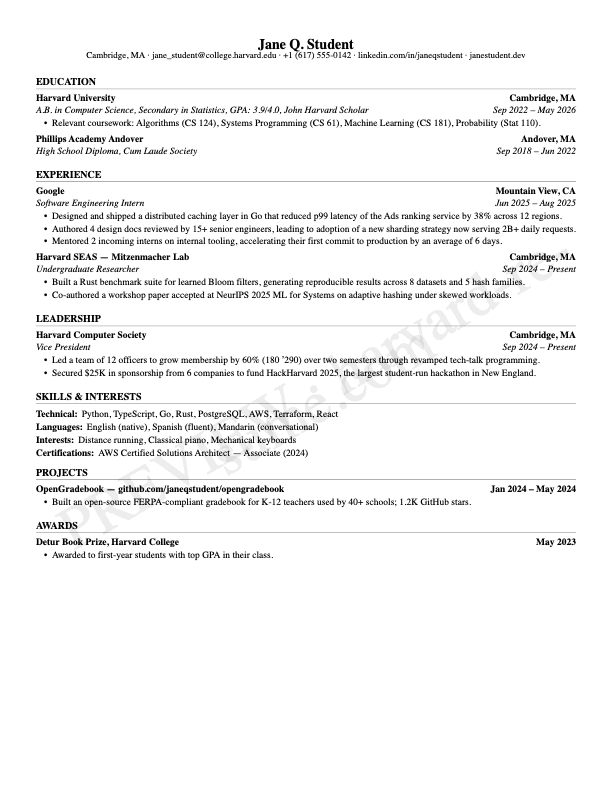
Strong vs weak bullets
Responsible for improving warehouse operations and reducing costs
Ran a 140-person, 3-shift fulfillment site ($38M opex); led a Kaizen rebalance of the pick-pack line that lifted units-per-labor-hour 22% and cut cost-per-order from $4.10 to $3.20 across 3.4M annual orders
Names scope (140 people, $38M, 3 shifts), the method (Kaizen line rebalance), and two stacked metrics with a real denominator (3.4M orders). A VP infers a hands-on operator, not a coordinator, in seconds.
Helped improve on-time delivery and customer satisfaction
Rebuilt the S&OP cadence and demand-planning model in NetSuite, raising OTIF from 87% to 96.5% over two quarters while holding inventory flat; recovered $2.4M in at-risk renewals tied to delivery SLAs
Pairs a named system (NetSuite S&OP) with the canonical ops KPI (OTIF, +9.5 pts), a constraint (inventory held flat), and dollar impact ($2.4M). Three layers a hiring director cares about.
Led a Six Sigma project that reduced defects
Led a DMAIC project (Black Belt) on the injection-molding line, cutting scrap rate from 6.8% to 1.9% and recovering 310K units/yr; annualized savings of $620K, with the control plan rolled to two sister plants
Shows the credential in action (DMAIC, Black Belt), the before/after defect metric, the recovered units, the dollar value, and that the fix scaled — exactly what 'continuous improvement' actually means.
Managed safety and reduced workplace incidents
Owned EHS for a 200-employee plant; launched a near-miss reporting program and 5S standard-work rollout that cut TRIR from 4.2 to 1.1 over 18 months and passed ISO 9001 surveillance audit with zero major findings
Safety is hard to quantify; here it is — TRIR cut to nearly a quarter, a named program, and a clean audit. Signals an operator who runs to a standard, not by firefighting.
Mistakes specific to this role
- Writing duty-list bullets ('responsible for daily operations'). Lead with the number you moved — a bullet without a metric is invisible to an ops director.
- Hiding scope. If you ran a $40M P&L and 150 people, that belongs in your first line, not buried in paragraph three.
- Listing tools generically ('inventory software', 'ERP systems'). Name SAP, NetSuite, Manhattan, Blue Yonder — directors filter on the exact stack they run.
- Claiming 'Lean Six Sigma' with no belt and no project. State the belt level and tie it to one DMAIC result, or drop the buzzword.
- Going two pages 'because you're senior'. The whole test is whether you can compress; a two-page ops résumé fails it before anyone reads it.
Your résumé starts here. Pay later.
Start composingFrequently asked
- I manage a large P&L and team — can I really fit on one page?
- Yes, and you should. Keep your two most recent roles rich (4-5 quantified bullets each), compress older roles to 1-2 lines, and drop anything pre-2012. The one-page constraint is itself a signal you can prioritize — exactly the skill the job tests.
- Where do my Lean Six Sigma and APICS certifications go?
- Put the belt level and APICS (CPIM/CSCP) in a dedicated Certifications line near Skills, and prove them inside Experience with at least one DMAIC or planning project tied to a number. A belt with no project on the page reads as a class you took, not a result you delivered.
- How do I show ops impact when my work was 'keeping things running', not a big project?
- Convert steady-state into deltas: 'held OTIF at 98% through a 40% volume ramp without adding headcount', or 'reduced overtime spend 18% YoY while output rose 11%'. Sustained performance under pressure is a result — quantify the pressure and the hold.
- Does this format survive ATS at large manufacturers and 3PLs?
- Yes. A single-column PDF with selectable text, no images or tables, parses cleanly in Workday, SuccessFactors, Greenhouse, and iCIMS — the systems most manufacturers, retailers, and logistics firms run. Mirror the job-post keywords (OTIF, OEE, S&OP, ERP name) in your bullets so the parser scores you.