Legal · 2026
Harvard Resume for Paralegals
Paralegal hiring is judged on billable output, document-review throughput, and certification. Surface case volume, e-discovery platforms, and cite-checking accuracy up top.
How do I write a Paralegals resume in the Harvard format?
Paralegal hiring at law firms and in-house legal departments is a throughput-and-trust game: attorneys want to know how many documents you can review, how cleanly you cite-check, and whether you can run a case from intake to trial binder without supervision. The Harvard one-page format suits the role because it forces you to lead with the practice area, the systems you run (Relativity, Clio, iManage), and quantified output instead of a vague 'assisted attorneys with legal matters' summary.
What recruiters look for
- NALA Certified Paralegal (CP) or NFPA PACE / Registered Paralegal (RP) credential, plus ABA-approved program or paralegal certificate
- Practice-area specialization named (litigation, corporate/M&A, IP, real estate, immigration, family, bankruptcy)
- E-discovery platforms (Relativity, Everlaw, Logikcull) and document-review volume handled
- Case management and DMS tools (Clio, MyCase, iManage, NetDocuments, ProLaw) plus e-filing via PACER/CM-ECF and state portals
- Bluebook citation, Shepardizing/KeyCite accuracy, and legal research on Westlaw and LexisNexis
- Billable-hour history, trial-prep experience (exhibit lists, witness binders, deposition summaries), and notary commission
Required sections, in this order
Header and Certifications block
- Put credential after your name on the contact line: 'Jordan Lee, CP' or 'RP' — attorneys scan for it first
- List the certifying body and year (e.g., 'NALA Certified Paralegal, 2023'; 'NFPA PACE, 2022') and active notary commission with expiration state
- Name your ABA-approved paralegal program or bachelor's + paralegal certificate in Education, not buried in a skills list
- Bar-association memberships (state paralegal association, local bar paralegal section) go in a one-line Affiliations entry
Experience bullets — paralegal-specific
- Lead with the practice area and matter type, then the quantified action: 'Litigation paralegal supporting 40+ active matters…'
- Quantify review volume, document counts, billable hours, and turnaround (e.g., '12,000-document review', '1,400 billable hours/yr', 'filings within 24h of attorney sign-off')
- Show ownership of the case lifecycle: intake, discovery, privilege logs, e-filing, trial prep, and post-trial — not just 'assisted'
- Name the platforms inside the bullet (Relativity, Everlaw, PACER, iManage) so the line doubles as a keyword and a credibility signal
Skills and Tools section content
- Group by category: Research (Westlaw, LexisNexis, Fastcase), E-discovery (Relativity, Everlaw, Logikcull), DMS/Case Mgmt (iManage, NetDocuments, Clio), E-filing (PACER/CM-ECF, state portals)
- List languages with proficiency if you support client interviews or translate documents (e.g., 'Spanish — fluent, conduct client intakes')
- Include drafting competencies that are real and testable: discovery requests, subpoenas, pleadings, cite-checking, Bluebook formatting, TOA/TOC generation
- Skip soft-skill filler ('detail-oriented', 'team player') — attorneys assume it and it costs you a line on a one-page resume
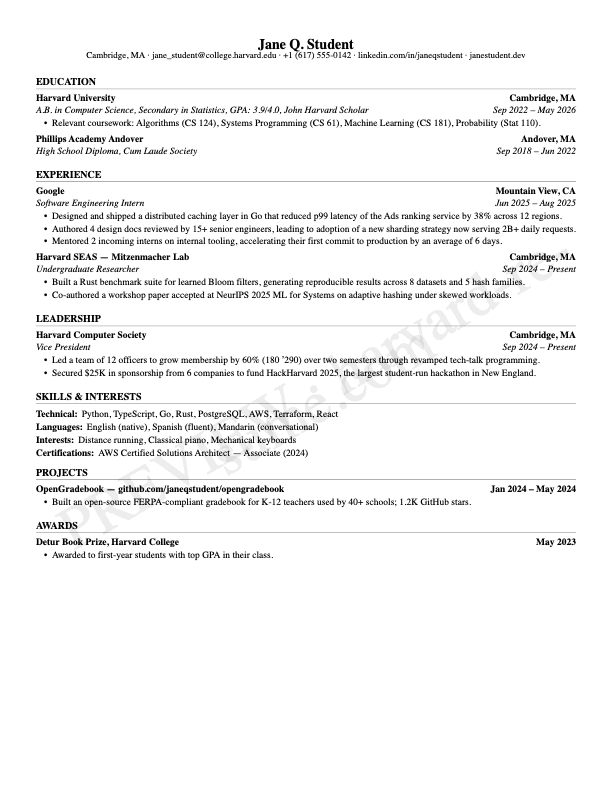
Sample in Harvard format
Strong vs weak bullets
Assisted attorneys with document review and discovery
Managed e-discovery for a 12-attorney litigation team across 18 active matters in Relativity; reviewed and coded 14,000+ documents, built privilege logs flagging 320 protected items, and reduced first-pass review time 27% by training 4 contract reviewers on the coding protocol
Names the platform (Relativity), the team and matter scale, the document volume, the privilege-log output, and a quantified efficiency gain with a leadership element (training reviewers). An attorney reads full discovery ownership, not 'assisted'.
Prepared documents for trial and filed with the court
Ran trial prep for a $4.2M commercial breach case: assembled 9 witness binders and a 210-exhibit list, drafted 14 deposition summaries, and e-filed 30+ pleadings via CM-ECF with zero rejected filings over the matter — freeing the lead associate for substantive briefing
Quantifies the stakes ($4.2M), the deliverables (binders, exhibits, depo summaries), the e-filing system (CM-ECF), and a quality metric (zero rejections) plus downstream impact on the associate. This is a paralegal who can run a trial binder unsupervised.
Helped with corporate filings and entity management
Maintained entity records for 85 corporate subsidiaries across 12 states in iManage; filed 60+ annual reports and 18 foreign-qualification registrations, drafting board resolutions and closing binders for 5 M&A deals totaling $90M with no missed statutory deadlines in 2 years
Shows corporate-paralegal scope (85 entities, 12 states), the DMS (iManage), deal context and value ($90M, 5 deals), and the metric that matters most in transactional work: zero missed deadlines. Specialization is unmistakable.
Did legal research and cite-checking for briefs
Cite-checked and Bluebooked 40+ appellate briefs in Westlaw, Shepardizing 600+ citations and catching 22 overruled or distinguished authorities before filing; generated tables of authorities and contents that passed clerk review on first submission across all 40 briefs
Quantifies brief volume, citation count, the catch rate (22 bad authorities), the research tool (Westlaw/Shepard's), and the first-pass acceptance metric. Cite-checking accuracy is exactly the trust signal litigation attorneys hire for.
Mistakes specific to this role
- Writing 'assisted attorneys with various legal tasks' instead of naming the practice area, the matter volume, and the systems you ran. Vagueness reads as a junior who can't own a case.
- Omitting your certification (CP/RP) and notary commission, or burying them in a skills list. Put the credential on the contact line where attorneys scan first.
- Listing tools you've barely touched. If you put Relativity or Westlaw on the resume, expect a screening question — only list platforms you can speak to under questioning.
- Leaving out numbers entirely: document-review volume, billable hours, filing turnaround, and deadline-hit rate are the metrics that separate a strong paralegal from a generic one.
- Confusing the resume with a writing sample — no paragraphs about your 'passion for the law.' Save persuasion for the cover letter and keep the resume to one page of quantified output.
Your résumé starts here. Pay later.
Start composingFrequently asked
- Should I list my paralegal certification after my name or in Education?
- Both, but the credential abbreviation (CP, RP, ACP) goes on the contact line right after your name where attorneys scan first. Then expand it in a Certifications line or under Education with the certifying body (NALA, NFPA) and year. An active notary commission belongs there too, with its expiration state.
- How do I show billable hours and document-review volume without making the resume look like a timesheet?
- Fold the numbers into outcome bullets, not a standalone stat block. For example: '1,400 billable hours/yr across 40+ active matters' inside an experience bullet, or '14,000-document Relativity review' as the action. One quantified detail per bullet keeps it readable and Harvard-clean.
- I'm a litigation paralegal applying to a corporate/transactional role. How do I reframe?
- Translate your transferable skills into corporate language: discovery coordination becomes due-diligence document management, e-filing becomes Secretary-of-State and SEC filings, privilege logs become closing-binder and data-room organization. Lead one bullet per role with the transactional-adjacent work and name DMS tools (iManage, NetDocuments) the corporate group will recognize.
- Do I need to put law school plans or an aspiring-attorney note on a paralegal resume?
- No. Firms hiring paralegals often prefer candidates committed to the paralegal track, and a 'using this as a stepping stone to law school' signal can hurt you. Keep the resume focused on paralegal output; if you're applying to firms that sponsor or value future JDs, raise it in the cover letter or interview, not the resume.