Healthcare · 2026
Harvard Resume for Pharmacists
Retail, hospital, clinical, or industry — what pharmacy directors and PIC's scan first, and how to prove patient-safety impact in one page.
How do I write a Pharmacists resume in the Harvard format?
Pharmacist hiring is credential-gated and patient-safety-driven. A residency director, a Director of Pharmacy, or a CVS/Walgreens district recruiter spends the first 10 seconds verifying three things: your PharmD and accredited school, your active license and DEA/board-certification status, and the practice setting you've actually worked in. The Harvard one-page format puts licensure, education, and quantified clinical impact in the top third — exactly where a busy preceptor scans before deciding to read on.
What recruiters look for
- PharmD from an ACPE-accredited school + active state license (RPh) and NAPLEX/MPJE pass status
- Board certification (BCPS, BCACP, BCOP, BCPS-AQ, or BPS specialty) and PGY1/PGY2 residency
- Practice setting named explicitly: retail/community, acute-care hospital, ambulatory clinic, specialty, or managed care
- Clinical intervention volume and impact: med-rec catches, DUR overrides, anticoagulation/antimicrobial stewardship outcomes
- Systems fluency: Epic Willow, Cerner, Pyxis/Omnicell ADCs, ScriptPro, EPIC/RxConnect, plus USP <797>/<800> sterile and hazardous compounding
- Immunization certification (APhA), MTM/CMR completion, and verified script volume or accuracy/error rate
Required sections, in this order
Licensure & header customisation
- Put license line directly under contact: 'RPh, License #XXXXX (State) · NPI · DEA on request' — verifiable in 5 seconds
- List NAPLEX and MPJE pass status and multi-state licensure (reciprocity) if you hold it
- No photo, no DOB; lead Education with PharmD + ACPE school, then PGY1/PGY2 residency with site and RPD
Certifications & clinical credentials section
- Surface BPS board certs (BCPS, BCACP, BCOP) and date earned — they gate ambulatory and specialty roles
- List immunization (APhA), CPR/BLS/ACLS, MTM, and collaborative practice agreement (CPA) authority
- For residency applicants, keep a Presentations/Research line: posters at ASHP Midyear, P&T projects
Experience bullets — setting-specific
- Lead each role with setting + daily script/patient volume so scope is instantly legible
- Quantify clinical interventions: medication reconciliations, DUR catches, dose adjustments, stewardship saves
- Pair a safety metric (error rate, near-miss catches) with a throughput or cost metric (verification volume, formulary savings)
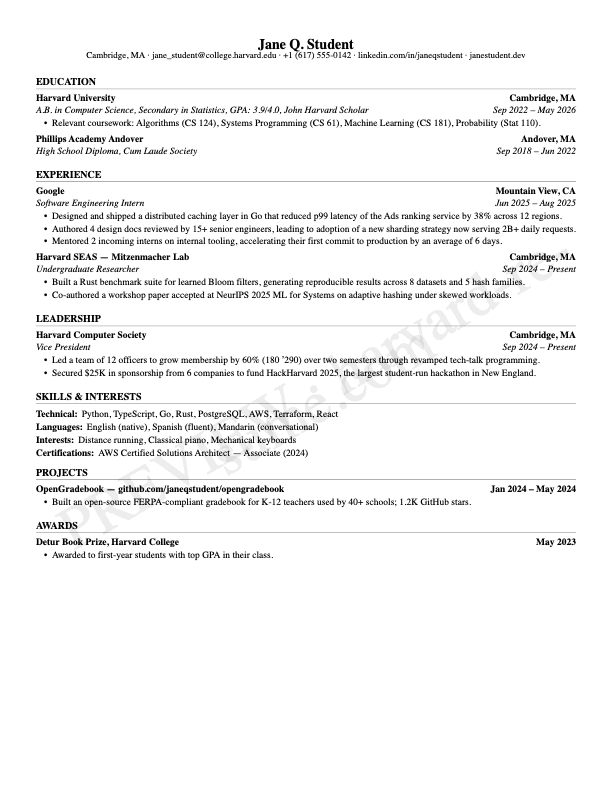
Sample in Harvard format
Strong vs weak bullets
Responsible for filling prescriptions and counseling patients
Verified and dispensed 450+ prescriptions per shift in a high-volume retail pharmacy while maintaining a 99.98% dispensing accuracy rate across 12 months (2 reportable errors / 130K fills); personally counseled 25-30 patients daily on adherence and interactions
Names the volume (450+/shift), the safety metric (99.98% accuracy with the raw error count), the timeframe, and the patient-facing counseling load. A district manager infers a high-throughput pharmacist who doesn't compromise safety in 4 seconds.
Participated in antimicrobial stewardship at the hospital
Co-led the antimicrobial stewardship program on a 280-bed acute-care unit; reviewed 40+ cultures weekly and drove IV-to-PO conversions and de-escalations that cut broad-spectrum days of therapy 18% and saved an estimated $214K in drug spend over FY2025
Setting and scale (280-bed, 40+ cultures/week), the specific clinical levers (IV-to-PO, de-escalation), and dual outcomes (-18% DOT and $214K saved). Reads as a stewardship pharmacist who moves both quality and cost.
Did medication reconciliation for admitted patients
Performed admission and discharge medication reconciliation for 1,800+ patients/year on a cardiology service; identified and resolved 320 discrepancies including 22 high-severity errors, contributing to a 14% reduction in 30-day medication-related readmissions on the unit
Patient volume, discrepancy catches with severity breakdown (22 high-severity), and the downstream outcome (-14% readmissions). The XYZ formula made concrete with real pharmacy metrics.
Managed an anticoagulation clinic
Ran a pharmacist-led anticoagulation clinic under a collaborative practice agreement, managing 140 warfarin patients; improved time-in-therapeutic-range (TTR) from 58% to 72% over 9 months and reduced INR-related ED visits by 31%
Names the CPA authority, panel size (140), the field-standard metric (TTR 58→72%), and a hard safety outcome (-31% ED visits). A clinic director sees autonomous practice with measured results.
Mistakes specific to this role
- Omitting license number, NAPLEX/MPJE status, and state. A pharmacist resume without verifiable licensure up top gets deprioritized instantly.
- Vague 'filled prescriptions and helped customers' bullets with no volume or accuracy metric. Without a script count and an error/accuracy rate, a reviewer can't gauge your scale or safety.
- Listing every drug class or 'strong clinical knowledge' as a skill. Show it through a stewardship, anticoagulation, or MTM outcome instead.
- Burying board certification (BCPS/BCACP) or PGY1/PGY2 residency in the body. These gate clinical and ambulatory roles — surface them in a dedicated certifications block.
- Running to two pages with pre-pharmacy retail jobs. Keep the Harvard one-page discipline; cut anything before your PharmD unless it built clinical or leadership signal.
Your résumé starts here. Pay later.
Start composingFrequently asked
- Should I list my license number on the resume?
- List the state and 'RPh, License #' plus NAPLEX/MPJE pass status — it lets a recruiter verify you on the state board site in seconds and signals you're truly licensed, not 'license-eligible.' Keep your full DEA number off the document; write 'DEA available on request.'
- I'm a new PharmD grad with no residency — how do I compete?
- Lead with rotations (APPE) treated as experience: name each site, setting, and a quantified contribution (interventions logged, projects completed). Surface immunization certification, any BLS/ACLS, and your NAPLEX status. One page, education-first — the Harvard format is built for exactly this lean profile.
- Do I need separate resume versions for retail vs hospital roles?
- Yes, lightly. Retail/community recruiters scan for script volume, accuracy, immunizations, and MTM/CMR counts. Hospital and clinical roles scan for residency, board certification, stewardship/anticoagulation outcomes, and Epic Willow/Pyxis fluency. Reorder which bullets and certs lead — keep both to one page.
- Where do continuing education and BPS certifications go?
- Board certifications (BCPS, BCACP, BCOP) belong in a dedicated Certifications section near the top with the year earned — they're filters, not footnotes. Routine CE hours don't need listing; licensure renewal already implies them. List ASHP Midyear posters or P&T projects under a short Presentations line if you're residency-tracking.