Healthcare · 2026
Harvard Resume for Physical Therapists
Outpatient ortho, neuro rehab, acute care, or home health — what rehab directors and clinic owners scan before they read your name.
How do I write a Physical Therapists resume in the Harvard format?
Physical therapy hiring is license-gated and outcomes-driven. A rehab director, a clinic owner, or a hospital recruiter spends the first 10 seconds verifying three things: your DPT (or transitional DPT) and CAPTE-accredited program, your active state license plus NPTE pass status, and the setting you've actually treated in — outpatient ortho, inpatient rehab, acute care, SNF, neuro, or pediatrics. The Harvard one-page format pushes licensure, education, and quantified functional outcomes into the top third, exactly where a busy clinician scans before deciding to interview you.
What recruiters look for
- DPT from a CAPTE-accredited program + active state PT license and NPTE pass status (PT, not PTA)
- Setting named explicitly: outpatient ortho, inpatient rehab (IRF), acute care, SNF, home health, neuro, pediatrics, or sports
- Board specialty (ABPTS) — OCS, NCS, SCS, GCS, or PCS — plus residency/fellowship (e.g. orthopedic or sports residency)
- Productivity and caseload: visits/units per day, evaluations per week, and payer mix (Medicare Part A/B, commercial)
- Documentation and EMR fluency: WebPT, Raintree, Epic, Net Health Casamba, Prompt — plus functional outcome tools (FOTO, LEFS, DASH, Berg, FIM, 10MWT)
- Quantified outcomes: discharge-to-home rates, LOS reduction, ROM/strength gains, pain (NPRS) reduction, return-to-sport timelines, fall-risk reduction
Required sections, in this order
Licensure & header customisation
- Put the license line directly under contact: 'PT, DPT · License #XXXXX (State) · NPTE passed' — verifiable in 5 seconds
- List multi-state licensure or PT Compact (PT-LIC) privileges if you travel or do telehealth across states
- No photo, no DOB, no marital status; lead Education with DPT + CAPTE program and any residency/fellowship site
- Add CPR/BLS and any modality certs (dry needling, Graston/IASTM, vestibular, LSVT BIG) on the credential line, not buried
Certifications & specialty credentials section
- Surface ABPTS board specialty (OCS, NCS, SCS, GCS, PCS) with year — it gates senior and specialty roles
- List residency/fellowship completion (orthopedic, sports, neuro) — these signal a top-tier clinician, not just years served
- Name technique certs precisely: APTA Dry Needling, Certified Manual Therapist (CMPT/COMT), LSVT BIG/LOUD, SFMA, vestibular rehab
- For new grads, add a Clinical Affiliations line: each rotation's setting, weeks, and a quantified contribution
Experience bullets — setting-specific outcomes
- Open each role with setting + caseload so scope is instantly legible (e.g. 'Outpatient ortho, 14-16 patients/day, 60% post-surgical')
- Pair a functional outcome (LEFS gain, gait speed, FIM change) with a throughput or business metric (visits, cancellation rate, plan-of-care adherence)
- Quantify what you moved: discharge-to-home %, LOS, NPRS reduction, return-to-sport %, fall reduction, ROM/strength deltas
- Cut generic verbs ('provided therapy', 'treated patients') — every PT does that; show the outcome and the validated tool you measured it with
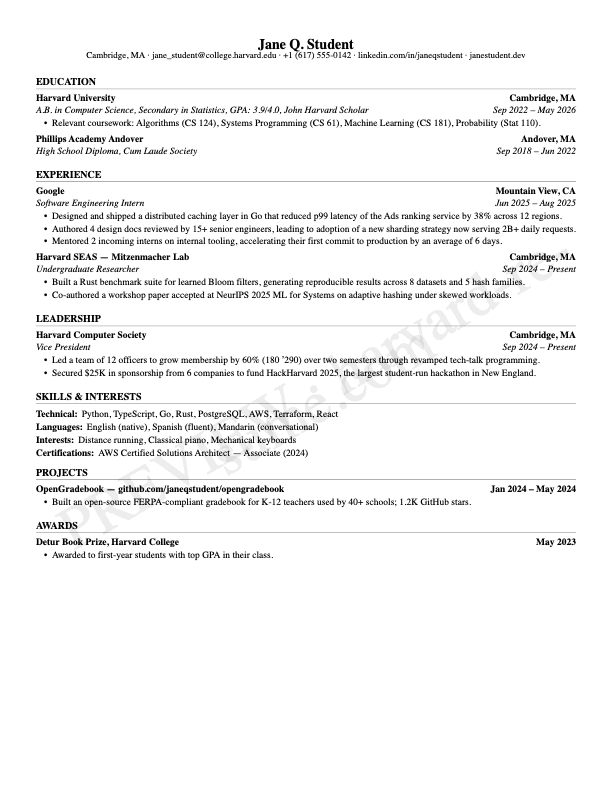
Sample in Harvard format
Strong vs weak bullets
Treated orthopedic patients and helped them recover from surgery
Managed a 15-patient/day outpatient ortho caseload (65% post-operative ACL, rotator cuff, and TKA) on WebPT; drove an average LEFS improvement of 28 points and returned 41 of 47 ACL-reconstruction athletes to sport at a mean 7.8 months, beating the clinic's 9-month benchmark
Names the caseload (15/day), the case mix (post-op ACL/RC/TKA), the EMR (WebPT), the validated outcome (LEFS +28), and a return-to-sport rate against a benchmark. A clinic owner infers a high-volume, outcomes-literate ortho PT in 4 seconds.
Worked in an inpatient rehab unit with stroke patients
Carried a neuro caseload on a 24-bed inpatient rehab unit (CARF-accredited), treating CVA and TBI patients; raised average FIM gain to 32 points and lifted discharge-to-home rate from 58% to 74% over 4 quarters while holding LOS at 14 days
Setting and scale (24-bed IRF, CARF), diagnosis mix (CVA/TBI), the field-standard metric (FIM +32), and dual outcomes (discharge-to-home 58→74%, stable LOS). Reads as a neuro PT who moves the metrics that drive IRF reimbursement.
Did fall prevention with elderly patients in home health
Delivered home-health PT to 30+ Medicare Part B patients/week across a rural county; implemented an Otago-based fall-prevention program that cut Berg Balance fall-risk classifications by 46% and reduced 60-day fall-related ED visits from 9 to 3 across the panel
Caseload and payer (30+/week, Medicare Part B), an evidence-based protocol (Otago), a validated tool (Berg), and a hard downstream outcome (-46% fall risk, ED visits 9→3). Shows a home-health PT who reduces cost, not just provides visits.
Helped improve patient satisfaction and clinic efficiency
As lead PT, mentored 4 clinicians and rebuilt the evaluation template in Raintree; raised plan-of-care completion from 71% to 89%, cut same-day cancellations from 14% to 6%, and lifted clinic NPS from 62 to 81 over two quarters
Quantifies leadership (4 clinicians), an operational fix (the template), and three business metrics owners care about (POC completion, cancellation rate, NPS). XYZ formula made concrete with real clinic-operations numbers.
Mistakes specific to this role
- Omitting license number, state, and NPTE pass status. A PT resume without verifiable licensure up top gets deprioritized instantly — and conflating PT with PTA is an immediate red flag.
- Listing generic duties ('provided manual therapy', 'created treatment plans') with no caseload or outcome. Without visits/day and a validated outcome tool, a reviewer can't gauge your scale or your results.
- Hiding your board specialty (OCS/NCS) or residency in the body text. These gate specialty roles — surface them in a dedicated credentials block near the top.
- Leaving off the EMR and outcome tools you used. WebPT, Epic, Net Health, FOTO, LEFS, and Berg are real onboarding costs and frequent hard filters.
- Stretching to two pages with pre-DPT retail or unrelated jobs. Keep the Harvard one-page discipline; cut anything that doesn't build clinical, productivity, or leadership signal.
Your résumé starts here. Pay later.
Start composingFrequently asked
- Should I put my license number on the resume?
- Yes — list 'PT, DPT · License #XXXXX (State)' plus NPTE pass status so a recruiter can verify you on the state board site in seconds. Add PT Compact privileges if you hold them, since they widen where you can practice. It signals you're truly licensed, not 'license-eligible.'
- I'm a new DPT grad with no full-time experience — how do I compete?
- Lead with your clinical affiliations treated as experience: name each rotation's setting (outpatient ortho, acute care, SNF), the weeks, and a quantified contribution (caseload carried, an in-service you delivered, an outcome you tracked). Surface NPTE status, BLS, and any technique certs. One page, education-first — the Harvard format is built for exactly this lean profile.
- Do I need different resume versions for outpatient vs. inpatient or home health?
- Yes, lightly. Outpatient ortho and sports recruiters scan for caseload/day, return-to-sport rates, manual-therapy and dry-needling certs, and LEFS/DASH outcomes. Inpatient rehab, SNF, and home health scan for FIM/Berg outcomes, discharge-to-home rates, Medicare documentation, and Net Health/Epic fluency. Reorder which bullets and certs lead — keep both to one page.
- Where do my board specialty and residency go?
- Board specialties (OCS, NCS, SCS, GCS, PCS) and residency/fellowship completion belong in a dedicated Certifications section near the top with the year earned — they're filters, not footnotes. List technique certs (dry needling, Graston, LSVT BIG, vestibular) on the same line. Routine CEU hours don't need listing; license renewal already implies them.