Aviation 2026
Airline Pilot Resume (Harvard Format)
Land the interview with a Harvard-format resume that proves flight hours, type ratings, and a clean safety record.
How do I write a Airline Pilot Resume (Harvard Format) resume in the Harvard format?
Airline pilot hiring is gated by hard numbers before a human reads a single bullet: total time, PIC, multi-engine, turbine, and night/IFR hours, plus your ATP, type ratings, and first-class medical. A Harvard-format resume puts those qualifications in a clean, scannable header and then uses quantified bullets to prove airmanship, CRM, and a spotless check-ride history — all on one disciplined page.
What recruiters look for
- ATP certificate (or R-ATP/restricted with the qualifying hours), current first-class FAA medical, and FCC RTL where required
- Hour totals broken out the way the airline's app expects: Total Time, PIC, SIC, multi-engine, turbine, instrument/actual, night, and cross-country
- Type ratings (e.g. B737, A320, EMB-145, CRJ) and the specific aircraft flown, with operation type (Part 121, 135, 91)
- A clean record: no failed check-rides, no FAA enforcement actions, on-time first-attempt pass rate on type-rating and recurrent checks
- CRM/TEM fluency, SMS participation, and currency on instrument, RVSM, and international/ETOPS operations where relevant
- FOQA/ASAP safety culture, dispatch coordination, and demonstrated decision-making under IMC, MEL, and irregular-ops conditions
Required sections, in this order
Header & Certifications (recruiters scan this first)
- Lead with a Certifications & Ratings block directly under contact info: ATP, type ratings, first-class medical (with expiry), FCC RTL, and total flight hours — recruiters filter on these before reading prose.
- Present hour breakdowns as a compact table or inline list (Total 3,200 / PIC 1,950 / Turbine 2,400 / Night 720 / Instrument 410) so an ATS or recruiter maps them to the airline's minimums instantly.
- Name every type rating and aircraft explicitly (A320 family, B737-800, CRJ-900) plus the operating regulation (Part 121, 135) — never write a generic 'jet experience'.
- Keep it to one page: a 12,000-hour captain still earns the same single page; depth shows in metrics, not length.
Experience Bullets (XYZ formula with real flight metrics)
- Use the Harvard XYZ formula: accomplished [X] measured by [Y] by doing [Z]. Quantify with on-time performance, hours, sectors flown, fuel savings, or safety outcomes.
- Lead bullets with airmanship and decision-making verbs — Commanded, Captained, Diverted, Mitigated, Mentored — not passive 'responsible for'.
- Anchor seniority: state seats (Captain/First Officer), fleet, route structure (domestic/international, ETOPS), and crew size you led or trained.
- Include CRM, training, and check-airman or line-check duties — airlines value pilots who develop others and uphold SOPs, not just stick-and-rudder skill.
Education, Training & Safety Record
- List your flight training path: ATP-CTP completion, initial type-rating school, and any university aviation degree (collegiate, R-ATP qualifying) with graduation year.
- Show recurrent training currency: last proficiency check / OPC date, RVSM, LOFT, and CRM recertification — currency signals readiness to fly the line.
- Surface a clean record proactively: 'No failed check-rides; no FAA enforcement actions' is a credible, expected signal in this field.
- Add measurable safety contributions — ASAP/FOQA submissions, SMS committee work, or a stand-down you led — to show safety leadership beyond compliance.
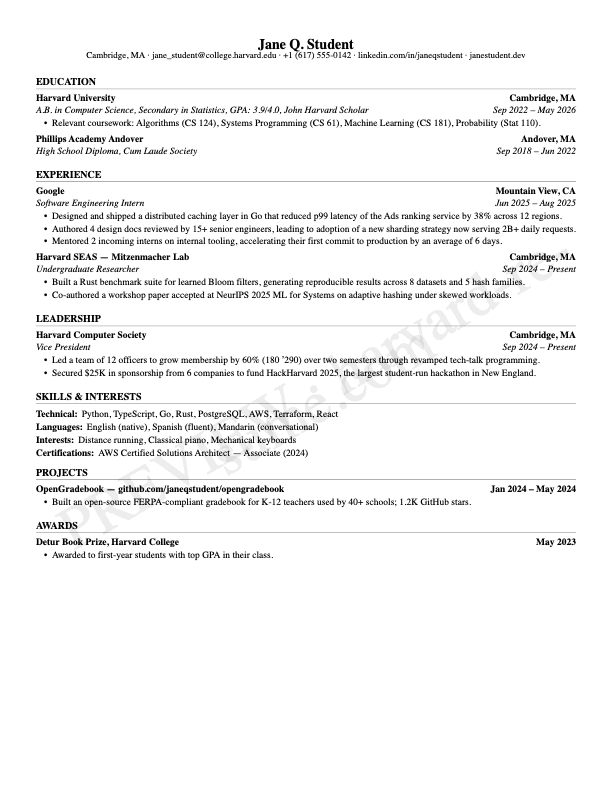
Sample in Harvard format
Strong vs weak bullets
Flew planes for a regional airline and followed safety rules
Captained 2,400+ hours on the CRJ-900 across 1,100+ Part 121 sectors with a 99.4% on-time first-attempt approach completion rate and zero reportable safety events over 3 years
Names the aircraft, regulation, hours, sectors, and a concrete safety/performance metric — recruiters can map it straight to minimums.
Helped save fuel on flights
Cut average fuel burn 3.8% (≈410 kg/leg) across an A320 fleet of 14 aircraft by championing single-engine taxi and optimized cost-index climb profiles, saving an estimated $1.9M annually
Quantifies the percentage, per-leg mass, fleet scale, the specific technique (Z), and dollar impact.
Trained new pilots and was a check airman
Mentored 26 First Officers to line-qualification as a designated Check Airman, raising first-attempt OPC pass rate from 88% to 97% by redesigning the IMC-diversion LOFT scenario
Shows leadership scale (26 FOs), a measurable training outcome, and the specific intervention that drove it.
Handled an emergency well during a flight
Commanded a precautionary diversion for a hydraulic system failure at FL370, executing the QRH and CRM brief to land 142 passengers safely in 18 minutes with zero injuries
Demonstrates decision-making under failure with altitude, procedure (QRH/CRM), passenger count, time, and outcome.
Mistakes specific to this role
- Burying hour totals in prose instead of a scannable block — recruiters filter on Total/PIC/turbine first and will skip a resume that hides them.
- Writing vague bullets like 'flew jets safely' with no aircraft type, regulation (Part 121/135), or quantified outcome.
- Omitting medical and certificate currency (first-class medical expiry, ATP, type ratings) — unverifiable currency reads as a red flag.
- Spilling onto two pages with every airport and aircraft ever flown; the one-page Harvard discipline still applies to a 10,000-hour pilot.
- Hiding or failing to address a check-ride failure or enforcement action — a proactive, factual line beats a discovered gap during the background check.
Your résumé starts here. Pay later.
Start composingFrequently asked
- Should I list every aircraft type and all my flight hours on a one-page resume?
- List type ratings and turbine/jet aircraft flown, plus the core hour breakdown the airline's application screens on (Total, PIC, multi-engine, turbine, night, instrument). You don't need every single tail or every light single you trained in — summarize early experience and keep the page to one. The detailed log lives in your application and logbook, not the resume.
- How do I show I have a clean record without it sounding defensive?
- State it as a neutral fact in your certifications or summary line: 'No failed check-rides; no FAA enforcement actions.' Airlines expect this signal, and including it proactively reads as confident, not defensive. If you do have a failure, address it factually and briefly — recruiters value honesty since it surfaces in the PRIA/background check anyway.
- What's the most important thing recruiters look at first on a pilot resume?
- Your hard qualifications: ATP, total and PIC time against their minimums, type ratings, and a current first-class medical. These are gating filters — if the numbers don't clear the threshold, the bullets never get read. Put them in a clean block at the top, formatted to match how the airline's pilot application asks for hours.
- How do I quantify pilot accomplishments when so much of the job is routine flying?
- Use operational metrics: on-time performance, sectors flown, fuel savings (% and dollars), pass rates for pilots you trained, safety events (or the absence of them), and outcomes of irregular operations you commanded. The XYZ formula — accomplished X measured by Y by doing Z — turns 'routine' flying into evidence of judgment, efficiency, and leadership.