Product · 2026
Harvard Resume for Product Managers
PM hiring is fierce. The Harvard format lets metrics, scope, and judgment travel together on one page.
How do I write a Product Managers resume in the Harvard format?
Product management hiring is more pattern-matched than most tech roles. Recruiters at Stripe, Notion, Linear, Google, and Meta look for evidence of judgment under ambiguity, shipped impact, and cross-functional credibility. The Harvard format works well for PMs because it forces compression — and compression mirrors the PM craft itself.
What recruiters look for
- Scope of products owned (DAU/MAU, revenue, regions)
- Cross-functional leadership (eng + design + data + GTM)
- Decision-making evidence (what you killed, not just what you shipped)
- Domain depth in one or two industries OR breadth across many
- Quantified user/business outcomes
Required sections, in this order
Header & domain framing
- Include one-line tagline under the name (optional but recommended for PMs): e.g., “Senior PM · B2B SaaS · 6 yrs”
- Optional: link to a portfolio of writing/case studies if you have one
Experience bullets
- Lead each role with the product or product-area owned
- Mix qualitative judgment + quantitative outcomes per bullet
- Include 1 bullet per role about something you DIDN'T ship and why
Skills section
- Tools (Figma, Linear, Mixpanel, Amplitude, SQL)
- Frameworks you actually apply (JTBD, ICE, Reach-Impact-Confidence-Effort)
- Skip generic 'roadmapping' / 'stakeholder management'
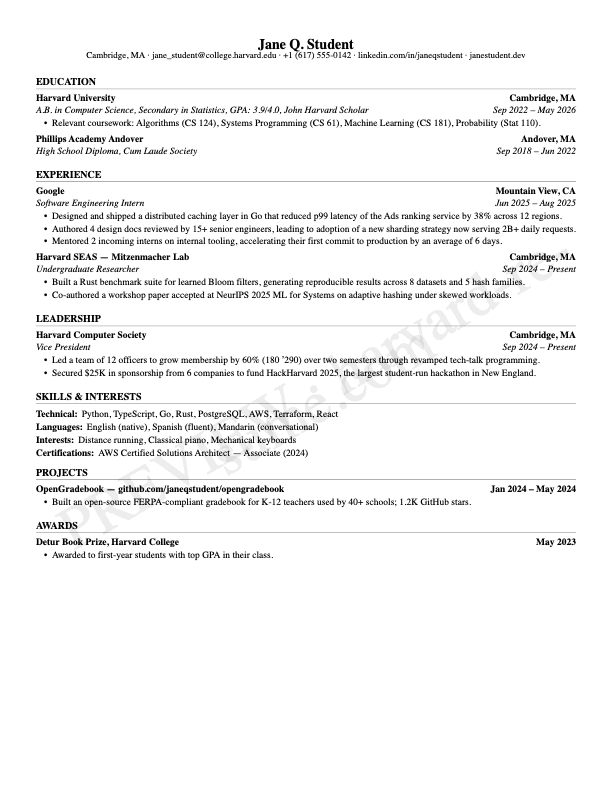
Sample in Harvard format
Strong vs weak bullets
Owned the onboarding flow and improved activation
Owned the onboarding flow for a 1.4M-DAU B2C app; redesigned the first-run experience based on 28 user interviews, lifting Day-7 activation from 31% → 47% and quarterly revenue contribution by $4.2M
Names the product scope (1.4M DAU), the research method (28 interviews), the metric (D7 activation), and dollar impact ($4.2M/quarter). All three layers a senior reviewer cares about.
Led a cross-functional team to launch a new feature
Led the 8-person cross-functional pod (3 eng, 2 design, 1 data, 1 GTM, 1 support) launching pricing tiers v2; ran the cycle in 11 weeks; +$1.8M ARR in first quarter post-launch
Pod composition + cycle time + outcome. A reviewer sees an operator who knows how to run a real ship.
Killed a project that wasn't working
Killed the recommendations v2 project at 60% build complete after 2 weeks of A/B data showed +0.2% lift vs control; saved 3 months of eng investment and re-deployed the pod to a feature that shipped +12% engagement
PM judgement = killing things matters. Naming the lift (+0.2%), the saved effort (3 months), and what came next signals you make decisions on data not on sunk cost.
Mistakes specific to this role
- Buzzword soup: 'strategic thinker', 'data-driven', 'customer-obsessed'. Show, don't claim.
- Listing every product you 'touched' without scope. A bullet without a number is invisible.
- Omitting the failed/killed bullet. Mature PMs love to see this; it differentiates you.
- Putting a 'Product Philosophy' paragraph at the top. Save it for the cover letter.
Your résumé starts here. Pay later.
Start composingFrequently asked
- Should I include side projects as a PM?
- Yes if they show real users + real iteration (e.g., a podcast with 10K subscribers, a newsletter, an indie product). Skip if they're personal-blog-only.
- Where do certifications like Reforge or Pendo go?
- Skills section as a one-liner. Don't dedicate a section unless you have 4+ that are genuinely industry-recognised.
- How do I show transition into PM from engineering or design?
- Make your most recent PM bullets the strongest (they're scanned first). Earlier eng/design experience earns its line if it shaped your PM craft (e.g., 'shipped 3 production features as IC engineer — built design intuition that informs current PM work').