Healthcare · 2026
Harvard Resume for Psychologists
Clinical, counseling, and school psychologists are judged on supervised hours, licensure, and measurable patient outcomes — not vague 'helped clients' lines. The Harvard format puts each on its own track.
How do I write a Psychologists resume in the Harvard format?
Hiring committees, group-practice directors, and internship/postdoc programs read a psychologist's resume for licensure status, supervised clinical hours, and evidence-based competence — long before they read a personal statement. Whether you are a newly licensed clinician applying to a community mental-health center, a school psychologist seeking a district role, or a postdoc targeting an APA-accredited site, the Harvard format separates clinical experience, assessment, research, and supervision into scannable sections. This recipe shows how to quantify caseloads, outcomes, and modalities the way credentialing reviewers expect.
What recruiters look for
- Licensure status and exam (Licensed Psychologist, EPPP passed, state license number, LCSW/LPC if relevant)
- Supervised clinical hours with breakdown (direct face-to-face vs. supervision) and APA-accredited internship
- Evidence-based modalities by name: CBT, DBT, ACT, EMDR, CPT, motivational interviewing — with population
- Assessment instruments administered: WAIS-IV/V, WISC-V, MMPI-2/3, PAI, ADOS-2, Conners, BDI-II
- Measurable outcomes: PHQ-9/GAD-7 score reduction, no-show rate, caseload size, treatment completion rates
- EHR/EMR fluency (Epic, TheraNest, SimplePractice) plus telehealth platforms and HIPAA documentation
Required sections, in this order
Section ordering for clinicians
- Education first, with degree (PsyD/PhD/EdS), clinical program, and APA-accreditation noted
- Licensure & Certifications second — list license, EPPP, and any specialty certs (board certification, EMDRIA)
- Clinical Experience as its own section, with population, setting, and supervised hours
- Assessment, Research, and Supervision as compact, distinct sections — never blended into one prose block
Quantify caseload and outcomes
- State weekly caseload and total clients seen (e.g., 'caseload of 25–30, 1,800+ direct hours')
- Cite validated outcome measures and the delta (PHQ-9, GAD-7, OQ-45, YOQ) rather than 'improved symptoms'
- Name the modality AND the population/diagnosis (CBT for adolescent OCD, not just 'provided therapy')
- Track operational metrics directors care about: no-show rate, treatment completion, intake-to-discharge time
Credentialing and compliance signals
- List your APA-accredited internship explicitly — credentialing bodies verify it
- Note supervision provided (if you supervise practicum students or pre-licensed associates) with count
- Specify EHR systems and that documentation met HIPAA / Joint Commission / state-board standards
- For school psychologists, cite NASP certification, IEP counts, and assessment turnaround times
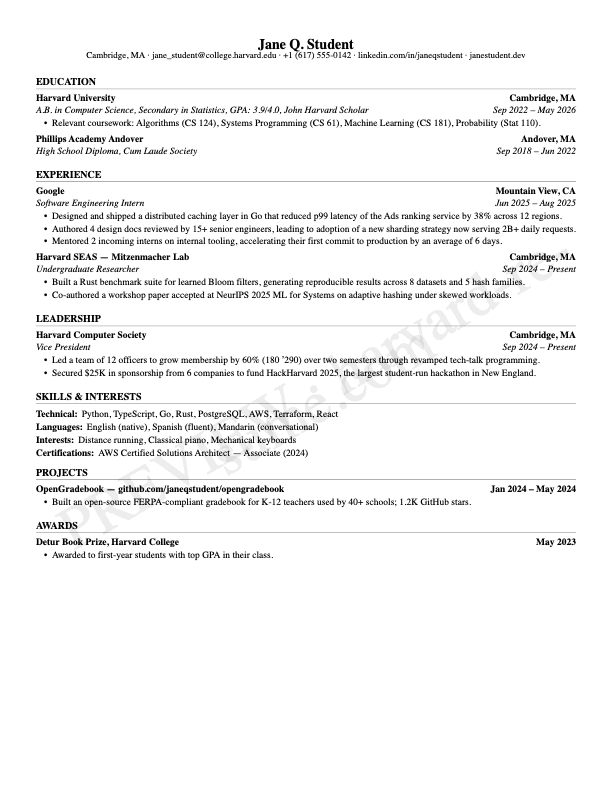
Sample in Harvard format
Strong vs weak bullets
Provided therapy to clients with anxiety and depression
Delivered manualized CBT and ACT to a caseload of 28 adult outpatients with GAD and MDD across 1,900+ direct clinical hours; achieved a mean PHQ-9 reduction of 9.4 points and 71% treatment completion over 14 months
Names the modalities, population, exact caseload, supervised-hour count, a validated outcome metric with magnitude, and a completion rate — exactly what a clinical director benchmarks.
Did psychological assessments and wrote reports
Administered, scored, and interpreted 60+ comprehensive batteries (WAIS-IV, MMPI-2-RF, PAI, Rey-Osterrieth) for adult forensic and disability evaluations; authored court-ready integrated reports with 48-hour turnaround under licensed supervision
Specific instruments, volume, evaluation type (forensic/disability), turnaround SLA, and supervision context signal genuine assessment competence to reviewers.
Worked as a school psychologist supporting students
Completed 75 psychoeducational evaluations (WISC-V, WIAT-4, BASC-3) and led 90+ IEP eligibility meetings for a 1,200-student K-8 district; cut average evaluation turnaround from 45 to 28 days by restructuring the referral intake workflow
Evaluation count, district scale, named instruments, IEP volume, and a process-improvement metric show NASP-aligned impact, not just attendance.
Helped run group therapy sessions at the clinic
Co-facilitated 3 weekly DBT skills groups (8–10 clients each) for clients with borderline personality disorder; group attendance rose from 62% to 84% after introducing a between-session coaching protocol, reducing crisis ER visits among participants by 30%
Modality, group size and frequency, diagnosis, an attendance delta, and a downstream clinical/cost outcome (reduced ER use) demonstrate measurable program impact.
Mistakes specific to this role
- Writing 'helped clients improve' with no modality, population, or outcome measure — committees can't distinguish you from a peer-support volunteer.
- Omitting supervised-hour breakdowns or your APA-accredited internship. Credentialing and licensure boards verify these; absence reads as a gap.
- Listing every assessment you have heard of. Only list instruments you have personally administered and can defend in an interview.
- Burying licensure at the bottom. For licensed roles, license status and EPPP belong near the top — it's the first gate.
- Including confidential client details or identifiable case material. Aggregate and de-identify; a PHI leak on a resume is disqualifying.
Your résumé starts here. Pay later.
Start composingFrequently asked
- Should I list my supervised hours if I'm not yet fully licensed?
- Yes — pre-licensure (postdoc/associate) candidates should state direct face-to-face and supervision hours explicitly, since registration and licensure boards count them. Note 'under the supervision of [Licensed Psychologist]' and your current registered/associate status.
- Do I put my dissertation on a clinical resume?
- One line under Education if it's relevant to the role (title + advisor), or a full entry in a Research section for academic/postdoc applications. For a community-clinic role, keep it to a single line and prioritize clinical hours.
- How do I show outcomes without violating client confidentiality?
- Use aggregate, de-identified metrics only — mean PHQ-9 reduction across a caseload, completion rates, no-show rates. Never reference an individual client. Aggregated program-level data is both safe and far more persuasive.
- Should licensed roles still list internship and practicum?
- Keep your APA-accredited internship (it's verified for credentialing) and consolidate practicum into one line if you have several years of licensed experience. Early-career clinicians should detail practicum; experienced ones lead with licensed positions.