Communications · 2026
Harvard Resume for Public Relations Specialists
PR is judged on coverage, sentiment, and crisis poise. The Harvard format puts earned media, metrics, and message discipline on one page.
How do I write a Public Relations Specialists resume in the Harvard format?
PR hiring rewards proof that you can earn coverage, shape sentiment, and stay calm in a crisis. Comms directors and agency leads at firms like Edelman, Weber Shandwick, and in-house teams scan first for media results — placements, share of voice, message pull-through — not for adjectives like 'strategic communicator.' The Harvard format suits PR because it forces you to compress a campaign into one quantified line, which is exactly the skill the job tests.
What recruiters look for
- Earned-media results: tier-1 placements (NYT, WSJ, TechCrunch), impressions, and share-of-voice vs. competitors
- Media-relations depth: a real reporter network, pitch-to-placement rate, and embargo/exclusive handling
- Crisis and issues management: a named incident you ran, response time, and sentiment recovery
- Tooling fluency: Cision, Muck Rack, Meltwater, Brandwatch, PR Newswire/Business Wire, Google Analytics 4
- Credentials that signal the craft: APR (Accredited in Public Relations), PRSA membership, or agency rotations
- Cross-channel reach: spokesperson media training, executive thought leadership, and integrated paid/owned/earned work
Required sections, in this order
Header & specialty framing
- Add a one-line tagline under your name: e.g. 'PR Specialist · B2B Tech & Crisis Comms · 5 yrs'
- Link a digital clip book or portfolio of bylined coverage if you have one — recruiters click it
- Include LinkedIn (PR is a relationships field); no photo, no DOB, no marital status
Experience bullets
- Lead each role with the account, brand, or campaign owned and its scale (budget, audience, region)
- Pair an output (placements, releases, briefings) with an outcome (impressions, sentiment, leads, sales)
- Reserve one bullet per role for crisis or issues work — it's the fastest credibility signal in PR
- Name the publications by tier; 'secured national coverage' is weaker than 'placed in WSJ and Reuters'
Skills section
- Tools: Cision, Muck Rack, Meltwater, Brandwatch, PR Newswire, Google Analytics 4, Asana
- Disciplines you actually run: media relations, crisis comms, executive thought leadership, message architecture
- Skip filler like 'excellent written and verbal communication' — it's assumed for the role
- List languages with proficiency if you pitch bilingual media — a real differentiator in PR
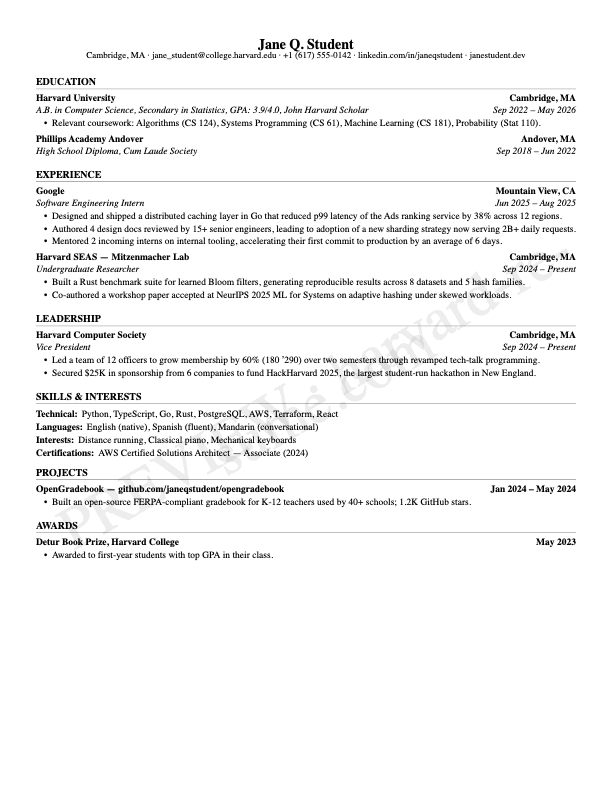
Sample in Harvard format
Strong vs weak bullets
Wrote press releases and pitched journalists to get media coverage for product launches
Led media relations for a Series B fintech launch; pitched 60 reporters and landed 14 placements including TechCrunch, Forbes, and American Banker, driving 38M earned impressions and a 22-point lift in share of voice vs. 3 named competitors
Names the pitch volume (60), placement count (14), tier-1 outlets, the impressions (38M), and competitive share-of-voice — the exact ladder a comms director reads in four seconds.
Handled a crisis situation for the company and managed the media response
Ran point on a data-breach response affecting 1.2M users; drafted holding statement and CEO Q&A within 90 minutes, briefed 11 outlets, and contained negative sentiment to 18% (vs. 60%+ industry benchmark) with no tier-1 follow-on stories
Crisis bullets win PR interviews. Response time (90 min), scope (1.2M users), reporter count (11), and a sentiment metric vs. benchmark prove you can operate under pressure.
Grew the company's social media and increased engagement across platforms
Built an executive thought-leadership program for the CEO; ghostwrote 24 LinkedIn posts and 4 bylined op-eds (placed in Fast Company and The Hill), growing follower base from 4K to 31K and generating 9 inbound speaking invitations in 12 months
Replaces vague 'engagement' with deliverables (24 posts, 4 op-eds), named placements, audience growth (4K→31K), and a business outcome (9 speaking invites).
Worked with the marketing team on campaigns and reported on results
Co-led an integrated POE campaign for a $400K product launch; coordinated earned media, paid social, and owned content across 3 teams, delivering 1,100 qualified leads at a 41% lower cost-per-lead than the prior quarter's paid-only effort
Shows integrated paid/owned/earned fluency, budget scale ($400K), cross-team scope (3 teams), and a hard efficiency metric (-41% CPL) marketing leaders respect.
Mistakes specific to this role
- Listing 'strong media relationships' without naming a single outlet or a placement. Show the clip, not the claim.
- Reporting outputs (releases sent, pitches made) with no outcome (impressions, sentiment, leads). An output without a result is invisible.
- Omitting any crisis or issues-management bullet. Even a small incident handled well is the highest-signal line on a PR résumé.
- Vanity metrics with no baseline: '1M impressions' means nothing without reach context or a share-of-voice comparison.
- A 'Communication Skills' section. Communication is the job — proving it in your bullets is the only credible move.
Your résumé starts here. Pay later.
Start composingFrequently asked
- Should I list every publication I've placed coverage in?
- No — curate. Lead with 5-8 tier-1 and tier-2 outlets relevant to the role you're targeting. A wall of 30 logos reads as padding; a tight list of WSJ, Reuters, and your industry's must-read trades reads as access.
- Is the APR (Accredited in Public Relations) worth putting on the résumé?
- Yes. APR is the field's recognized credential and signals you've passed a rigorous exam on ethics, research, and strategy. List it after your name (Jane Doe, APR) and again under Skills/Certifications. PRSA membership is a nice-to-have, not a differentiator on its own.
- How do I show PR impact when results are hard to attribute?
- Use the metrics PR actually owns: earned impressions, share of voice, message pull-through (% of coverage carrying your key message), sentiment shift, and tier-1 placement count. For business outcomes, attribute conservatively ('contributed to' a lead or sales lift) rather than overclaiming.
- Agency or in-house — should my résumé read differently?
- Yes. Agency reviewers want account breadth, client retention, and billable scope; lead with the brands and verticals you've served. In-house reviewers want depth and business proximity; lead with the company's metrics you moved (sentiment, SOV, executive visibility, pipeline).