Software Quality · 2026
Harvard Resume for QA Engineers
Your résumé is a test suite: assert measurable quality, not a tool checklist.
How do I write a QA Engineers resume in the Harvard format?
QA Engineers are hired by teams who scan your résumé for one thing first: did quality go up because you were there? Recruiters at product orgs, platform teams, and consultancies look for escaped-defect rate, automation coverage, regression cycle time, and the frameworks you actually maintain — not a logo wall of every tool you have opened once. The Harvard one-page format forces you past 'tested the application' into outcomes: fewer prod incidents, faster release pipelines, flake driven to zero. Lead with quantified quality work, keep certs tight, and write every bullet like a test report with a measurable result.
What recruiters look for
- Quantified quality outcomes: escaped-defect rate cut, prod incidents reduced, regression suite runtime (4h → 35min), automation coverage % of critical paths
- Real automation depth named explicitly: Selenium/WebDriver, Cypress, Playwright, Appium, REST Assured, Postman/Newman — with the language (Java/TypeScript/Python) and the framework you built or own
- CI/CD test integration: tests gating PRs in Jenkins/GitHub Actions/GitLab CI, parallelization, flake quarantine, and the build-time impact
- Test strategy depth: risk-based testing, the test pyramid, BDD/Gherkin (Cucumber/SpecFlow), contract testing (Pact), and how you decided what to automate vs. explore
- Performance & API testing: JMeter, k6, Gatling, p95/p99 latency validated, throughput and error-rate thresholds enforced in pipeline
- Certifications that gate the role: ISTQB Foundation / Advanced (Test Analyst, Test Automation Engineer), and tool/cloud certs where the stack demands them
Required sections, in this order
Lead with Quality Outcomes, Not a Tool Wall
- Put a tight Experience section first after Education; open each bullet with the outcome (escaped defects down, cycle time cut, coverage up), not the tool name
- State the scope in the bullet — 'authored 320+ automated E2E tests across 6 microservices' tells a reviewer your blast radius instantly, no skills line needed
- Group a 'Technical Skills' footer by Automation / API & Performance / CI-CD / Test Management so an ATS keyword-matches without a 30-item soup
- Cut 'familiar with' tools — list only frameworks you have built, maintained, or can be tested on in a live coding interview
Make Education, Certs & ISTQB Work Harvard-Style
- Education first, one line each: degree, institution, graduation year — omit GPA unless above 3.5 and recent
- Put active certs (ISTQB Foundation/Advanced, ISTQB Test Automation Engineer) directly under Education with the level and year earned
- If you write code, prove it: show the test framework you architected and the language, because manual-only QA résumés get filtered for SDET roles
- Bootcamp or self-taught path is fine — the Harvard format rewards shipped suites and coverage metrics over pedigree
One Page, ATS-Clean, Plain-Text Discipline
- No photo, no DOB, no graphics or skill bars — your test reports don't have progress bars and neither should your résumé
- Single column, standard fonts, no tables or text boxes — multi-column layouts get shredded by ATS parsers into garbage
- Spell the term then the acronym once: 'System Under Test (SUT)' and 'Software Development Engineer in Test (SDET)' so both keyword variants match
- Reverse-chronological, action-verb bullets (Automated, Built, Reduced, Migrated) — every line earns its place or it gets cut
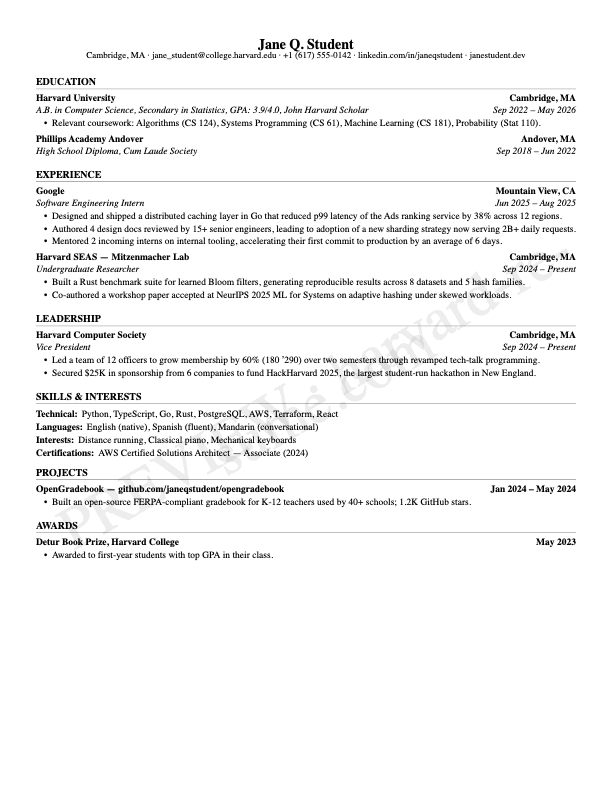
Sample in Harvard format
Strong vs weak bullets
Responsible for writing and running test cases for the web application.
Built a Playwright + TypeScript E2E framework covering 92% of critical user journeys across 6 microservices, cutting the manual regression cycle from 3 days to 40 minutes and catching 14 release-blocking defects before staging in the first quarter.
Names the stack (Playwright/TypeScript), the coverage (92% of critical paths), the scale (6 microservices), and the outcome (cycle time and defects caught). A reviewer reads 'this person owns automation end-to-end' in seconds.
Worked on improving test automation and reducing flaky tests.
Drove the CI test suite's flake rate from 18% to under 1% by isolating async race conditions, adding deterministic waits, and quarantining unstable tests in GitHub Actions — restoring developer trust and unblocking 40+ daily merges.
Before/after metric (18% → <1%), the specific techniques (race conditions, deterministic waits, quarantine), and the business impact (40+ daily merges unblocked). This is automation maturity, not a vague 'worked on'.
Did performance testing on the API.
Designed k6 load tests simulating 5,000 concurrent users against the checkout API, exposing a connection-pool leak that capped throughput at 220 req/s; validated the fix held p95 latency under 180ms and gated it as a pipeline threshold.
Names the tool (k6), the load (5,000 VUs), the root cause found (connection-pool leak), and the enforced SLO (p95 < 180ms). It reads like a real performance investigation, not 'did testing'.
Reported bugs and worked with developers to fix them.
Reduced production escaped-defect rate 64% in two release cycles by introducing risk-based test prioritization and shift-left API contract tests (Pact), cutting customer-reported Sev-2 bugs from 22 to 8 per quarter.
The headline quality metric (escaped-defect rate −64%), the strategy that drove it (risk-based + contract testing), and the customer-facing result (Sev-2 bugs 22 → 8). This is the number QA hiring managers scan for first.
Mistakes specific to this role
- Listing 30+ tools as a flat keyword wall. Recruiters trust depth over breadth — group 4-6 categories and only list frameworks you have built or can be tested on live.
- Describing duties instead of outcomes ('responsible for writing test cases'). Every bullet needs a number: escaped-defect rate, coverage %, cycle time cut, or flake reduced.
- Saying 'manual and automation testing' with no proof of code. For SDET/automation roles, name the framework you architected and the language, or you get filtered.
- Hiding the scope. 'Tested the app' is meaningless; '320 E2E tests across 6 microservices, 92% critical-path coverage' tells the reviewer your real blast radius.
- Going two pages with exhaustive test-case detail. Harvard discipline is one page — if a bullet has no metric and no scope, it's filler, cut it.
Your résumé starts here. Pay later.
Start composingFrequently asked
- Should I list manual testing and automation separately, or just my strongest?
- Lead with automation — it's what gates most modern QA and SDET roles and ATS filters. Keep manual/exploratory testing as a credibility signal (risk-based testing, exploratory charters, edge-case judgment) but don't let a résumé read as manual-only. Name the framework you built, the language, and the coverage you achieved. Depth in one real automation stack beats a logo soup of tools you opened once.
- How do I quantify QA work when I don't 'ship features'?
- Your metrics are quality and velocity, not features. Quantify escaped-defect rate, defect-detection percentage, automation coverage of critical paths, regression cycle time, flake rate, and prod incidents prevented. Add performance numbers (p95/p99 latency validated, throughput) and CI impact (build time, merges unblocked). These are exactly what QA hiring managers scan for first.
- Do I need ISTQB certification?
- It's not mandatory but it gates many roles and ATS filters, especially in enterprise, consulting, and EU/LatAm markets. ISTQB Foundation is a strong baseline; Advanced (Test Analyst or Test Automation Engineer) helps for senior and lead roles. Put current certs under Education with the level and year. For SDET roles, proven code and a maintained framework matter more than the cert — show both.
- Can a QA résumé really fit on one page with all the test detail?
- Yes, and it should. The Harvard one-page rule forces you to cut test-case minutiae down to quantified outcomes. Put scope in the bullet ('320 E2E tests, 92% critical-path coverage') instead of a paragraph, cap skills at a grouped footer, and let metrics do the talking. Reviewers spend roughly 7 seconds — one dense, outcome-driven page beats two pages of filler.